

Key Takeaways
Our Verdict
For most everyday US drivers, neither transmission type holds a clear safety edge - the bigger variable is how well the driver manages their attention and vehicle control in the moment. Automatics tend to reduce workload in heavy traffic and unfamiliar conditions, while manuals can offer experienced drivers a greater sense of mechanical engagement and engine braking authority. The transmission that keeps you safest is the one you are fully confident and practiced operating.
| Best for | Recommended |
|---|---|
| New or less experienced drivers navigating busy urban roads | Automatic Transmission |
| Experienced drivers who want maximum engine braking on steep terrain | Manual Transmission |
| Drivers prioritizing modern electronic safety system integration | Automatic Transmission |
| Drivers seeking full mechanical control in low-traction situations | Manual Transmission (with proper training) |
Why Transmission Type and Safety Are Worth Discussing
The debate between manual and automatic transmissions usually centers on driver preference, fuel economy, or cost - but safety is a dimension that deserves a closer look. When you're behind the wheel, every task that pulls your focus away from the road increases risk. Whether you're managing a clutch pedal or leaving gear selection to the car, these differences have measurable effects on your mental workload and physical control of the vehicle.
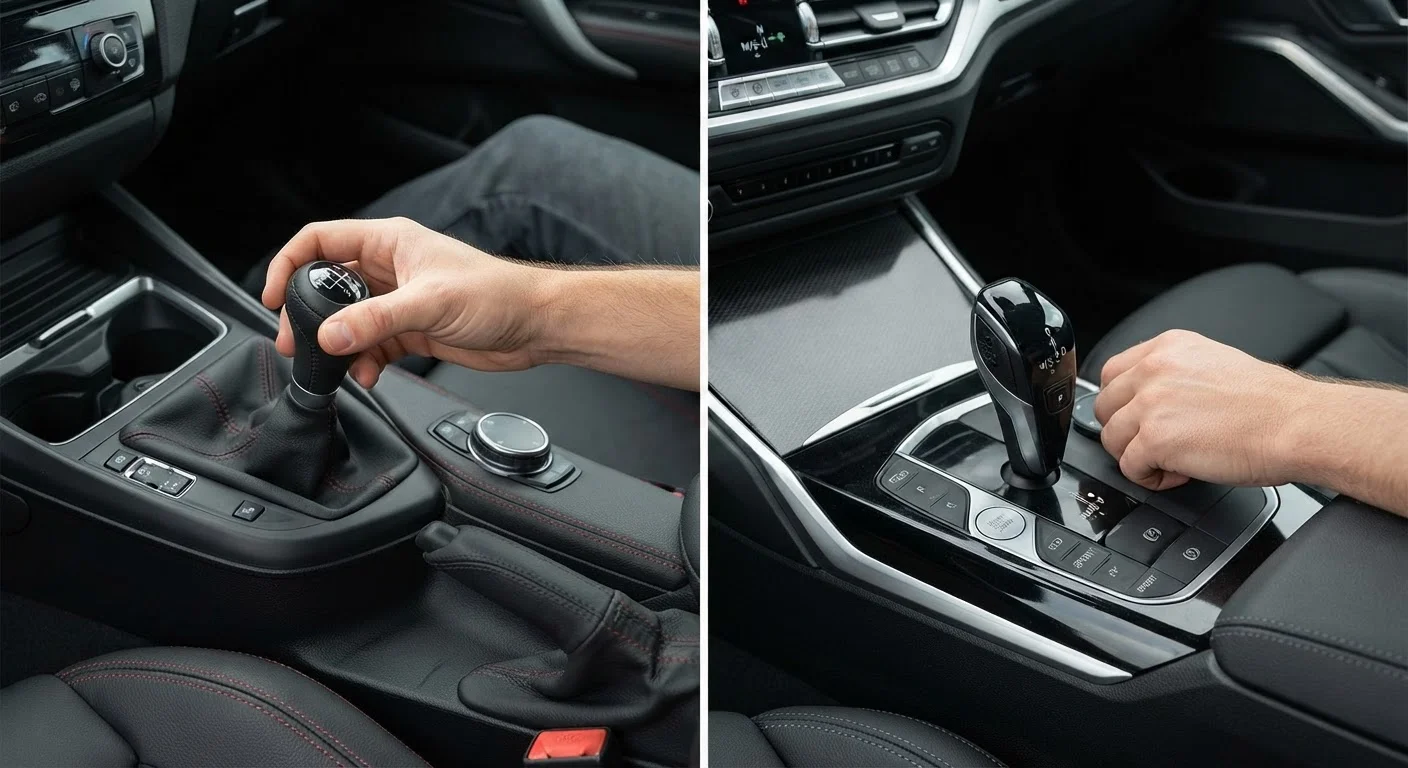
Manual transmissions (also called stick shift) require the driver to coordinate the clutch pedal, gear lever, and throttle simultaneously. Automatics handle gear changes internally, letting the driver focus on steering, braking, and observation. Understanding these trade-offs honestly - rather than through nostalgia or marketing - helps you make safer decisions and stay sharp on the road.
For a broader foundation on vehicle safety fundamentals, see our guide for new drivers.
Cognitive Load and Distraction: Where Automatics Have an Edge
One of the clearest safety differences between transmission types is cognitive load - the mental effort required to operate the vehicle. With a manual, the driver must consistently monitor engine RPM, anticipate gear needs, and physically execute clutch-and-shift sequences. In slow city traffic or on steep hills, this can occupy a significant portion of a driver's attention.
Automatic transmissions remove that layer of task management entirely. Research in driver attention consistently shows that reducing the number of concurrent tasks lowers error rates, particularly under stress or fatigue. A driver who isn't thinking about clutch engagement is better positioned to watch for pedestrians, cyclists, and sudden stops.
94%
Crashes attributable to human error
According to the National Highway Traffic Safety Administration (NHTSA), approximately 94% of serious crashes involve human choice or error as a contributing factor.
~97%
New US vehicles sold with automatic transmission
Industry sales data consistently shows that manual transmissions account for a small fraction of new vehicle sales in the United States, reflecting strong market preference for automatics.
This doesn't mean automatics eliminate distraction risk - phones, passengers, and infotainment systems remain serious hazards regardless of what's in the center console. But for drivers still building confidence or navigating dense urban environments, automatics meaningfully reduce the baseline demand on attention. See how aggressive driving patterns compound these attention risks.
Hill Starts, Slopes, and the Risk of Rolling Back
One area where manual transmissions introduce a specific and real safety risk is the hill start - stopping on an incline and then pulling away without rolling backward into following traffic. Executing a smooth hill start requires precise coordination of the clutch, throttle, and handbrake, and it takes deliberate practice to do it reliably under pressure.
Stalling on a hill, or rolling back even a foot, can startle following drivers and cause rear-end collisions. New or infrequent manual drivers are particularly vulnerable in this scenario. Many modern manual vehicles include a hill-hold assist feature that briefly holds the brakes after the driver releases the foot brake, buying time to engage the clutch - a practical safety improvement worth looking for.
Automatic transmissions handle inclines with no additional driver input, making hill starts essentially non-events for most drivers. For those teaching new drivers, this is a meaningful consideration - see our guide to teaching teens to drive for more on managing early skill gaps safely.
Wet Roads, Snow, and Traction Control Considerations
Slippery conditions are where the manual-versus-automatic debate gets more nuanced. An experienced manual driver can use engine braking - downshifting to slow the vehicle without applying wheel brakes - to maintain smoother control on descents or reduce the risk of brake-induced wheel lock. This technique, when executed correctly, can be an asset in snowy or icy conditions.
However, abrupt or poorly timed downshifts can actually break traction and cause a skid, particularly on rear-wheel-drive vehicles. The margin for error is narrow, and it requires practiced skill to apply safely.
Engine Braking Works Best With Proper Training
If you drive a manual and want to use engine braking on slippery roads, practice the technique in a safe, low-traffic environment before relying on it in real conditions. Downshift one gear at a time and avoid abrupt clutch releases, which can cause wheel lockup. If in doubt, smooth, steady brake pressure and reduced speed going into a descent is always a sound default.
Modern automatic transmissions pair with electronic stability control (ESC) and traction control systems that intervene far faster than any human input - typically within milliseconds of detecting wheel slip. These systems are standard on all new US vehicles and work most seamlessly when the transmission is not being manually overridden. For a comprehensive breakdown of seasonal driving strategies, our wet and winter driving guide covers the adjustments that matter most.
The Real Verdict: Skill and Attention Outweigh Gear Choice
Safety data does not point to one transmission type as categorically safer. What research and accident analysis consistently highlight is that driver behavior - inattention, impairment, excessive speed, and poor hazard response - drives the overwhelming majority of crash risk. Transmission type is a secondary variable.
| Safety Factor | Manual Transmission | Automatic Transmission | |
|---|---|---|---|
| Cognitive load while driving | Higher - requires active gear management | Lower - transmission self-manages | |
| Hill start risk | Present; requires practiced technique | Minimal; handled automatically | |
| Engine braking control | Direct driver control via downshifting | Limited; some models offer paddle shifters | |
| Traction/stability system integration | Can conflict if driver overrides gears | Works seamlessly with ESC and traction control | |
| Distraction risk in heavy traffic | Higher due to frequent gear changes | Lower; driver focuses on road | |
| Skill threshold for safe operation | Higher; practice required | Lower; accessible to most drivers quickly |
The practical implication: if you drive a manual confidently and without distraction, it is not a safety liability. If you're still developing comfort with clutch control or frequently drive in demanding conditions like dense traffic or steep terrain, an automatic reduces one source of error meaningfully. Before every drive, a quick pre-trip safety check ensures that whichever transmission you're operating, your vehicle is ready to respond when it matters.