

Key Takeaways
Why Early Habits Matter More Than Hours Logged
Research consistently shows that new drivers are disproportionately at risk during the first 6-12 months after licensure - not because of age alone, but because habits are still forming. Whatever a teen practices repeatedly during supervised sessions tends to become automatic. That makes the quality of practice far more important than the quantity.
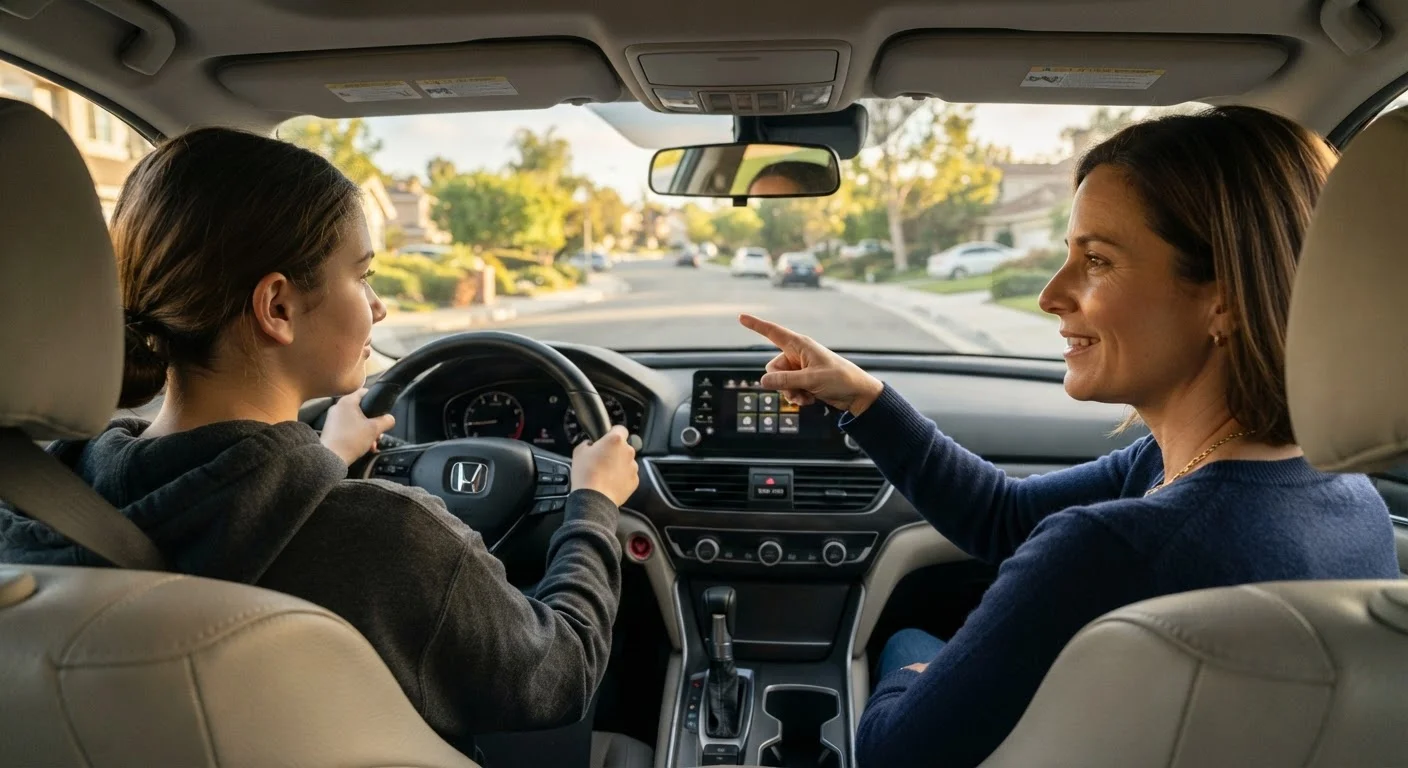
As a supervising parent, your role is less about controlling the car and more about shaping a mental framework. The goal is to help your teen build responses that happen instinctively before a hazard fully develops. See our complete introduction to safe road behavior for a broader look at the foundational skills new drivers need.
Quality Over Quantity in Every Session
A focused 30-minute session with clear objectives teaches more than a 90-minute drive with no structure. Decide before you pull out of the driveway what one or two skills you're working on that day. End each session with a brief, calm debrief - what went well and what to focus on next time.
What to Cover Before the First Session
Ground rules set before you leave the driveway signal that driving is a serious responsibility, not a privilege to take lightly.
What you will need
Agree on a distraction policy upfront. No phone use - including hands-free - during lessons. Limit passengers; even one additional teenager in the car significantly increases crash risk for new drivers, according to traffic safety data. Keep music off or at low volume until your teen can handle basic maneuvers without thinking about them.
Step-by-Step: Building the Habits That Stick
Structure your practice sessions around these steps, roughly in order. Don't rush to the next stage until your teen handles the current one with minimal prompting.
Start with vehicle familiarity before moving
Before the car moves, have your teen adjust the seat, steering wheel, and all three mirrors correctly. Walk through the dashboard indicators and what they mean. Confirm they understand how to operate the headlights, wipers, and emergency flashers. This sets a deliberate, methodical tone from day one.
Practice smooth acceleration and braking in a low-traffic area
New drivers tend to be jerky on both the accelerator and brake pedal. Spend several sessions in a parking lot or quiet street focused exclusively on smooth inputs. Smooth control reduces wear on the vehicle and is the foundation of safe speed management.
Teach the scanning habit - eyes always moving
Many new drivers fix their gaze on the car directly ahead. Teach your teen to scan: check mirrors every 5-8 seconds, look far ahead down the road, and glance at intersections before reaching them. This habit is the single most effective way to build reaction time. Narrate your own scanning out loud initially so they can model it.
Establish and maintain safe following distance
The three-second rule (increase to four or more in poor conditions) gives new drivers a concrete, measurable standard. Pick a fixed object on the roadside, watch when the car ahead passes it, and count seconds until your teen's car passes the same point. Reinforce this every session until it becomes automatic.
Introduce intersections and right-of-way rules deliberately
Intersections are one of the highest-risk environments for new drivers. Practice approaching them at reduced speed, scanning left-right-left before proceeding, and never assuming another driver will yield. Run through various scenarios: four-way stops, uncontrolled intersections, left turns across traffic.
Progress to highway driving only after basics are solid
Highway driving introduces merging, higher speeds, and lane changes - each requiring quick judgment. Wait until your teen handles city and suburban roads confidently before moving to the highway. Start with low-traffic times and shorter stretches. For a detailed breakdown of safe merging technique, see our guide on highway merging and lane changes.
Add night and adverse-weather sessions near the end of training
Reduced visibility and slippery roads demand skills that build on everything practiced before. Don't skip these conditions - licensure doesn't pause for rain. Introduce night driving on familiar roads first, then wet conditions at low speeds. Discuss how to respond to skids, reduced visibility, and glare from oncoming headlights.
For guidance on defensive driving principles - including how experienced drivers anticipate hazards - share that resource once your teen has a few sessions under their belt.
State Graduated Licensing Laws Vary
Most US states use a Graduated Driver Licensing (GDL) system that restricts night driving, passenger numbers, and phone use for new drivers. These restrictions exist because data shows they reduce crash risk. Verify the specific rules in your state with your DMV before each stage of practice, and make sure your teen understands them as law - not just suggestions.
Common Coaching Mistakes to Avoid
Your tone and timing during corrections directly affect how well the lesson lands. Shouting or grabbing the wheel in non-emergency situations creates anxiety, which impairs learning. Instead, narrate what you observe calmly: "Notice how we're drifting toward the shoulder - let's adjust early."
Avoid coaching too many things at once. Pick one or two focus areas per session. Teens absorb corrections better when they aren't overwhelmed. After each session, ask your teen what felt difficult - their self-assessment is often surprisingly accurate and tells you where to focus next.
Once your teen is comfortable with everyday driving, introduce fuel-smart habits too. Hard acceleration and late braking drain fuel - habits that are easy to prevent when they're addressed from the very start of a driving education.