

Key Takeaways
Why Weather Demands a Different Driving Mindset
Most driving errors in poor weather aren't caused by lack of skill - they're caused by not adjusting habits fast enough when conditions change. Rain, snow, and ice each alter the physics of your vehicle in specific ways: they reduce traction, extend stopping distances, and limit what you and other drivers can see. Understanding why roads become more dangerous helps you respond with the right adjustments rather than generic caution.
Rain is the most frequently encountered hazard. A light drizzle can actually be more slippery than steady rain in some cases, because it mixes with road oil without washing it away. Snow reduces traction gradually as accumulation increases, and heavily packed snow can feel deceivingly stable. Ice - particularly black ice - offers almost no warning before a tire loses grip entirely.
Your vehicle's transmission type can also influence how you manage traction on slippery surfaces, particularly during acceleration and engine braking. Understanding your drivetrain's behavior is a useful part of weather preparedness.
Test Your Brakes Early on Winter Roads
Shortly after setting out on a snowy or icy day, find a safe, open stretch of road and apply your brakes gently to gauge how much stopping distance you actually need. This gives you a realistic baseline before you encounter traffic or intersections.
What to carry before heading out in questionable conditions:
All-season or winter tires
Provide the tread depth and rubber compound needed for grip on wet, snowy, or icy surfaces.
Ice scraper and snow brush
Clear all windows, mirrors, lights, and the roof of snow and ice before driving.
Tire pressure gauge
Cold temperatures reduce tire pressure; maintaining proper inflation preserves handling and braking performance.
Emergency roadside kit
Includes blanket, jumper cables, flashlight, and traction aid - useful if you become stranded in winter weather.
Before stepping through the specific adjustments, confirm you have these covered:
What you will need
Step-by-Step Adjustments for Rain, Snow, and Ice
The following steps walk through the practical changes that make the biggest difference in adverse weather - from vehicle preparation to in-the-moment responses. Apply them together rather than selectively; each builds on the others to reduce overall risk.
Prepare your vehicle before adverse-weather trips
Cold and wet weather expose any deferred maintenance. Before heading out, confirm your tire pressure is at the manufacturer's recommended level - cold air causes pressure to drop roughly 1 PSI for every 10°F decrease in temperature. Check that your wiper blades clear cleanly without streaking, and top off washer fluid rated for low temperatures. In snow and ice, clear all surfaces of the vehicle: windows, mirrors, lights, and the roof. Snow sliding off your roof onto the windshield or another driver is a genuine hazard.
See our pre-trip safety checklist for a complete rundown of what to verify before every drive.
Reduce your speed below the posted limit
Speed limits are set for ideal road conditions. On wet roads, stopping distance increases significantly - a vehicle traveling at 60 mph on a rain-soaked road needs considerably more distance to stop than it would on dry pavement. On snow or ice, that gap widens further. As a practical rule: slow down to a speed where you feel confident you can stop within the distance you can see clearly ahead of you.
This principle applies on highways too. If heavy rain is reducing visibility or causing standing water on the road surface, slow down proactively rather than waiting until conditions feel out of control.
Extend your following distance significantly
The standard 3-second following distance is a dry-road baseline. On wet roads, increase that to at least 6 seconds. On snow or ice, 8-10 seconds is more appropriate. Choose a fixed reference point - a sign, an overpass - and count the seconds between when the vehicle ahead passes it and when your front bumper does.
Rear-end collisions are among the most common crash types in poor weather, and most happen because following distance wasn't adjusted to account for longer stopping distances. A larger gap also gives you more time to scan the road surface ahead for standing water or ice patches.
Turn your headlights on - even in daylight rain
Many US states legally require headlights when windshield wipers are in use, but the safety rationale goes beyond compliance. Headlights in daytime rain dramatically improve how visible your vehicle is to other drivers and pedestrians - not just how well you can see ahead. Use low beams in fog and heavy precipitation; high beams reflect off water droplets and can reduce your forward visibility.
Reduced visibility in rain shares some characteristics with nighttime driving. Our article on night driving risks covers additional visibility strategies that apply in these conditions.
Handle ice with smooth, minimal inputs
On icy roads, your ability to steer, brake, and accelerate depends on what little friction remains between your tires and the surface. Abrupt inputs - hard braking, sharp steering, sudden acceleration - break that friction and cause skids. Instead, every action should be gradual: accelerate slowly from stops, brake gently and early, and steer with smooth, deliberate movements.
Black ice deserves special mention. It forms when moisture freezes on pavement and is nearly transparent - the road looks wet but is actually frozen. Be especially alert on bridges, overpasses, and shaded stretches of road, which freeze first. If the outside temperature is at or below 32°F, treat any wet-looking road surface as potentially icy.
[important_callout]Respond correctly to hydroplaning on wet roads
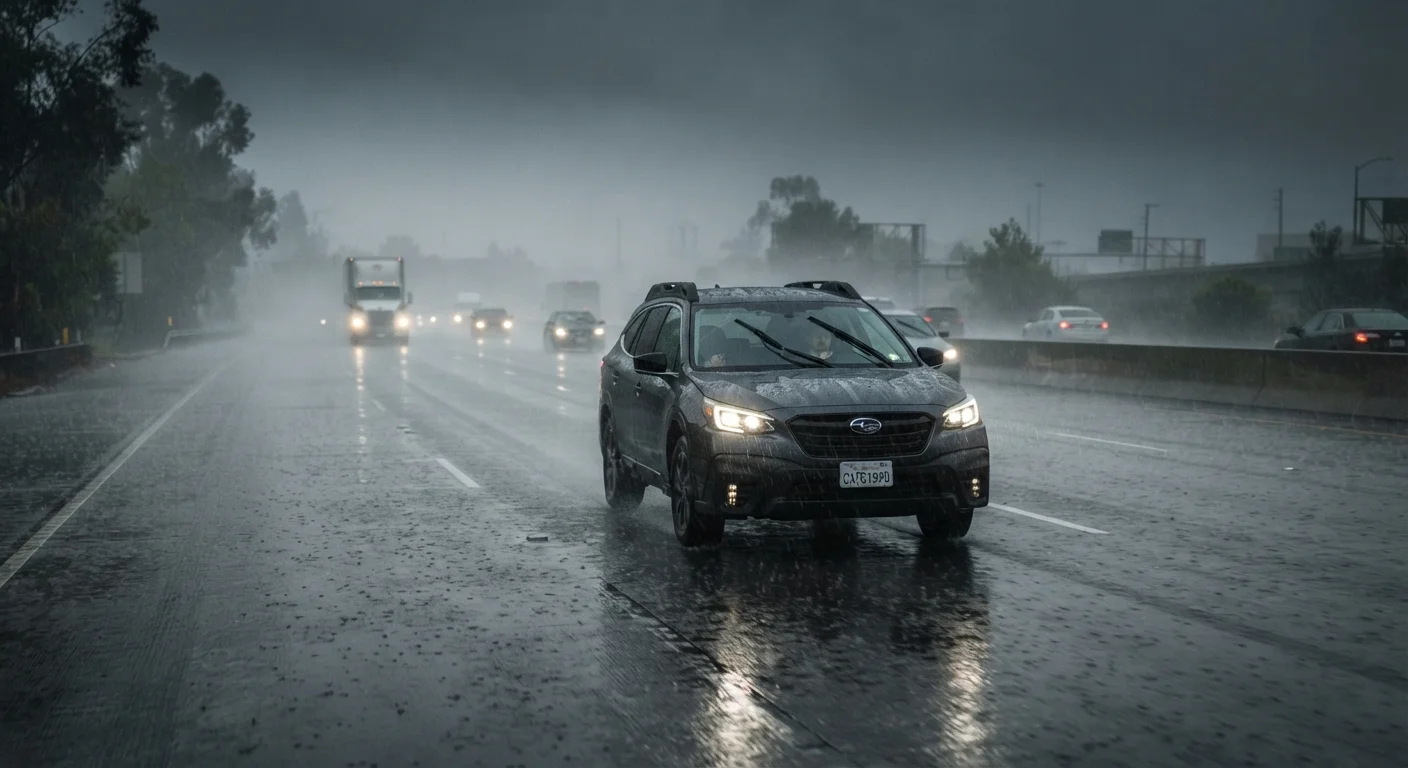
Hydroplaning occurs when tires lose contact with the road surface and begin riding on a film of water. You may notice the steering wheel feels suddenly light or unresponsive, and the vehicle may pull to one side. The correct response is calm and gradual: ease off the accelerator - do not brake hard - and steer gently in the direction you want to travel. Allow the tires to slow naturally until they regain contact with the pavement.
Proper tire tread is your primary defense. Worn tires channel water far less effectively and hydroplane at lower speeds. Checking tread depth is a simple maintenance task covered in our car maintenance guide.
[warning_callout]Know when to delay or cancel the trip
Not every drive needs to happen on schedule. If conditions are severe - near-zero visibility, widespread ice, road closures, or active winter storm warnings - postponing is a legitimate and often wise choice. No destination is worth the risk of a serious crash. Check your local weather service and state department of transportation road condition updates before committing to a winter drive.
If you do drive in severe conditions and feel your skills or vehicle's capabilities being pushed to their limit, find a safe place to pull off and wait for conditions to improve. Pulling over on a highway shoulder in a snowstorm carries its own risks, so prioritize exits, rest areas, or parking lots whenever possible.
For new drivers or those helping a young driver practice these habits, our guide on teaching a teen to drive covers how to introduce adverse-weather driving progressively and safely.
This article is for general informational and educational purposes. Driving conditions vary widely by region, vehicle type, and individual experience. Always follow local traffic laws and heed official road condition advisories from your state or local transportation authority.