

Key Takeaways
Why Aggressive Driving Is a Crash Risk, Not Just a Courtesy Issue
Most drivers can recall a moment when someone cut them off, rode their bumper at highway speed, or blew through a yellow light at full throttle. These aren't merely rude gestures - they're measurable risk factors. According to the NHTSA, aggressive driving - which the agency defines as operating a vehicle in a way that endangers or is likely to endanger people or property - plays a role in a significant share of US traffic fatalities each year.
What makes aggressive driving especially dangerous is how it compresses the margin for error. Safe driving depends on reaction time, following distance, and predictability among all road users. Aggressive behaviors erode each of these buffers simultaneously. The driver weaving between lanes at 80 mph isn't just risking their own safety - they're forcing other drivers to respond to sudden, unpredictable stimuli with no warning.
Understanding the specific patterns that create crash risk - and why they're physically dangerous, not just impolite - helps everyday drivers recognize and correct these tendencies in themselves. For a fuller picture of what driving well actually looks like, see our guide to defensive driving principles.
Speeding - Especially Situational Speeding
Driving above the posted limit is the most commonly cited form of aggressive driving, but situational speeding is equally dangerous: traveling at the legal speed limit when conditions - rain, fog, heavy traffic, road construction - call for slower movement. Physics is unforgiving here. Stopping distance increases with the square of speed, meaning that a vehicle traveling at 60 mph needs roughly four times the stopping distance of one at 30 mph.
Higher speeds also reduce the driver's field of peripheral vision and shrink reaction windows. A hazard that takes 1.5 seconds to perceive becomes far more costly at 70 mph than at 45 mph. Posted limits are designed for ideal conditions; they are a legal ceiling, not a blanket guarantee of safety. Our article on reading speed in context explains this distinction in detail.
Stopping distance increases with the square of speed - physics offers no exceptions.
Tailgating - Eliminating the Safety Buffer
Following too closely - commonly called tailgating - is one of the leading causes of rear-end collisions, which account for a substantial portion of all US crashes annually. The standard guidance is the three-second rule: pick a fixed point ahead, and ensure at least three seconds pass between when the vehicle in front passes it and when you do. At highway speeds or in wet conditions, that gap should increase.
Tailgating is often used as a form of pressure - an attempt to make a slower driver move over. Even when it "works," the tailgating driver has already spent several seconds with virtually zero stopping margin. If the car ahead brakes suddenly for any reason - a debris field, an animal, a merging vehicle - there is no recovery time. The collision is essentially pre-determined by the following distance chosen.
When you tailgate, any sudden stop ahead makes a collision almost inevitable.
Unsafe Lane Changes and Weaving
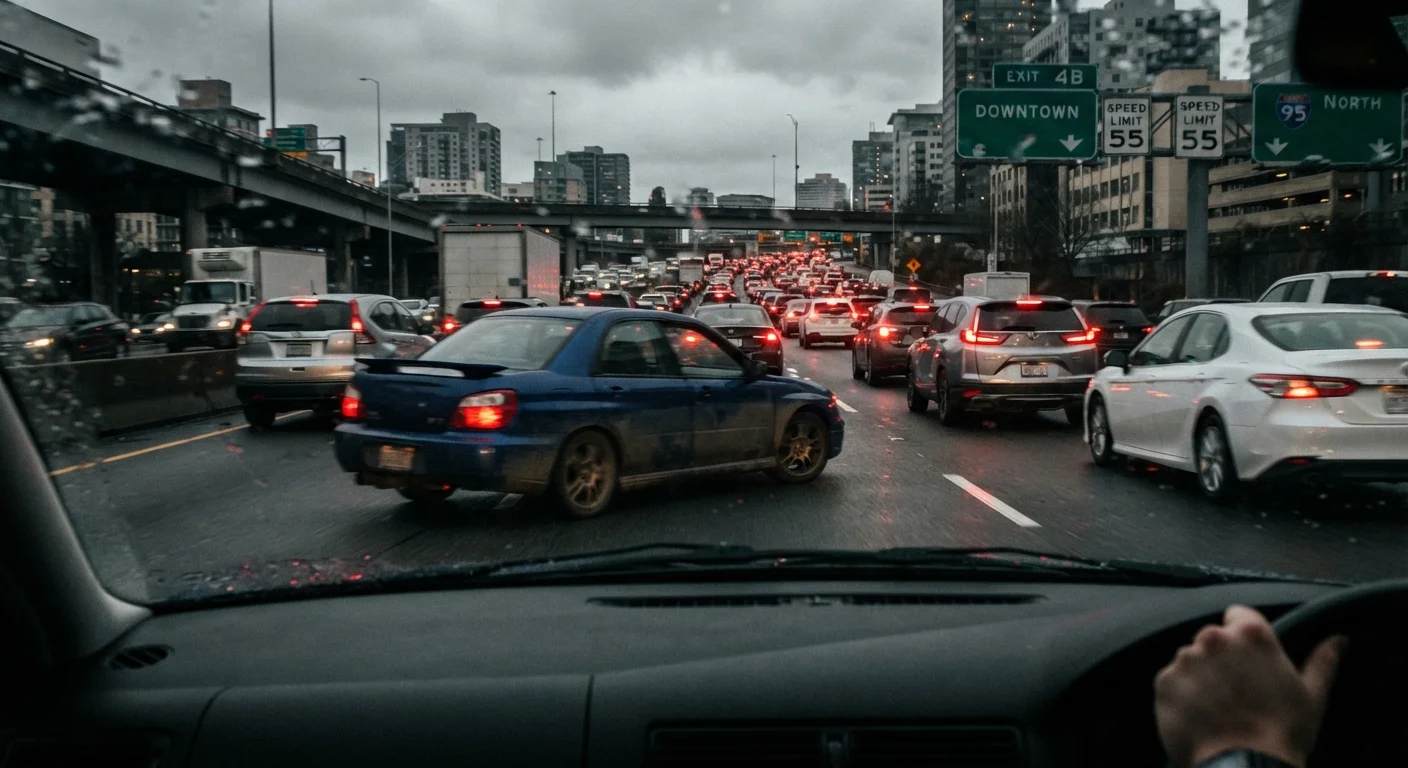
Rapid, unsignaled lane changes create blind-spot conflicts and force other drivers to brake or swerve with little warning. When a driver weaves through traffic - repeatedly changing lanes to gain small positional advantages - they create a ripple of disruption across multiple lanes. Other drivers must constantly adjust, and the aggregate effect raises crash probability for everyone in the area, not just the weaving vehicle.
Mirrors and signals exist to make lane changes a collaborative action between drivers. Skipping that communication turns a routine maneuver into a gamble. For a detailed look at why this matters especially on highways, see our piece on how lane changes cause crashes.
Weaving through traffic disrupts every driver nearby, not just the vehicles directly involved.
Running Red Lights and Stop Signs
Red-light running is among the most lethal forms of aggressive driving because it creates right-angle (T-bone) collisions - impacts that strike the side of a vehicle where structural protection is thinner than at the front or rear. Drivers who accelerate through late yellows or roll through stop signs often rationalize the behavior as time-saving. In practice, the time gained across an entire commute is negligible; the crash risk is not.
Intersections are where vehicle paths deliberately cross, making them inherently the highest-conflict zones on any road network. Aggressive intersection behavior - including blocking the box, ignoring yield signs, or failing to check cross-traffic - compounds that conflict. Understanding right-of-way rules is a core safety competency; our guide to right-of-way at US intersections breaks this down clearly.
T-bone collisions from red-light running are among the most injurious crash types on US roads.
Road Rage Escalation
Road rage is what happens when aggressive driving becomes interpersonal conflict. It can begin with horn use, gesture exchange, or high-beam flashing, and escalate to deliberate vehicle contact, forced stops, or confrontations outside the vehicle. What distinguishes road rage from standard aggressive driving is intent: actions shift from reckless to purposeful.
From a safety standpoint, the key is to avoid engaging with a driver who appears to be in an enraged state. Honking back, maintaining eye contact, or brake-checking a tailgater can all escalate a situation rapidly. If you feel your own frustration rising behind the wheel, recognizing it early - pulling off, slowing breathing, creating more space - is a concrete risk-reduction step. Emotional regulation while driving is a skill, not a personality trait.
Engaging with an enraged driver - even defensively - almost always makes the situation worse.
Hard Braking and Late Braking
Drivers who follow too closely or aren't scanning far enough ahead often end up braking hard and late. This is both a crash precursor and a signal of poor situational awareness. Hard braking in wet, icy, or gravel conditions can cause skids or loss of directional control, even on vehicles equipped with ABS. It also compresses stopping distances to their minimum, eliminating any buffer.
From a fuel-efficiency standpoint, hard braking also wastes the kinetic energy that smooth deceleration could preserve. The connection between aggressive driving and fuel waste is direct and measurable - something our article on fuel-draining driving habits covers in practical terms. Smooth, anticipatory braking - reading traffic well ahead and coasting to decelerate - is both safer and more economical.
Late braking is often a symptom of poor scanning habits, not just impatience.
Turning Awareness Into Action
Aggressive driving patterns are often habit-driven rather than intentional. Drivers who routinely speed may not recognize it as aggression - they see it as normal. The same goes for close following or last-second lane changes. Self-awareness is the first and most important corrective tool.
Try the 'Two-Second Check' on Yourself
During your next drive, periodically ask: Am I following at a safe distance? Did I signal that lane change? Am I checking mirrors every 5-8 seconds? These micro-habits take almost no time to build but meaningfully reduce the risk of aggressive-pattern drift over long commutes or familiar routes.
It's also worth recognizing that many aggressive behaviors are intertwined with fuel waste. Hard acceleration, late braking, and high-speed travel all consume significantly more fuel than steady, measured driving. Our article on habits that drain your fuel tank details the overlap between unsafe and inefficient driving.
If you share the road with a new driver, directing them to foundational safety resources early can prevent these patterns from forming at all. Our new driver's introduction to safe road behavior covers the core habits that reduce lifetime crash risk.