

Key Takeaways
The Assumption That Online Is Always Cheaper
The idea that online shopping reliably undercuts physical retail has taken on the status of conventional wisdom. It feels logical: digital storefronts have lower overhead, no sales staff, and access to a global supplier base. Why wouldn't they be cheaper?
The reality is more complicated. While online prices can absolutely be lower - and often are - the channel itself is not a guarantee of savings. A growing body of retail research and shopper experience shows that the final amount leaving your account can easily exceed what you'd have paid walking into a store. Understanding why requires looking beyond the listed price.
For a full accounting of where the gaps appear, see how hidden costs change the math on online shopping.
Myth
Online retailers have lower overhead, so their prices are always lower than physical stores.
Fact
Lower overhead doesn't automatically translate to lower consumer prices; platform fees, fulfillment costs, and dynamic pricing algorithms all influence what you pay.
E-commerce platforms charge sellers significant fees - often 8-15% of the sale price - and fulfillment costs for warehousing and last-mile delivery are substantial. These costs are passed along to buyers in ways that offset the savings from not maintaining a physical storefront. Meanwhile, large brick-and-mortar chains have enormous purchasing leverage that often yields lower wholesale costs than smaller online sellers can negotiate.
Myth
The price you see online is the price you pay.
Fact
Shipping, handling, sales tax, and membership fees routinely add 10-25% or more to the checkout total, depending on the item and your location.
A $79 item with $12 shipping and applicable state sales tax could realistically cost $97 or more at checkout. If you're paying an annual membership fee to access free shipping, that cost should be spread across your qualifying purchases to get an honest per-order cost. Shoppers who skip this math consistently underestimate what they're spending online. For a structured way to do this accounting, see understanding total cost of ownership before any purchase.
Myth
A sale badge on an online listing means you're getting a deal.
Fact
Many online 'sale' prices are measured against inflated reference prices or reflect pricing that was only briefly higher before being marked down.
Dynamic pricing means a retailer can raise a price for a short period, then advertise a percentage discount off that elevated figure. Price history tools - which chart an item's price over weeks or months - reveal whether a marked-down price is genuinely low or simply back to its usual level. Understanding the difference between a sale price and a good price is a core skill for value-driven shopping.
Myth
You can't negotiate or get a better price in a physical store.
Fact
Many brick-and-mortar retailers have formal price-match policies and discretionary markdown authority, particularly for high-ticket items near end-of-season.
Floor staff at large-format retailers - particularly in electronics, appliances, and furniture - frequently have the ability to apply discounts, match a verified online price, or bundle accessories at no added cost. This negotiating surface doesn't exist in an automated online checkout. Shoppers who ask tend to fare better than those who assume the sticker price is fixed.
Myth
Online shopping eliminates the cost of travel, making it inherently more economical.
Fact
Travel cost is real but often small relative to the hidden costs of online orders, and in-store trips frequently serve multiple purposes.
A short drive to a store may cost a few dollars in fuel or time, but that's a fixed cost spread across everything purchased. Contrast that with per-item shipping charges on an online order of similar goods. If your online cart requires multiple shipments from multiple sellers, the total shipping cost can exceed a reasonable estimate of travel costs - especially on heavy or large items where freight rates are high.
Where the Math Actually Breaks Down
Three structural forces push online totals upward in ways shoppers routinely underestimate.
Dynamic pricing. Major e-commerce platforms adjust prices algorithmically, sometimes dozens of times per day, based on demand signals, inventory levels, competitor pricing, and browsing behavior. A price you see at 9 a.m. may be meaningfully different by afternoon. This volatility makes point-in-time comparisons unreliable. Price tracking tools help establish whether a listed price is genuinely low or just average for that item's history.
Shipping and handling. Free shipping thresholds mean shoppers often add items they don't need to qualify, effectively paying for them in a roundabout way. Expedited shipping costs can exceed $10-$20 per order on bulky or heavy goods. And membership fees - often $100-$140 per year for major services - are a real cost that should be amortized across purchases.
Returns friction. In-store returns are typically immediate. Online returns frequently require prepaid labels (sometimes at the buyer's expense), repackaging, and waiting days or weeks for a refund to clear. When a product doesn't fit, malfunctions, or disappoints, that friction has a financial value that the checkout screen doesn't capture.
~15%
Typical e-commerce platform seller fee
Industry analyses of major online marketplaces consistently show seller fees ranging from 8-15% of transaction value, costs that are often embedded in listed prices.
32 states
States collecting online sales tax after 2018 ruling
Following the U.S. Supreme Court's 2018 South Dakota v. Wayfair decision, the majority of states now require online retailers to collect sales tax, eliminating a key historical advantage of e-commerce.
~$100-$140
Annual cost of major shipping memberships
Paid shipping membership programs at leading US retailers typically run $100-$140 per year, a real cost that must be recovered through qualifying purchases to justify the fee.
Before assuming an online price is the better deal, use a like-for-like total cost comparison. Our guide to price-checking across channels walks through that method step by step.
When In-Store Pricing Has the Advantage
Physical retail has adapted to online competition in ways that have narrowed or eliminated the price gap in several categories.
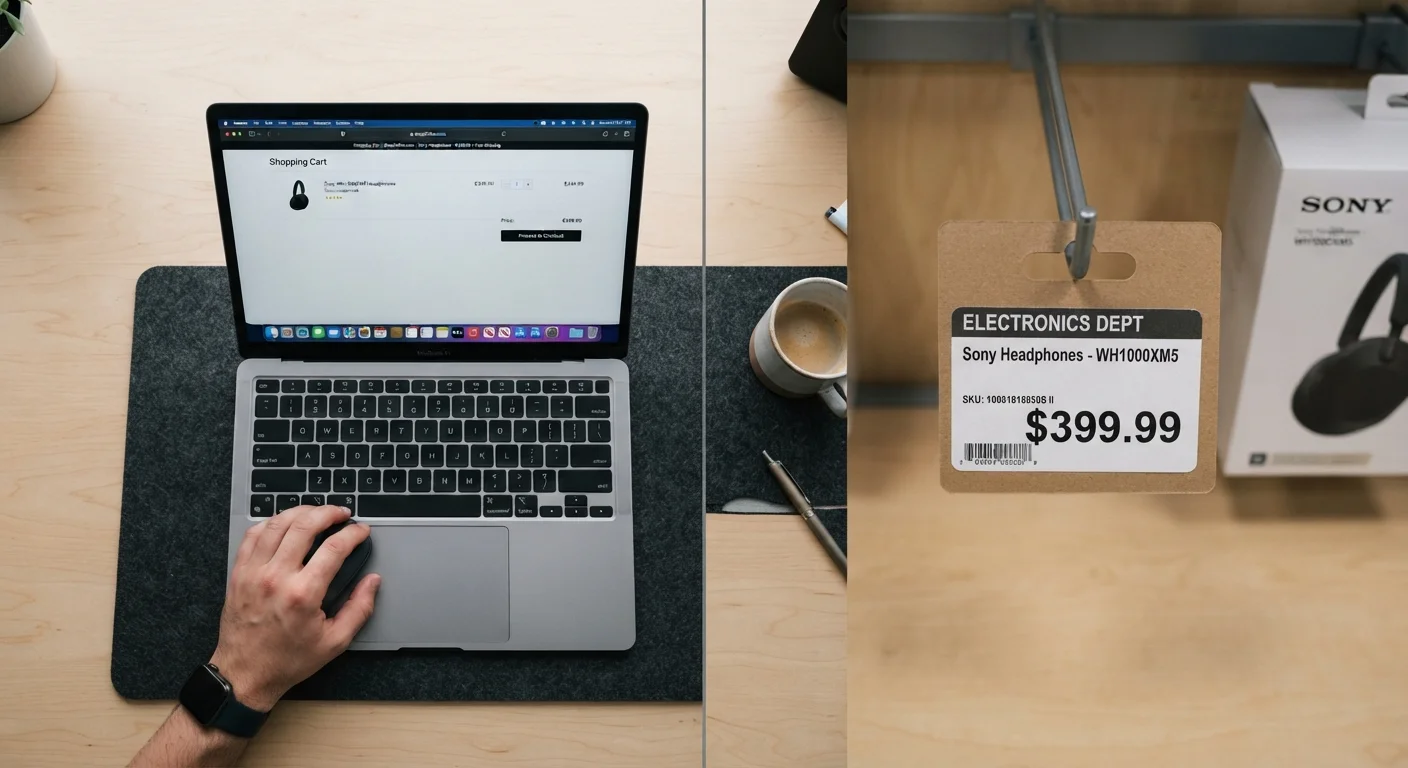
Price-matching policies. Many large-format retailers now formally match verified competitor prices, including online listings, at the point of sale. For high-value categories like electronics and appliances, this means you can access online pricing while also getting in-person service, same-day possession, and an easier return process. Electronics purchases are a particularly strong case for exploring this option.
Clearance and floor-model pricing. Physical stores generate end-of-season and floor-model inventory that must move quickly and is often marked down more aggressively than comparable online listings, which can reach national audiences and therefore face less pressure to discount.
No sales tax arbitrage - mostly. Tax law changes in recent years have largely eliminated the sales-tax advantage online shopping once held in many states. Most major online retailers now collect state sales tax at checkout, erasing what was once a meaningful cost difference.
The broader trade-off picture - including convenience, trust, and return experience - is covered in the real trade-offs between shopping online and in a store.
Don't Confuse Channel Loyalty With Value
Defaulting to online shopping for every purchase - without comparing total costs - can lead to consistently paying more than necessary. Equally, avoiding online channels out of a preference for in-store shopping can mean missing genuine savings. Neither habit is a substitute for calculating the actual total cost before committing. The channel is just a variable, not the answer.
The bottom line: channel loyalty - defaulting to online or to stores out of habit rather than calculation - is a spending pattern, not a strategy. Value-conscious shoppers treat each purchase as its own decision, factoring in total cost, return likelihood, and timing. For a framework on developing that habit, see smart habits for comparing prices across channels and formats.