

Key Takeaways
Why Standard Price-Checking Falls Short
Most shoppers compare prices by glancing at two or three retailers and choosing the lowest number. This approach misses the variables that determine what you actually pay. As explored in our overview of why online prices aren't always lower, shipping fees, dynamic pricing, and channel-specific variants routinely distort a straight sticker-price comparison.
The goal of systematic price-checking isn't to identify the cheapest headline figure - it's to identify the lowest total cost for an identical item, accounting for every mandatory expenditure and meaningful trade-off. The steps below give you a repeatable method to do exactly that.
What you will need
Spreadsheet or Note-Taking App
Records landed costs, notes, and comparison data for each retailer in a structured format.
Retailer Website or App
Provides current listed prices, shipping estimates, and availability for online channel checks.
Browser Extension for Price History
Displays historical price trends so you can assess whether a current price is genuinely low.
Calculator
Used to add tax, shipping, and any applicable membership fees to the base price.
Step-by-Step: How to Price-Check Across Channels
Work through these steps in order. Skipping ahead - particularly past the landed cost calculation - is where comparison errors most commonly occur.
Confirm the exact item and model number
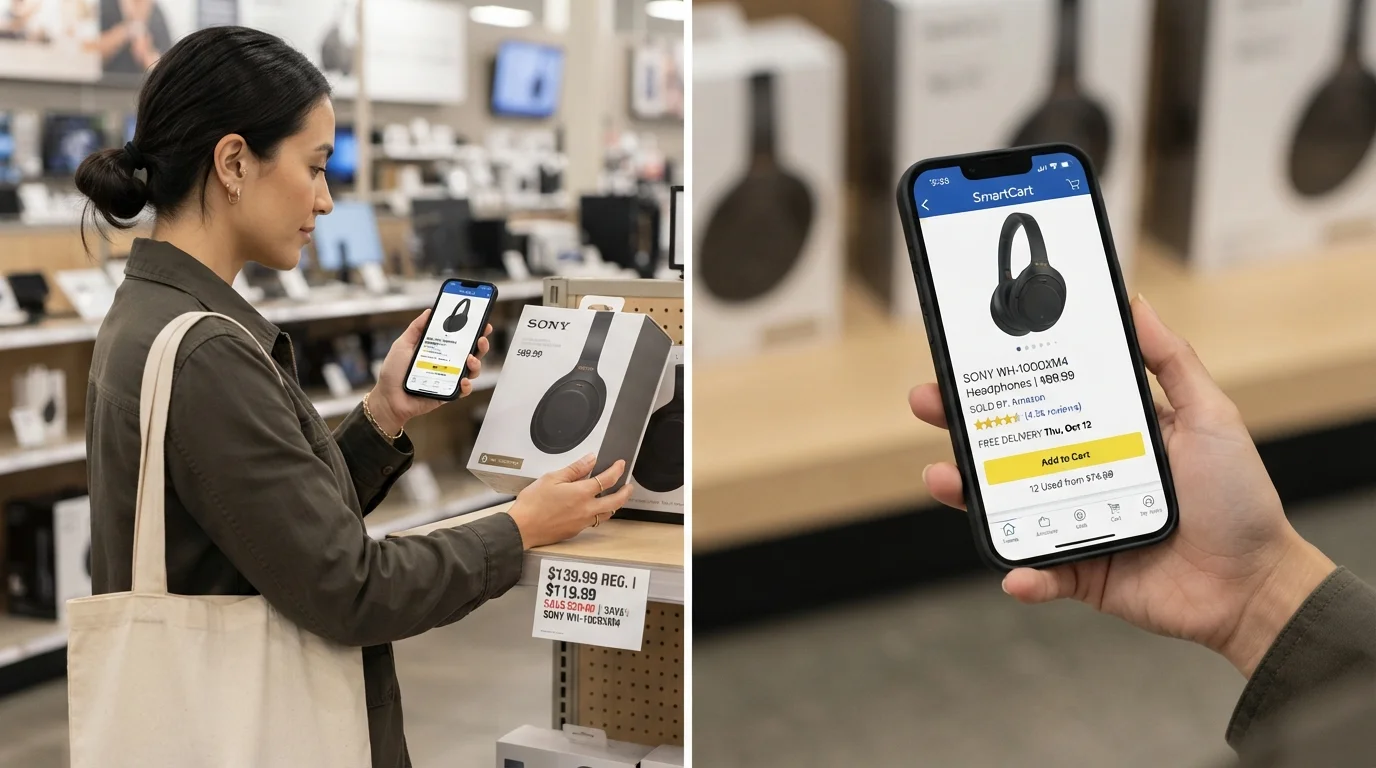
Before opening a single retailer tab or visiting a store, nail down the precise product you're evaluating. Note the manufacturer's model number, SKU, or UPC code. If you're researching in-store first, photograph the shelf label. Retailers often carry similar-sounding variants - slight differences in specifications can justify meaningful price gaps. Without a confirmed identifier, you risk comparing items that aren't truly equivalent.
Record the base (sticker) price at each channel
Open your comparison worksheet and log the listed price at each retailer - both online and in-store if applicable. Check at least two to three sources to establish a realistic range. Note the date and time for online checks, since prices can shift. For in-store prices, record the shelf tag price, not the price from the retailer's website, as they can differ.
Calculate the full landed cost for each option
Add every mandatory cost to each base price to arrive at a landed cost - the true amount leaving your account. For online orders, this includes shipping fees, handling charges, and applicable sales tax. For in-store purchases, include sales tax and any realistic travel cost. If a membership fee (such as a warehouse club or subscription delivery service) is required to access a listed price, prorate that annual fee across your typical purchase frequency and add the proportional share.
See our guide to hidden costs in online shopping for a complete breakdown of charges that often go unaccounted.
Factor in return and warranty conditions
A lower landed cost becomes less attractive if the return window is short, restocking fees apply, or a return requires shipping the item back at your expense. Check each retailer's return policy and note any conditions that add cost or friction. Similarly, verify whether the warranty is honored through the retailer or only through the manufacturer - this affects your recourse if something goes wrong.
Assign a value to time and convenience
In-store shopping involves travel time, parking, and potential wait time. Online orders involve a delivery window during which you may need to be available, or a delay if the item is needed urgently. Neither of these is free. A reasonable approach is to estimate how much your time is worth per hour and apply that to any meaningful difference in time required between channels. If both options take similar time, this factor is neutral. If one option saves 45 minutes, that has a real value worth accounting for.
Compare totals and make your decision
With landed costs, return terms, and time factors all recorded, compare the figures side by side. The channel with the lowest total cost - including time - is the rational choice, all else being equal. If the difference is under a few dollars, non-financial factors like trust, convenience, or preference legitimately tip the scales. Document your final choice and the key numbers; this record is useful if a price adjustment policy applies or if a return becomes necessary.
Dynamic Pricing Changes Quotes Quickly
Online retailers frequently adjust prices based on demand, browser history, and time of day. A price you checked this morning may differ from what you see tonight. Complete your comparison and make your decision within a short window - ideally the same session - to avoid acting on outdated figures.
Avoiding the Most Common Comparison Mistakes
Even shoppers who follow a structured approach can be tripped up by a few recurring pitfalls.
Model Numbers and Variants Can Mislead
Retailers sometimes carry slightly different product variants under near-identical names - different storage capacities, color options, or bundled accessories. Always verify the exact model number or SKU before treating two listings as comparable. Comparing mismatched items is one of the most common price-check errors shoppers make.
Use Price History to Validate the Comparison
A current price only tells you what something costs today. Browser extensions that display price history for major online retailers let you see whether a listed price is near its typical level or temporarily inflated. This context prevents you from anchoring to a 'sale' price that may simply be a return to normal. Price history tools are particularly useful for electronics and appliances, where promotional pricing patterns are predictable.
A broader look at these dynamics, including how warehouse and format pricing further complicate comparisons, is covered in our piece on smart habits for comparing prices across channels. And if you want to understand total cost beyond the point of purchase - including maintenance and lifespan - see our guide on understanding total cost of ownership.
Effective price-checking is a skill that compounds: the more consistently you apply this method, the faster and more intuitive it becomes. The real trade-offs between shopping channels remain the same regardless of what you're buying - but your ability to navigate them improves with practice.