

Key Takeaways
Broader selection including discontinued model-year devices
Online retailers can list deep inventory that no physical store could stock, giving buyers access to prior-generation models that may offer comparable performance at lower prices.
Price competition across multiple sellers in one search
Aggregated marketplaces make side-by-side price comparison fast, and periodic sales events can produce prices below standard retail.
Doorstep delivery eliminates transport logistics
Large items like televisions require a vehicle capable of hauling them; delivery removes that barrier entirely, along with the time cost of a store trip.
User reviews provide real-world performance data
Verified purchase reviews and independent test lab write-ups give online shoppers access to aggregated experience that a store demo cannot replicate.
Shipping damage risk for fragile or large items
Large displays and devices with delicate components are susceptible to transit damage, and resolving a damaged shipment takes time and effort that in-store purchase avoids.
Cannot assess build quality or tactile feel before buying
Weight, keyboard action, screen uniformity, and speaker output are all difficult to evaluate from specs and photos alone, leading to some purchases that disappoint in person.
Returns involve packaging, shipping, and wait times
Returning a defective or unwanted item online requires repackaging, a return label, drop-off, and a processing delay before a refund or replacement arrives.
Counterfeit and gray-market product risk on open marketplaces
Third-party marketplace listings have a higher rate of counterfeit or misrepresented products than authorized retail channels, which is a meaningful risk for high-value electronics.
No same-day availability for urgent needs
Standard shipping timelines of two to five business days make online purchase impractical when a device is needed immediately.
Our Verdict
Neither channel holds a consistent edge for electronics purchases. Online shopping tends to reward patient, well-researched buyers comfortable with return logistics, while physical retail suits those who value hands-on evaluation, immediate availability, or in-store support. The right call depends on the specific product, its price point, and how much uncertainty you're willing to absorb.
Shoppers who already know exactly what model they want and have confirmed a competitive price with a reputable seller will find online purchasing straightforward; those buying unfamiliar or high-cost items benefit most from a store visit first.
Why Electronics Make the Channel Decision More Complex
Buying a TV, laptop, or pair of headphones involves a different calculus than picking up a book or a kitchen utensil. Electronics carry higher price tags, have meaningful variation in build quality and software experience between models, and come with warranty structures that can differ by seller. A 65-inch display that arrives with a cracked panel, or a "new" device that turns out to be a refurbished unit sold as new, creates a problem that's far harder to resolve than a poorly fitting shirt.
For a broader lens on how the channel decision plays out across categories, see the real trade-offs between shopping online and in a store. Electronics, however, sit near the high-stakes end of that spectrum, so the individual factors deserve a closer look.
Broader selection including discontinued model-year devices
Online retailers can list deep inventory that no physical store could stock, giving buyers access to prior-generation models that may offer comparable performance at lower prices.
Price competition across multiple sellers in one search
Aggregated marketplaces make side-by-side price comparison fast, and periodic sales events can produce prices below standard retail.
Doorstep delivery eliminates transport logistics
Large items like televisions require a vehicle capable of hauling them; delivery removes that barrier entirely, along with the time cost of a store trip.
User reviews provide real-world performance data
Verified purchase reviews and independent test lab write-ups give online shoppers access to aggregated experience that a store demo cannot replicate.
Where Online Shopping Has an Edge
The primary draw is price competition. Because online marketplaces aggregate multiple sellers, shoppers can compare prices across dozens of listings in seconds. Manufacturer-direct storefronts, third-party marketplaces, and e-tailer sales events can all push prices below what a physical store typically stocks. Extended sales windows-not just annual shopping holidays-mean deals surface throughout the year.
Selection depth is another real advantage. A regional electronics chain carries a curated inventory limited by shelf space; an online retailer can list hundreds of SKUs in the same product category, including older model-year devices that may represent strong value. Delivery to your door eliminates travel time, which matters for large items like televisions that require vehicle planning to transport.
It's worth noting, however, that the price advantage isn't guaranteed. Online prices aren't always lower than in-store once shipping fees, return shipping costs, and dynamic pricing fluctuations are factored in.
~40%
Electronics purchases made online in the US
E-commerce's share of consumer electronics sales has grown substantially over the past decade, reflecting both price transparency and expanded delivery infrastructure.
1 in 5
Online marketplace listings flagged for authenticity issues
Reports from consumer protection organizations have noted elevated rates of counterfeit or misrepresented products on open third-party marketplaces, particularly in electronics.
Where Physical Retail Still Holds Ground
The tactile dimension of electronics shopping is underrated. Screen color accuracy, keyboard feel, speaker output, and the actual weight of a device are all things that spec sheets describe imperfectly. Holding a mirrorless camera body or typing on a laptop keyboard for 90 seconds resolves questions that hours of online review reading may not.
Immediate availability matters more with electronics than with many other categories. A laptop needed for a work trip tomorrow, or a router required to restore home internet service, cannot wait three to five business days. In-store purchase also eliminates shipping damage risk-a non-trivial concern for large panels or devices with delicate components.
Returns are simpler in person. Walking a defective unit back to a service desk is generally faster and less logistically demanding than packaging, labeling, and shipping a return, then waiting for a replacement or refund to process. For items over a certain value, that friction reduction has real worth. Some purchase situations genuinely favor the store, and large or fragile electronics are a clear example.
Shipping damage risk for fragile or large items
Large displays and devices with delicate components are susceptible to transit damage, and resolving a damaged shipment takes time and effort that in-store purchase avoids.
Cannot assess build quality or tactile feel before buying
Weight, keyboard action, screen uniformity, and speaker output are all difficult to evaluate from specs and photos alone, leading to some purchases that disappoint in person.
Returns involve packaging, shipping, and wait times
Returning a defective or unwanted item online requires repackaging, a return label, drop-off, and a processing delay before a refund or replacement arrives.
Counterfeit and gray-market product risk on open marketplaces
Third-party marketplace listings have a higher rate of counterfeit or misrepresented products than authorized retail channels, which is a meaningful risk for high-value electronics.
No same-day availability for urgent needs
Standard shipping timelines of two to five business days make online purchase impractical when a device is needed immediately.
Warranties, Price Matching, and the Hybrid Approach
Warranty coverage is one factor that shoppers frequently overlook until something goes wrong. Manufacturer warranties apply regardless of channel, but some physical retailers offer extended in-store service plans or price-match guarantees that add value beyond the sticker price. Understanding what coverage applies-and from whom-before purchase is worthwhile. For a structured comparison of coverage types, warranties and extended protection plans explains what each typically includes and excludes.
Price Matching: Check the Fine Print
Many large electronics retailers offer price-match guarantees, but these programs typically exclude third-party marketplace sellers, bundle-only offers, and limited-time flash sales. Before assuming a price match will apply, verify the specific conditions the retailer publishes. In some cases, presenting a verifiable competitor price in-store can close the gap between online and physical retail pricing without sacrificing the in-store purchase experience.
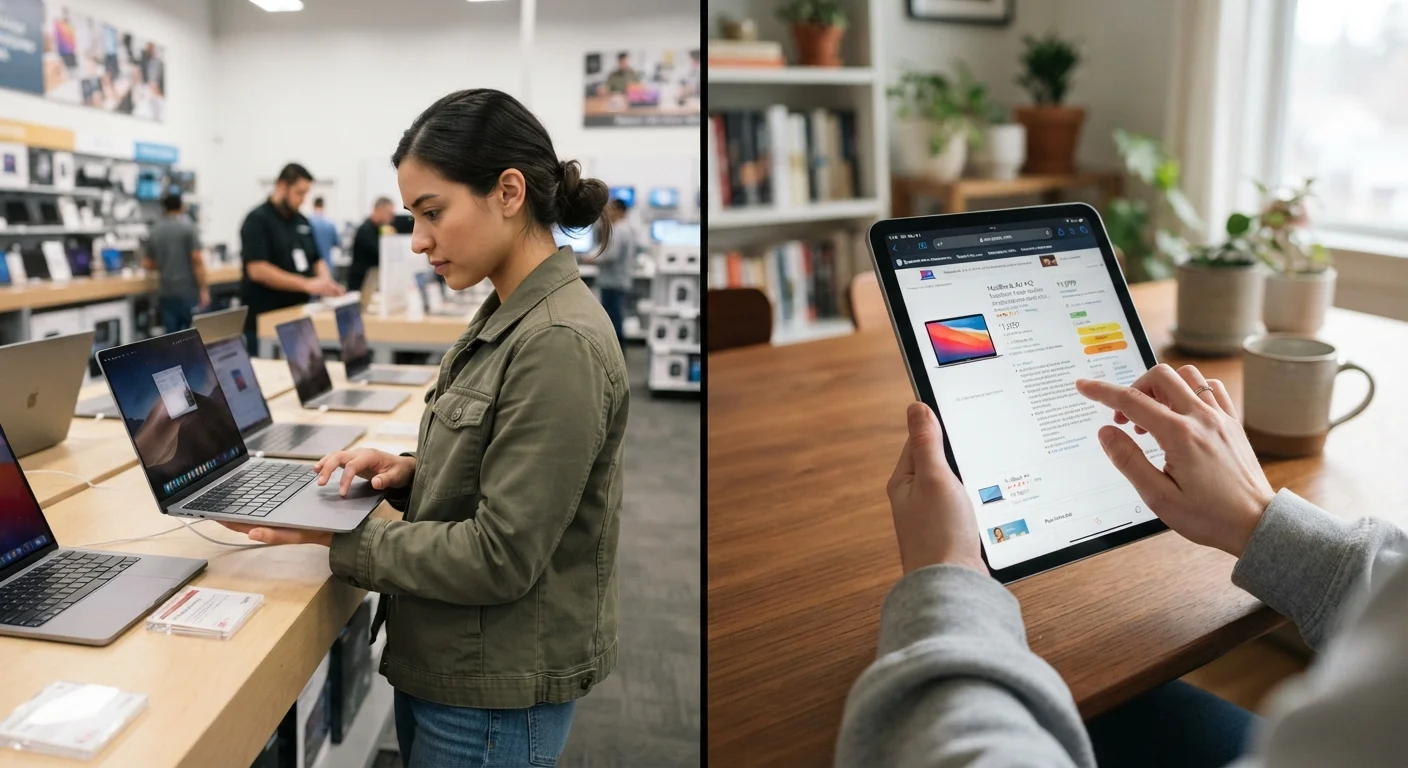
Many experienced electronics buyers use a deliberate hybrid strategy: research and compare models online, then visit a store to evaluate the shortlist in person, then buy through whichever channel offers a verifiable price advantage at that point. This approach, sometimes called channel switching, captures the information density of online research without sacrificing hands-on confidence. Channel switching strategies are worth understanding before any significant electronics purchase.