

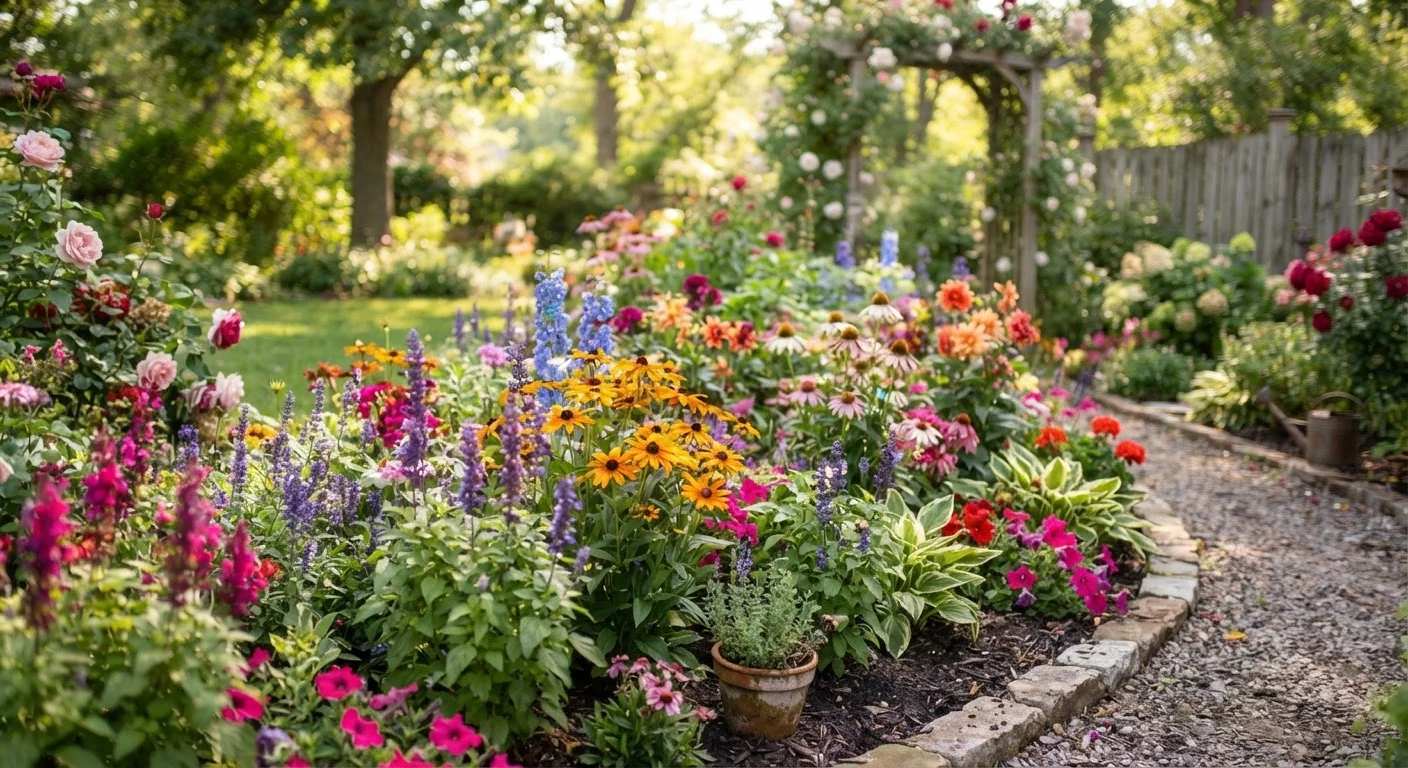
Key Takeaways
Option A
Perennials
The long-term investment that pays dividends every season.
Best for: Gardeners who want a low-maintenance backbone of reliable color that returns without replanting each year.
Option B
Annuals
The flexible, high-impact filler for instant seasonal color.
Best for: Gardeners who want full-season blooms, creative freedom to change their palette each year, or color in newly established beds.
If you want to minimize annual replanting costs
Perennials
Once established, perennials return each year on their own, significantly reducing both labor and plant purchase costs over time.
If you want nonstop color all season long
Annuals
Most annuals bloom continuously from planting until frost, delivering reliable, dense color through the entire growing season.
If you're designing a new garden bed from scratch
Perennials
Perennials establish the garden's structure and form, giving you a permanent framework to build and refine over the years.
If you want to experiment with new colors or styles each year
Annuals
Because annuals are replanted each season, they let you change your garden's palette and layout without any permanent commitment.
If you want the best of both worlds with minimal effort
Perennials
Plant perennials as your permanent foundation and use a smaller selection of annuals to fill gaps - this approach balances color, value, and low upkeep.
What Sets Perennials and Annuals Apart
The most fundamental difference between perennials and annuals comes down to lifespan. Perennials live for more than two years, dying back to their root systems in winter and resprouting each spring. Annuals complete their entire life cycle - germination, flowering, seed production, and death - within a single growing season.
This distinction shapes nearly every practical decision in garden planning: how much you spend, how often you replant, how reliably a plant blooms, and how your garden evolves over the years. Neither category is superior - each fills a distinct role, and understanding both is the foundation of smart garden design.
For deeper context on how plant selection fits into an overall garden strategy, see our guide to starting a garden from scratch.
| Criterion | Perennials | Annuals |
|---|---|---|
| Lifespan | Returns each year from roots | Completes life cycle in one season |
| Bloom duration | Typically 2-6 weeks per season | Often all season until frost |
| Upfront cost | Generally higher per plant | Generally lower per plant |
| Long-term cost | Lower - no annual repurchase needed | Higher - replanted each season |
| Maintenance | Division every few years; pruning | Regular deadheading for best bloom |
| Design flexibility | Fixed - plants return in same spot | High - palette changes yearly |
| Establishment time | 1-3 years to full size | Productive from first season |
| Best use | Garden structure and backbone | Seasonal color and gap-filling |
The Case for Perennials: Long-Term Value and Structure
Perennials are widely considered the structural backbone of a well-designed garden. Examples include coneflowers (Echinacea), black-eyed Susans, hostas, daylilies, and ornamental grasses. Once established - typically after the first full growing season - most perennials require little intervention beyond occasional division and pruning.
From a cost perspective, perennials tend to carry a higher price tag at the nursery than annuals of comparable size. However, because they return each year and can be divided to multiply your stock, the long-term cost per plant is often lower. A single clump of daylilies, for instance, can be divided every three to four years to fill additional areas of the garden at no extra cost.
One trade-off: most perennials bloom for a shorter window - typically two to six weeks - compared to annuals. Thoughtful selection of varieties with staggered bloom times can extend interest across the full season. Pair this approach with the advice in our seasonal garden maintenance guide to keep perennials performing their best month by month.
3-4 yrs
Typical perennial division interval
Most clump-forming perennials benefit from being divided every three to four years to maintain vigor and expand plantings at no additional cost.
70/30
Perennial-to-annual ratio used by many designers
A commonly recommended starting point in garden design is planting roughly 70% perennials for structure and 30% annuals for continuous seasonal color.
2-6 wks
Average individual perennial bloom window
Most perennial species bloom for a relatively short window each season, making staggered variety selection critical for extended garden interest.
The Case for Annuals: Continuous Color and Creative Flexibility
Annuals - such as petunias, marigolds, zinnias, impatiens, and snapdragons - are unmatched for season-long, uninterrupted bloom. Because their biological purpose is to produce as many seeds as possible before dying, they flower prolifically and continuously, especially when deadheaded (spent blooms removed) regularly.
Their disposable nature is also a design advantage. If a color combination doesn't work, or you simply want a fresh look next spring, you start with a clean slate. This makes annuals particularly appealing for container gardens, window boxes, and entry beds where visual impact is the primary goal.
Annuals also serve a practical purpose in new garden installations. Perennials can take one to three years to reach their full size, leaving the border looking sparse in the interim. Planting annuals in those gaps keeps the space looking full and intentional while the perennials establish themselves.
Designing a Garden That Uses Both Strategically
The most resilient and visually rewarding garden designs use perennials as the permanent framework and annuals as flexible seasonal accents. A practical starting ratio for many homeowners is roughly 70% perennials to 30% annuals - enough perennial mass to carry the garden year over year, with enough annuals to guarantee continuous color and allow for seasonal creativity.
When placing plants, consider bloom time, height, and sun requirements for each species. Taller perennials like ornamental grasses or rudbeckia can anchor the back of a border, while low-growing annuals like sweet alyssum or lobelia edge the front. Mid-border perennials with staggered bloom times carry color from spring through fall when selected carefully.
Companion planting principles can also inform which plants you place near each other - certain pairings naturally deter pests and reduce maintenance. Our companion planting guide explains how strategic plant combinations work in practice. Additionally, your choice of bed type affects how both annuals and perennials perform; raised beds vs. in-ground planting explores how each setup influences drainage, soil control, and long-term plant health.
Hardiness Zones Matter for Perennials
A plant labeled as a perennial in one region may behave as an annual in another, depending on winter temperatures. Before purchasing perennials, check the USDA Plant Hardiness Zone Map to confirm a variety is rated for your local climate. Plants purchased outside their hardiness zone will not reliably survive winter and will need to be treated - and budgeted - as annuals instead.