

Key Takeaways
Companion Planting
Companion planting is the practice of growing different plants near each other so they mutually benefit - or at least don't compete. Some plant pairings deter pests, attract pollinators, improve soil nutrients, or provide physical support. The goal is to work with natural plant relationships to create a more productive, balanced garden.
Plant interactions in companion planting involve allelopathy (chemical signals that suppress or stimulate neighboring plants), nutrient cycling through nitrogen fixation, and habitat modification that influences insect behavior.
How Plant Relationships Work
Plants don't exist in isolation. They release compounds through roots and leaves, attract or repel insects, and alter the soil around them. Companion planting is the intentional use of these interactions to make a garden function better as a whole.
The mechanisms fall into a few main categories:
- Pest deterrence: Aromatic herbs and flowers can confuse or repel insects searching for host plants.
- Attraction of beneficial insects: Flowering companions lure pollinators and predatory insects that feed on garden pests.
- Nitrogen fixation: Legumes (beans, peas, clover) host bacteria in their roots that convert atmospheric nitrogen into a soil-available form, feeding neighboring plants.
- Physical support and shade: Taller crops shelter low-growing neighbors from heat and wind, while sprawling plants suppress weeds between rows.
Understanding which mechanism applies to a given pairing helps you set realistic expectations and pick combinations that address your specific garden challenges.
Companion Planting Varies by Context
The effectiveness of any companion planting strategy depends heavily on your local climate, soil health, and the specific pest or challenge you're addressing. A pairing that works well in a warm, humid garden may produce different results in a dry or northern climate. Observing your own garden over time is the most reliable guide.
Classic Pairings and Why They Work
A handful of companion planting combinations have stood up to both long practical use and scientific scrutiny.
The Three Sisters
Corn, beans, and squash form a well-known trio developed by Indigenous agricultural communities across North America. Corn provides a vertical trellis for beans; beans fix nitrogen that feeds corn and squash; squash spreads along the ground, shading weeds and retaining soil moisture. Each plant solves a problem the others create.
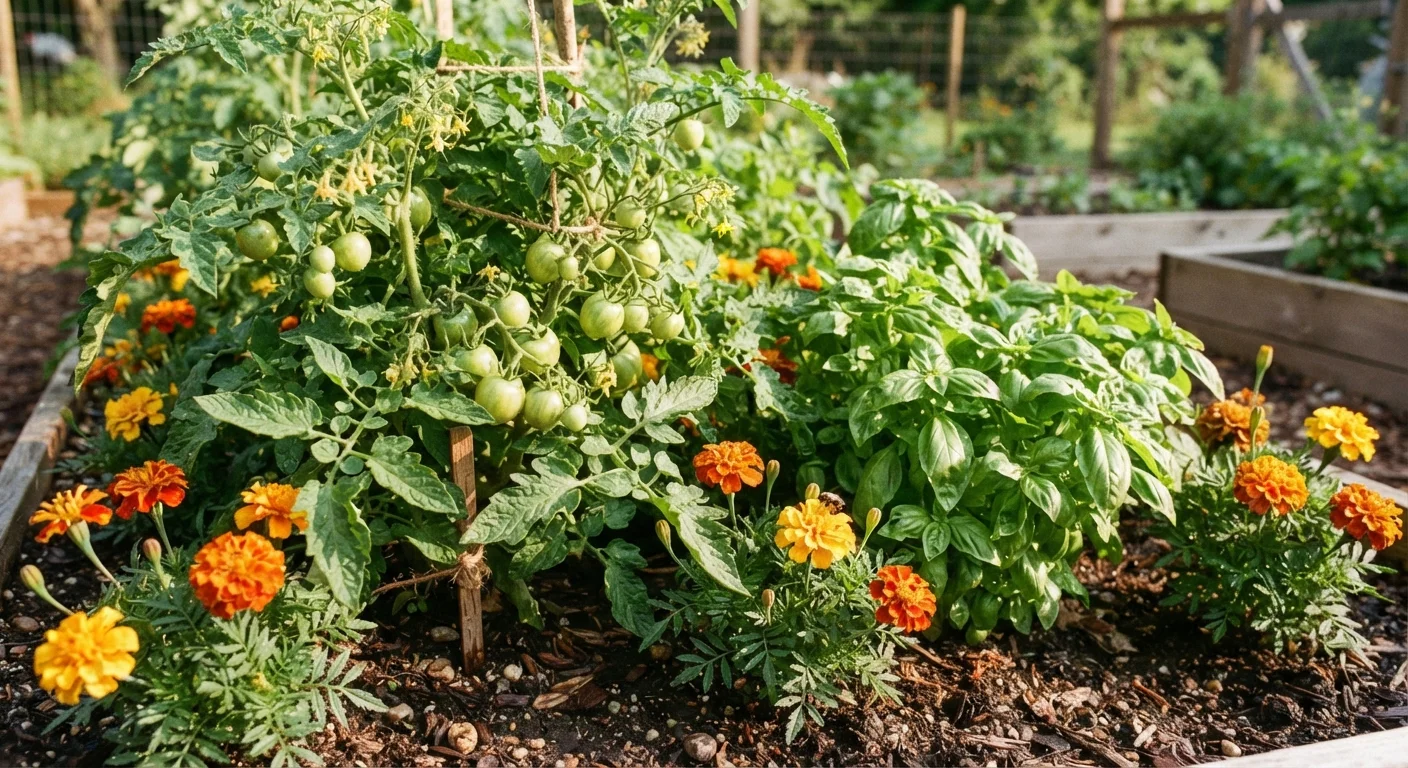
Tomatoes, Basil, and Marigolds
Basil planted near tomatoes is widely observed to improve flavor and may help deter aphids and thrips, though the evidence is largely experiential. Marigolds (Tagetes species) have stronger research support - their roots release compounds that suppress soil nematodes, and their flowers attract hoverflies, whose larvae consume aphids.
Brassicas and Dill or Nasturtiums
Cabbage, kale, and broccoli are frequent targets of caterpillars and aphids. Dill attracts parasitic wasps that prey on caterpillars. Nasturtiums act as a trap crop, drawing aphids away from more valuable plants. For a broader look at evidence-backed pest strategies, see natural pest control methods that actually work in the garden.
Planning Your Companion Garden
Starting simple is key. Pick one or two pairings that address a real problem in your garden - whether that's heavy aphid pressure, poor soil fertility, or bare ground attracting weeds.
A few practical planning considerations:
- Spacing matters: Companions need to be close enough to interact but not so crowded that they compete for light and water. Check mature plant sizes before planting.
- Match plant needs: Pairing plants with similar water and sunlight requirements prevents one from thriving at the other's expense.
- Incorporate perennials where possible: Perennial herbs like chives or oregano establish beneficial insect habitat year after year without replanting. See how perennials and annuals can work together to plan a more layered garden.
- Keep records: Note which pairings performed well or poorly in your specific conditions. Local climate, soil type, and pest pressure all influence outcomes.
Native flowering plants are particularly effective companion allies because they support regional pollinators and predatory insects already adapted to your area. Native plants offer benefits that go well beyond aesthetics, including built-in resilience to local pests.
Start With a Single Proven Pairing
If companion planting is new to you, begin with one well-supported combination - such as marigolds alongside tomatoes or beans next to corn - rather than redesigning your entire garden. This lets you observe real results in your conditions before scaling up. A small experiment this season builds practical knowledge that's worth more than any general rule.
What Companion Planting Can't Do
Companion planting is a genuine and useful tool, but it works best when combined with good foundational practices - healthy soil, appropriate watering, crop rotation, and adequate spacing. No companion combination will fully compensate for depleted soil or chronically poor drainage.
It's also worth noting that not every claimed pairing in gardening folklore has scientific support. Some widely repeated combinations have limited or mixed evidence. Treat new pairings as experiments rather than guarantees, and give them at least one full growing season before drawing conclusions.
Used thoughtfully, companion planting can meaningfully reduce your input costs - less fertilizer, fewer pest interventions - while making your garden more productive and diverse. That's a strong return for something that requires only careful planning at planting time.
~30%
Pest reduction with polyculture planting
A meta-analysis published in the Journal of Applied Ecology found that growing multiple crop species together reduced herbivorous pest abundance by roughly 30% compared to monocultures.
Up to 200 lbs/acre
Nitrogen fixed by legume cover crops annually
According to USDA research, nitrogen-fixing legumes such as clover and field beans can contribute up to 200 pounds of nitrogen per acre per year, significantly reducing synthetic fertilizer needs.