

Key Takeaways
Option A
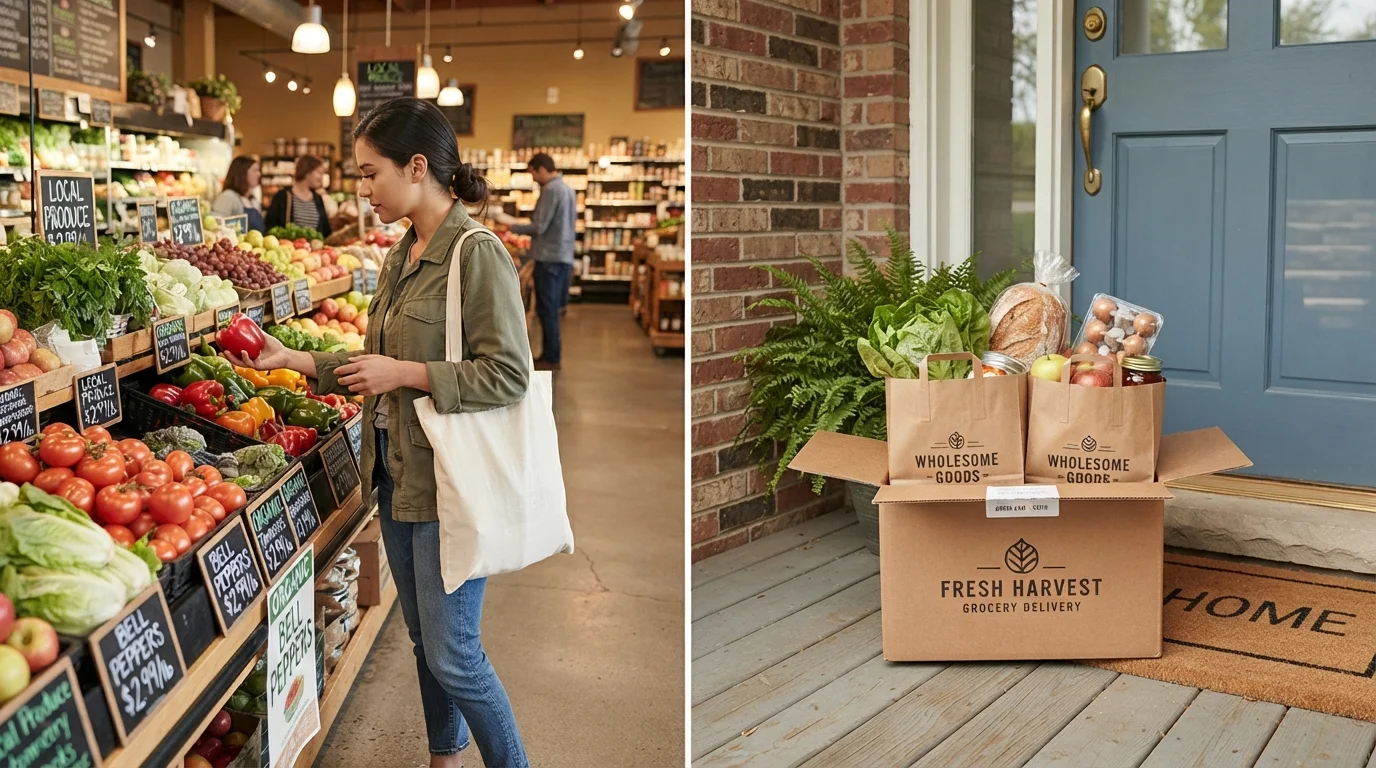
Online Grocery Delivery
The time-saving, hands-off option for busy households.
Best for: Shoppers who prioritize convenience, have predictable weekly lists, and want to avoid impulse purchases.
Option B
In-Store Grocery Shopping
The tactile, flexible choice for quality-conscious buyers.
Best for: Shoppers who want to inspect produce, compare prices visually, and adapt their choices based on what looks good that day.
If your schedule leaves little time for weekly shopping trips
Online Grocery Delivery
Delivery eliminates commute and in-store time, which can easily add up to an hour or more per week for a typical household.
If produce freshness and item selection are your top priorities
In-Store Grocery Shopping
Physically inspecting fruit, vegetables, and meat lets you choose based on actual ripeness and quality - something no algorithm can replicate.
If you're working with a tight grocery budget
In-Store Grocery Shopping
In-store shoppers can spot unadvertised markdowns, clearance items, and manager specials that rarely appear in online listings.
If you tend to overspend or struggle with impulse buying
Online Grocery Delivery
Ordering from a pre-built list in an app removes the sensory triggers - displays, samples, end-caps - that typically drive unplanned purchases.
If you want to balance cost savings with convenience
In-Store Grocery Shopping
Using in-store pickup (click-and-collect) gives you the ease of a pre-built cart without per-order delivery fees or tip expectations.
What You're Actually Comparing
Grocery delivery and in-store shopping serve the same fundamental purpose - getting food into your home - but they involve very different trade-offs around cost, quality control, and time. Understanding those trade-offs clearly matters more than defaulting to one channel out of habit.
This comparison focuses on four dimensions that directly affect value: total cost, freshness and selection control, substitution risk, and time efficiency. For a broader look at how these dynamics play out across retail categories, see the real trade-offs between shopping online and in a store.
| Criterion | Online Delivery | In-Store Shopping |
|---|---|---|
| Typical added costs | Delivery fee, service fee, tip | Transportation cost |
| Impulse spending risk | Lower (list-based ordering) | Higher (sensory triggers) |
| Produce quality control | Delegated to picker | Full shopper control |
| Substitution risk | Present - varies by platform | None |
| Time to shop | Saves in-store time; requires delivery window | Full trip time required |
| Access to markdowns | Limited - not always listed online | Full access to in-store deals |
| Flexibility day-of | Low - order locked in | High - adapt as you go |
Cost: More Than the Sticker Price
Online grocery orders carry costs that don't appear on in-store shelf tags. Delivery fees, service fees, and platform membership costs can add anywhere from a few dollars to over $15 per order, depending on the retailer and service tier. Tipping a driver - while optional - is a common additional expense. Some platforms also mark up individual item prices compared to the store shelf price, though this varies by retailer.
In-store shoppers have their own cost pressures: transportation, time, and the well-documented tendency toward unplanned purchases. Research consistently shows that shoppers spend more than intended when browsing physical aisles, largely due to promotional displays and sensory cues. What research reveals about list-based buying is worth understanding before your next trip.
~$10-$15
Typical per-order delivery cost overhead
Delivery fees and service charges from major US grocery platforms commonly range from $3.99 to $9.99, with tips adding further cost on top.
~$30
Estimated average unplanned in-store spend
Consumer behavior surveys have repeatedly found that shoppers without a fixed list spend meaningfully more than those who plan purchases in advance.
Click-and-collect (ordering online, picking up curbside) occupies a useful middle ground: it avoids delivery fees while preserving the list-discipline benefits of online ordering. Many major grocery chains offer this at no added charge.
Freshness, Substitutions, and What You Don't Control
The most significant quality risk with grocery delivery is that you're delegating item selection to a picker - usually a store employee or gig worker choosing on your behalf. For shelf-stable goods (canned goods, pasta, cereals), this works fine. For produce, meat, seafood, and bakery items, the results are more variable. Pickers may select items with shorter sell-by windows or less favorable ripeness than you would choose yourself.
Substitutions compound this issue. When an item is out of stock, many delivery platforms automatically substitute a similar product - sometimes at a different price point or size. Review substitution settings in your app before ordering, and opt for manual approval if the platform allows it.
In-store shoppers bear none of this risk. You can pick the firmest avocado, check the sell-by date on the milk at the back of the shelf, and adjust your meal plan on the fly based on what's actually available and priced well that day. For households that cook fresh and plan meals around seasonal produce, this control has real value. See a nutritional checklist for everyday grocery shoppers if you want a structured way to assess your weekly haul.
Sell-By Dates and Delivery
Some grocery platforms allow you to request the latest sell-by date in order notes, though fulfillment varies. If freshness and shelf life matter - particularly for dairy, meat, or pre-cut produce - it's worth checking whether your platform offers any quality preferences or guarantees before placing your order.
Time and the Hybrid Approach
Delivery saves door-to-door travel and in-store browsing time, which is genuinely valuable for households where that hour has high opportunity cost. But it introduces its own friction: order lead times, delivery windows, and the occasional need to be home or available for drop-off. Same-day delivery is widely available from major chains, but peak windows can fill quickly.
Neither channel dominates on time for every household. A practical hybrid - ordering pantry staples, cleaning supplies, and packaged goods online while shopping fresh categories in person - captures most of the time savings without surrendering quality control on perishables. This kind of channel-switching strategy is worth considering if your current routine feels like a compromise. For context on how groceries compare to other categories, the complete picture across every major shopping category provides a useful reference.