

Key Takeaways
Start here
Why the Needs-Wants-Impulse Framework Exists
Build understanding
Defining Each Category Precisely
Handle complexity
Where Gray Areas Live - and How to Handle Them
Put it to work
Applying the Framework Before You Spend
Go further
Connecting the Framework to a Broader Budget
Why the Needs-Wants-Impulse Framework Exists
Most people don't overspend because they can't do math. They overspend because spending decisions arrive fast, feel urgent, and are surrounded by environments engineered to reduce hesitation. A simple classification framework - needs, wants, and impulse - introduces a deliberate pause that math alone can't provide.
The framework doesn't require a spreadsheet or financial expertise. It requires only that you ask a single orienting question before committing: Why am I buying this, and what would happen if I didn't? That question, consistently applied, builds a habit of intentional spending rather than reactive spending. It also surfaces patterns - most people find that reviewing a month of purchases reveals one category that reliably runs over without their conscious awareness.
Defining Each Category Precisely
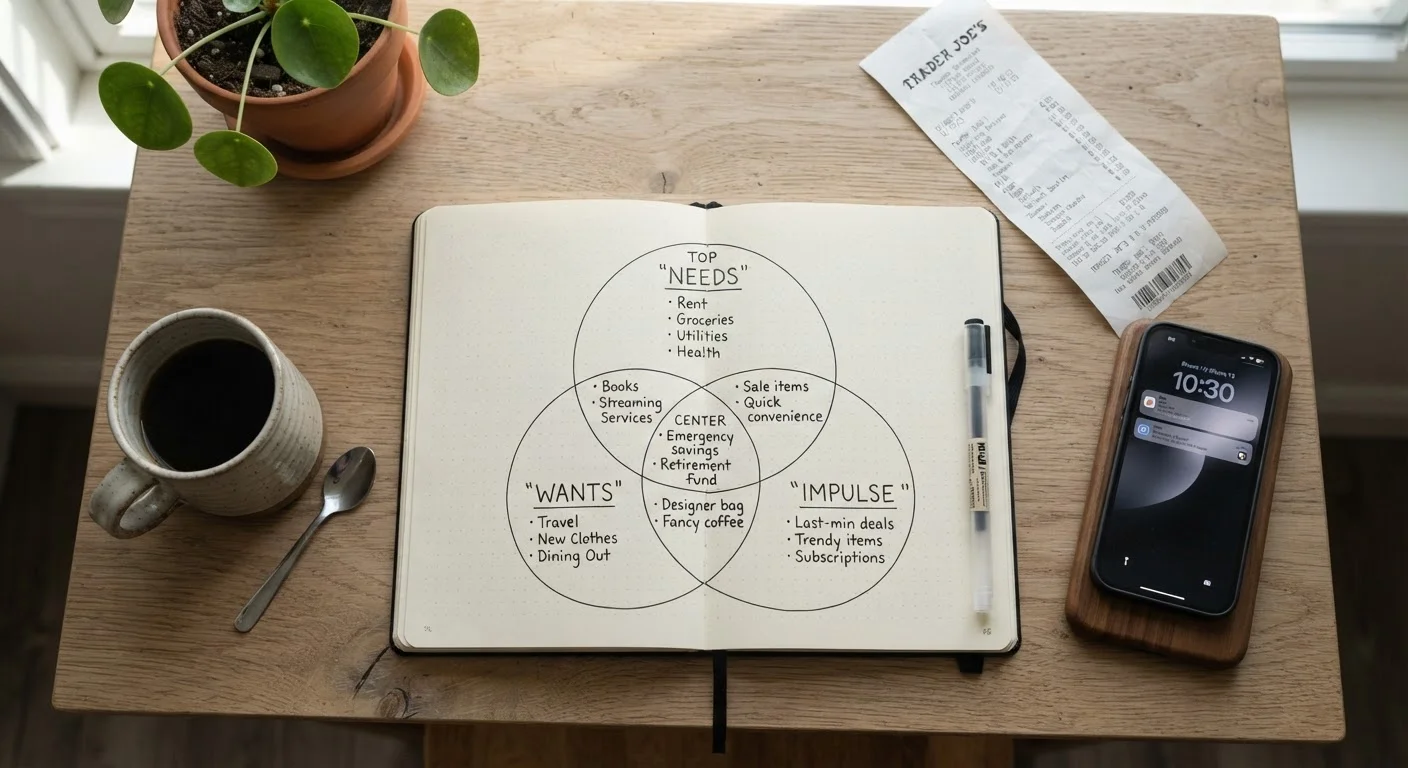
Needs are expenditures required for basic functioning, safety, or meeting firm obligations. Housing, utilities, groceries, necessary medications, and transportation to employment are standard examples. The clearest test: Would skipping this purchase cause genuine harm or prevent me from meeting a core responsibility? If yes, it's a need.
Wants are expenditures that improve quality of life, comfort, or enjoyment beyond baseline functioning. A streaming subscription, dining out, clothing beyond basic coverage, or an upgraded appliance when an existing one works - these are wants. They are legitimate and worth planning for. The key distinction is that their absence is an inconvenience, not a hardship.
Impulse purchases are unplanned expenditures triggered by situational cues - a sale sign, an algorithm-served ad, the mood of a particular moment - rather than by genuine preference or prior planning. What separates an impulse buy from a want isn't the item itself; it's the absence of prior intention and the presence of an emotional trigger at the point of purchase. Research in consumer behavior consistently finds that checkout-area placement, limited-time framing, and social proof cues increase unplanned spending independent of actual desire for the item.
Where Gray Areas Live - and How to Handle Them
The framework gets genuinely complicated in the middle. Consider a new pair of running shoes: for someone recovering from a foot injury on medical advice, they may qualify as a need. For a casual walker who already owns functional shoes, they're a want. For someone who spotted them on sale with no prior plan to buy, they may be an impulse dressed up as a need after the fact - a phenomenon sometimes called post-hoc rationalization.
A few practical rules keep gray areas manageable:
- Apply your own circumstances, not a universal list. There is no item that is inherently always a need or always a want. Context determines category.
- Watch for rationalization signals. If you find yourself building a case for why something you weren't thinking about an hour ago is actually essential, treat that as a yellow flag.
- Consistency matters more than perfection. Choosing a personal rule - say, anything unplanned over $30 waits 48 hours - and applying it uniformly produces better outcomes than trying to perfectly classify every edge case in real time.
The 48-Hour Rule for Unplanned Purchases
For any unplanned purchase above a threshold you set yourself - many people use $25 or $50 - commit to waiting 48 hours before completing it. If the desire is still genuine after that window, it is more likely a real want than a triggered impulse. This single habit, applied consistently, tends to eliminate a significant share of regretted purchases without requiring complex tracking.
Applying the Framework Before You Spend
The framework is most effective as a pre-purchase check, not a post-purchase audit. Before completing any non-routine purchase, run through three questions:
- Is this planned or unplanned? Unplanned items get automatic extra scrutiny.
- What category does this genuinely belong to? Apply the definitions honestly, not aspirationally.
- If it's a want or an impulse - does my budget have room, and does this reflect my actual priorities?
For larger purchases, a more structured pre-purchase review can help. The pre-purchase checklist pairs well with this framework, adding questions about alternatives, timing, and whether you're solving the right problem.
For everyday shopping, research suggests that entering a store or website with a defined list meaningfully reduces unplanned purchases. See what consumer behavior research reveals about list-based shopping for more on how that dynamic works in practice.
Connecting the Framework to a Broader Budget
The needs-wants-impulse model is a classification tool. A budget is an allocation plan. They serve different functions and work best together. The framework tells you what kind of purchase something is; a budget tells you how much room that category has in your monthly plan.
If you're looking for a starting point on allocation, the 50/30/20 rule uses the same three-category logic - needs, wants, and savings - as a percentage structure for monthly income. It translates the framework directly into numbers.
For a more detailed breakdown of where specific spending types typically land, spending categories every household budget should include provides a practical reference organized by area of life.
Used consistently, the needs-wants-impulse framework doesn't restrict spending - it makes spending more deliberate. Over time, deliberate spending tends to produce both better financial outcomes and fewer regretted purchases, which is a reasonable working definition of spending well.
This article is for general informational and educational purposes only and does not constitute personalized financial advice. For guidance specific to your situation, consult a qualified financial professional.