

Key Takeaways
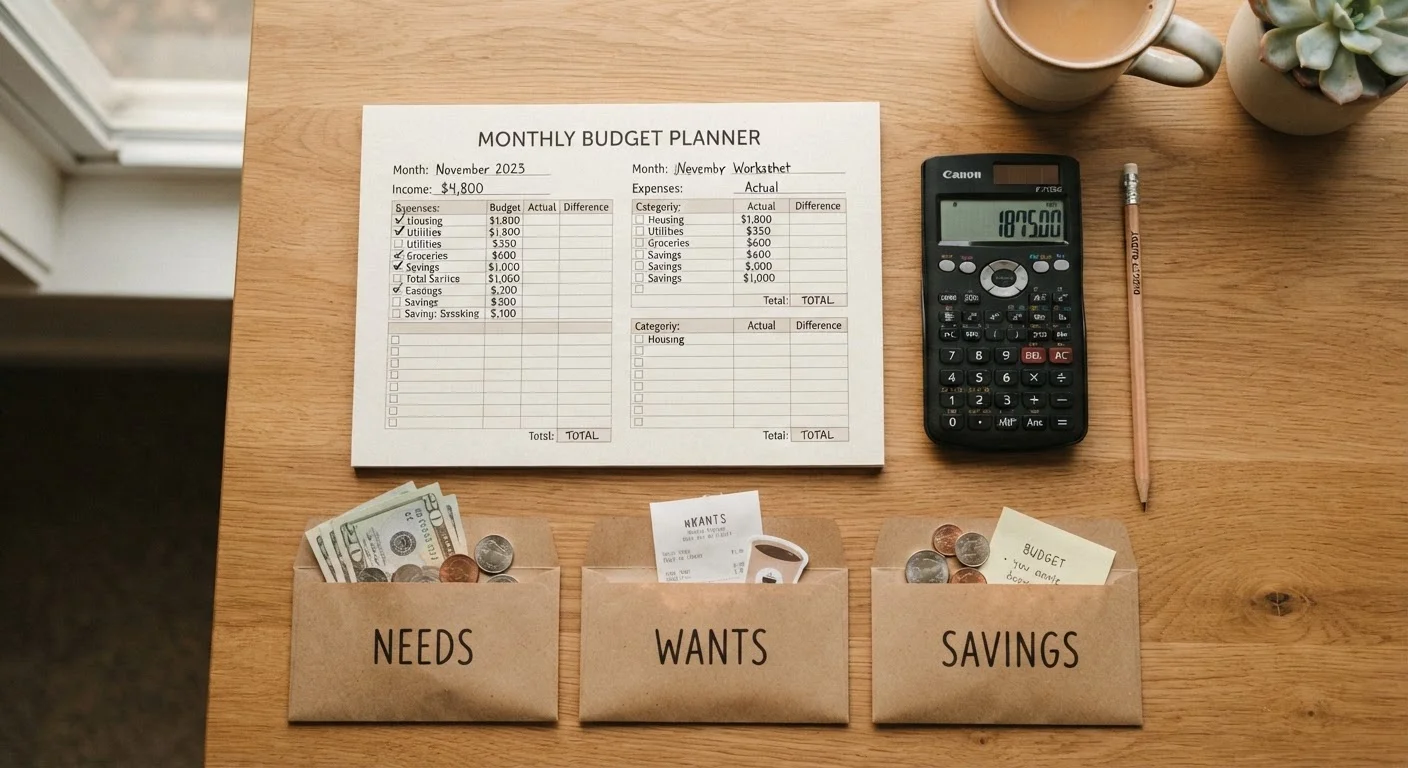
The 50/30/20 Rule
The 50/30/20 rule is a straightforward budgeting framework that divides your after-tax income into three categories: 50% toward needs, 30% toward wants, and 20% toward savings and debt repayment. It was popularized by bankruptcy expert and U.S. Senator Elizabeth Warren and her daughter Amelia Warren Tyagi in their book 'All Your Worth.' The goal is to give households a simple, percentage-based structure without requiring detailed line-item tracking.
The percentages apply to net income - your take-home pay after taxes, not your gross salary. Pre-tax contributions like 401(k) deferrals complicate the math slightly and may need to be factored in separately.
How the Three Categories Break Down
The framework's power comes from its simplicity. Once you know your monthly take-home pay, you apply three percentages to get your spending targets.
50% - Needs
This covers non-negotiable expenses: rent or mortgage payments, renter's or homeowner's insurance, utilities, groceries, basic clothing, health insurance premiums, and the minimum required payments on any debts. These are expenses where non-payment creates immediate hardship or legal consequence.
A practical test: if you could cancel it without serious consequence, it's probably a want, not a need. A gym membership? Want. Basic internet for remote work? Need.
30% - Wants
This bucket covers discretionary spending - the choices that improve quality of life but aren't survival essentials. Dining out, streaming subscriptions, hobbies, vacations, and entertainment all belong here. So do upgrades beyond the baseline - choosing a newer car than you strictly require, or a more expensive apartment than the minimum you could afford.
For a clearer mental model on sorting purchases, this framework for clearer spending decisions can help you draw the line more confidently.
20% - Savings and Debt Repayment
The final slice is where financial progress happens. This covers emergency fund contributions, retirement account deposits, and any debt payments above the required minimum. Prioritizing an emergency fund - typically three to six months of essential expenses - before aggressively investing is a common approach, though the right order depends on your specific situation. Consult a licensed financial professional for guidance tailored to your circumstances.
~33%
Share of income Americans spend on housing
According to U.S. Bureau of Labor Statistics Consumer Expenditure data, housing represents the largest single expense category for American households, often exceeding the 50/30/20 rule's implied allocation.
~57%
Americans living paycheck to paycheck
Multiple surveys conducted in recent years, including research by LendingClub and PYMNTS, have found that a majority of U.S. consumers report spending most or all of their monthly income on expenses.
< 3 months
Emergency savings held by many U.S. households
Federal Reserve survey data has consistently shown that a significant share of U.S. adults could not cover three months of expenses from savings, underscoring why the 20% savings target matters.
Putting Real Numbers to the Rule
To make the framework concrete, consider a household with $5,000 in monthly take-home pay. Under the 50/30/20 rule, the allocation would be:
- $2,500 for needs (rent, utilities, groceries, insurance, minimum debt payments)
- $1,500 for wants (dining, entertainment, subscriptions, travel)
- $1,000 for savings and extra debt repayment
Those numbers feel manageable on paper, but real households face real friction. In cities where median rent consumes well over half of typical take-home pay, the 50% ceiling becomes aspirational rather than achievable without significant tradeoffs in other categories.
The framework works best when you start by auditing your current spending, then compare it against the 50/30/20 targets. A monthly budget setup checklist can guide you through that initial inventory systematically.
Start by Auditing One Month of Spending
Before applying any percentages, pull three months of bank and credit card statements and categorize each transaction as a need, want, or savings contribution. Most people find their actual spending ratios differ significantly from what they estimate. That honest baseline is what makes the 50/30/20 targets meaningful rather than arbitrary.
Where the Rule Works - and Where It Strains
The 50/30/20 rule is a starting point, not a universal prescription. It tends to work well for middle-income earners with stable, predictable paychecks and moderate housing costs. The simplicity removes the friction that causes more detailed budgeting systems to collapse after a few weeks.
Where it strains:
- High cost-of-living areas: Housing alone can consume 40-50% of take-home pay in cities like New York, San Francisco, or Boston, leaving almost no room for other needs before the ceiling is hit.
- Lower incomes: When baseline survival costs represent most of your income, a 30% wants allocation is unrealistic and a 20% savings target may be temporarily out of reach.
- Irregular income: Freelancers, contractors, and gig workers face month-to-month income swings that make fixed-percentage targets harder to track consistently.
- Heavy debt loads: Households carrying significant high-interest debt may need to redirect more than 20% toward repayment to make meaningful progress.
For a fuller picture of where this framework excels and where it falls short, this detailed look at the 50/30/20 rule's limitations is worth reading before you commit to it.
Irregular or Variable Income Requires a Baseline Approach
If your income varies month to month, apply the 50/30/20 percentages to a conservative estimate of your typical monthly income - not your best month or your projected annual average. This prevents overspending during high-income periods and ensures your needs are covered when income dips. Building a small income buffer in a separate account can smooth out the gaps.
Making the Framework Work for Your Household
The most useful adjustment is treating the percentages as targets to move toward, not rules to follow perfectly from day one. If your needs currently consume 60% of take-home pay, the goal becomes identifying one or two levers - a housing change, a refinance, a transportation cost reduction - to work that number down over time.
Building in a monthly review strengthens the system. Tracking whether you stayed within each bucket, and why you didn't when you strayed, creates the feedback loop that makes budgeting stick. A monthly budget audit checklist can make that review process faster and more consistent.
Finally, consider categorizing your spending for a full month before applying the rule. Many households discover that what they thought were needs are actually wants in disguise - and that awareness alone can shift behavior without requiring a rigid overhaul. For a structured view of how to organize all your household spending categories, this reference breakdown of budget categories provides practical allocation context.
This article is for general informational and educational purposes only and does not constitute personalized financial advice. Consult a licensed financial professional for guidance specific to your situation.