

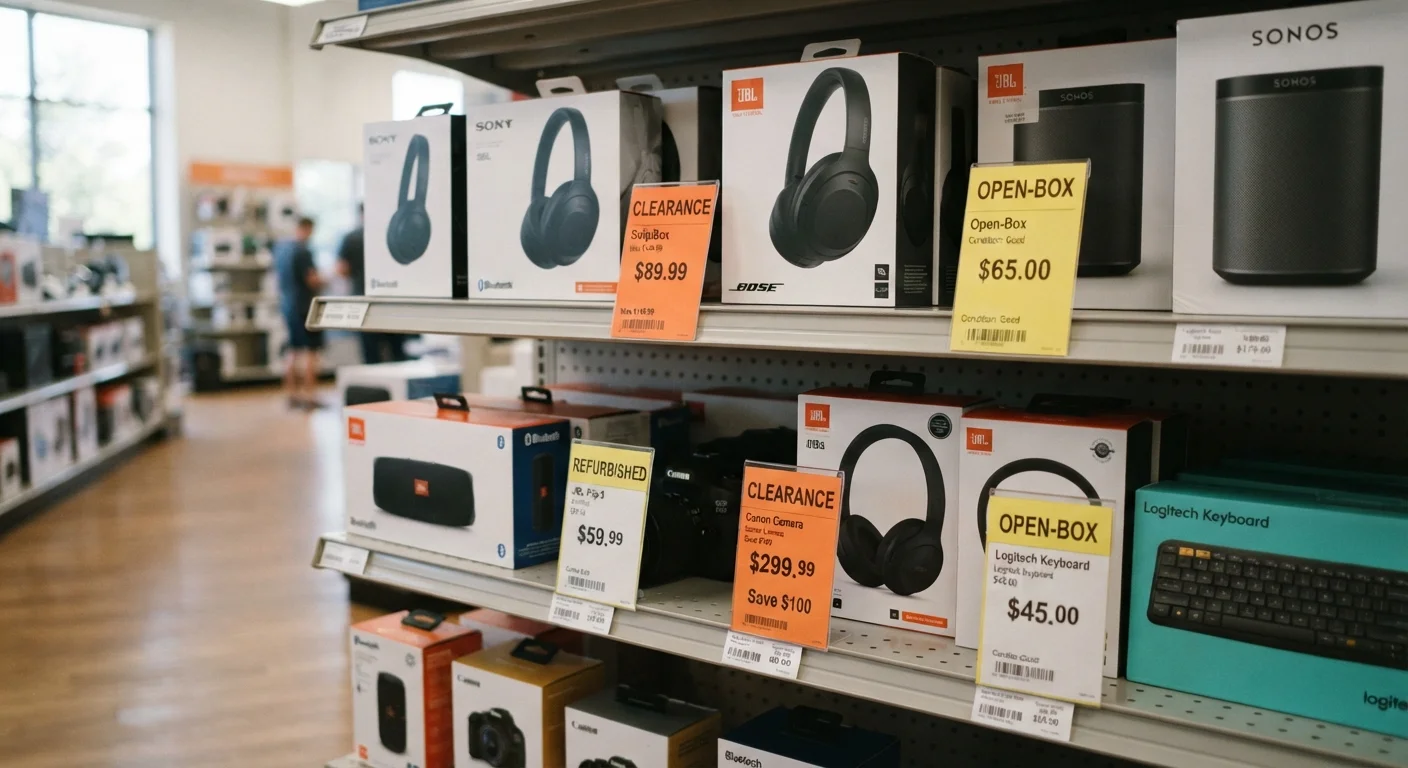
| Clearance item condition | New (factory-sealed in most cases) |
| Open-box item condition | Previously opened; cosmetic or accessory variations possible |
| Refurbished item condition | Repaired and tested; quality depends on who performed refurbishment |
| Manufacturer warranty on clearance | Typically applies in full |
| Manufacturer warranty on open-box | May be voided or partially remaining - verify with seller |
| Manufacturer warranty on certified refurbished | Usually included; length varies by manufacturer |
| Return policy risk | Higher for open-box and refurbished; clearance often final sale |
Why These Labels Aren't Interchangeable
Walk through any major retailer - physical or online - and you'll encounter merchandise tagged with terms like clearance, open-box, or refurbished. Many shoppers treat these as rough synonyms for "discounted," but each label describes a fundamentally different product condition, seller relationship, and risk profile. Conflating them leads to mismatched expectations and, sometimes, unwelcome surprises after the purchase.
This guide cuts through the marketing ambiguity and explains what each designation actually means in practice, what protections you can reasonably expect, and what to verify before committing to a purchase. For broader context on how channel choice shapes your experience, see our look at the real trade-offs between shopping online and in a store.
Clearance
New, typically factory-sealed merchandise marked down by a retailer to clear inventory. The discount reflects the seller's stock situation, not any flaw in the product itself.
Open-Box
Merchandise that has been opened - through a customer return or display use - and resold. Condition, included accessories, and warranty coverage vary by seller and item.
Refurbished
A product that has been returned, repaired or restored to a functional state, tested, and resold. Quality depends heavily on whether refurbishment was performed by the manufacturer, an authorized partner, or a third party.
Certified Refurbished
A refurbished item that has been serviced and certified by the original manufacturer or an authorized service provider, often accompanied by a manufacturer-backed warranty.
Condition Grade
A tiered label (e.g., Excellent, Good, Fair) some sellers use to systematically describe the cosmetic and functional state of a secondary market item. Definitions are not standardized across retailers.
Final Sale
A purchase designation indicating the item cannot be returned or exchanged. Commonly applied to clearance and open-box merchandise - always verify before buying.
Clearance: New Merchandise, Reduced Price
Clearance items are almost always new, factory-sealed goods that a retailer needs to move - typically because a model is being discontinued, a season is ending, or shelf space must be freed for incoming inventory. The product itself has not been used, returned, or serviced. The markdown reflects the retailer's inventory situation, not any defect in the item.
Key considerations for clearance purchases:
- Manufacturer's warranty usually applies in full, since the product is new.
- Return eligibility can be restricted - some clearance items are sold as final sale. Verify before purchasing. Our guide on what return policy fine print actually means explains what to look for.
- Discontinued models may have limited future accessory or parts availability - worth weighing for electronics and appliances.
To understand how retailers structure markdowns over time, see how retailers mark down clearance inventory.
| Clearance item condition | New (factory-sealed in most cases) |
| Open-box item condition | Previously opened; cosmetic or accessory variations possible |
| Refurbished item condition | Repaired and tested; quality depends on who performed refurbishment |
| Manufacturer warranty on clearance | Typically applies in full |
| Manufacturer warranty on open-box | May be voided or partially remaining - verify with seller |
| Manufacturer warranty on certified refurbished | Usually included; length varies by manufacturer |
| Return policy risk | Higher for open-box and refurbished; clearance often final sale |
Open-Box: Returned or Displayed, Condition Varies
Open-box merchandise has been opened - either by a customer who returned it or by a retailer for use as a display or demo unit. The item may be functionally identical to new, or it may show cosmetic wear, have missing accessories, or carry a voided original warranty depending on the specific seller's policies.
Condition grading varies widely. Some retailers use a structured tiering system (e.g., "Excellent," "Good," "Fair") with documented definitions; others use vague language. Always look for:
- A written description of exactly what has been inspected and what is included.
- Whether the original manufacturer's warranty is still valid or has been replaced with a retailer warranty.
- The seller's return window for open-box specifically - it often differs from the standard policy. Our article on return policies across retail channels covers this in depth.
Open-box carries more variability than clearance but generally less scrutiny than refurbished - it's the category where asking questions before purchase matters most.
Refurbished: Repaired, Tested, and Certified - to Varying Standards
Refurbished products have been returned, repaired to a functional standard, and resold. The critical distinction is who performed the refurbishment. This shapes quality meaningfully.
- Manufacturer-refurbished (or "certified refurbished"): Serviced by the original manufacturer or an authorized partner. Typically includes a manufacturer warranty, often replaced components, and documented testing. Generally the most reliable refurbished tier.
- Seller-refurbished: Refurbished by the retailer or a third party. Standards vary enormously. Look for documented testing protocols, included warranty terms, and a clear return window.
- "Refurbished" with no further detail: Treat with caution. Request specifics on what was inspected, replaced, and guaranteed before buying.
Refurbished items often carry meaningful price reductions compared to new, but that reduction should be weighed against the warranty length and coverage you're receiving. For a broader vocabulary of retail and resale terminology, the shopping channel glossary is a useful reference.
"Renewed" and "Reconditioned" Mean Refurbished
Some retailers and marketplaces use proprietary terms like "renewed," "reconditioned," or "pre-owned certified" to describe what is functionally refurbished merchandise. These labels are marketing choices, not distinct product categories. Apply the same scrutiny: ask who performed the work, what was tested, and what warranty is included - regardless of the exact word used.
Questions to Ask Before Any Secondary Market Purchase
Regardless of the label, a short checklist of questions protects you across all three categories:
- What is the exact condition - and is that definition written down, not just implied?
- What warranty applies - manufacturer, retailer, or none? What does it cover and for how long?
- What is the return policy for this specific item type, and who pays return shipping?
- What accessories and documentation are included? Missing power cables, manuals, or licenses can affect usability and resale value.
- Who is the seller? A marketplace listing from a third-party vendor carries different accountability than a purchase directly from a major retailer.
Secondary market buying can represent genuine value - but that value depends almost entirely on how clearly the seller defines what they're selling. Ambiguous listings deserve skeptical scrutiny, not the benefit of the doubt.
For ongoing deal-timing strategies across product categories, the Deals & Timing hub provides additional context on when and how to find reduced pricing.