

Key Takeaways
No commute - train whenever fits your schedule
Removing travel time from the equation is one of the most consistent predictors of exercise adherence. A 10-minute morning session at home beats a 0-minute gym visit that never happens.
Lower ongoing cost than most memberships
A modest investment in a few versatile pieces of equipment - resistance bands, a mat, adjustable dumbbells - can cover years of training without monthly fees.
Private environment reduces self-consciousness
Gym anxiety is a documented barrier for many adults, particularly beginners. Training alone at home eliminates that friction entirely, making it easier to focus and experiment.
Full control over environment and schedule
You choose the music, the temperature, the rest intervals, and whether the session runs 15 minutes or an hour - without waiting for equipment or navigating peak hours.
Easier to build a consistent daily habit
Reducing the steps between intention and action - no packing a bag, no driving, no parking - makes it significantly easier to maintain frequency over the long term.
Limited equipment restricts some training modalities
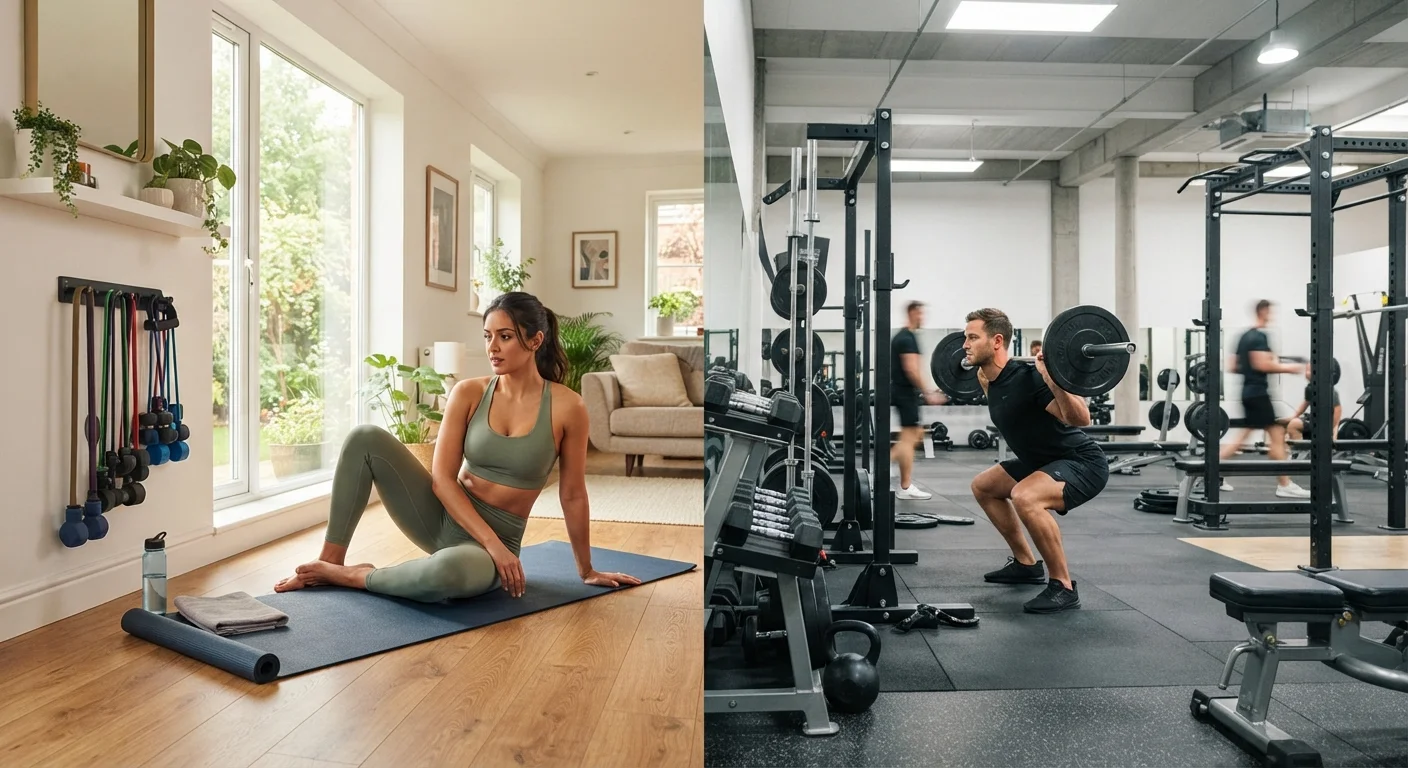
Heavy compound lifts - barbell squats, deadlifts, bench press - are difficult or unsafe to replicate at home without significant investment. This can cap progress for strength-focused goals.
Distractions and low accountability at home
Household responsibilities, family members, and digital distractions compete directly with a home workout in ways they don't in a dedicated gym environment.
No built-in community or social support
The motivational lift of training alongside others, taking a group class, or having a regular workout partner is genuinely harder to replicate at home.
Risk of poor form without expert oversight
Without access to a trainer or knowledgeable peer, technique errors can go uncorrected for long periods - increasing injury risk, especially for beginners learning new movement patterns.
Space limitations affect exercise variety
Not every home has room for a full warm-up, lateral movements, or dedicated recovery work. Limited floor space can make well-rounded programming harder to execute.
Our Verdict
Home workouts win on convenience, cost, and privacy - making them the more sustainable default for many people. Gyms offer equipment variety, structure, and community that can meaningfully accelerate progress, particularly for strength-focused or competitive goals. Neither environment automatically produces better fitness; consistency and progressive effort matter far more than the venue.
Home training suits busy adults who prioritize convenience and low cost, while gym training is a stronger fit for those who thrive on structured environments, need specialized equipment, or benefit from professional coaching.
Why the Setting Actually Matters
The debate between home workouts and gym training is often framed as a simple cost comparison, but the real variables run deeper. Environment shapes motivation, exercise selection, accountability, and long-term adherence - all of which determine whether a fitness routine lasts weeks or years.
This isn't a verdict on which setting is objectively better. Instead, it's a clear-eyed look at what each genuinely offers and where each falls short, so you can match the environment to your own life rather than someone else's routine. For a broader look at how everyday movement fits into the picture, see movement beyond the gym.
The Case for Home Workouts
Training at home removes several of the most common obstacles people cite when exercise falls off their schedule - time, cost, and self-consciousness.
No commute - train whenever fits your schedule
Removing travel time from the equation is one of the most consistent predictors of exercise adherence. A 10-minute morning session at home beats a 0-minute gym visit that never happens.
Lower ongoing cost than most memberships
A modest investment in a few versatile pieces of equipment - resistance bands, a mat, adjustable dumbbells - can cover years of training without monthly fees.
Private environment reduces self-consciousness
Gym anxiety is a documented barrier for many adults, particularly beginners. Training alone at home eliminates that friction entirely, making it easier to focus and experiment.
Full control over environment and schedule
You choose the music, the temperature, the rest intervals, and whether the session runs 15 minutes or an hour - without waiting for equipment or navigating peak hours.
Easier to build a consistent daily habit
Reducing the steps between intention and action - no packing a bag, no driving, no parking - makes it significantly easier to maintain frequency over the long term.
Effective home training doesn't require a full equipment setup. Bodyweight movements, resistance bands, and a single set of adjustable dumbbells cover a wide range of strength and cardio goals. See how building muscle at home is more achievable than many people assume, and how free weights and resistance bands compare for different training needs.
The Limitations of Training at Home
Home workouts are not without genuine trade-offs, and being honest about them helps set realistic expectations.
Limited equipment restricts some training modalities
Heavy compound lifts - barbell squats, deadlifts, bench press - are difficult or unsafe to replicate at home without significant investment. This can cap progress for strength-focused goals.
Distractions and low accountability at home
Household responsibilities, family members, and digital distractions compete directly with a home workout in ways they don't in a dedicated gym environment.
No built-in community or social support
The motivational lift of training alongside others, taking a group class, or having a regular workout partner is genuinely harder to replicate at home.
Risk of poor form without expert oversight
Without access to a trainer or knowledgeable peer, technique errors can go uncorrected for long periods - increasing injury risk, especially for beginners learning new movement patterns.
Space limitations affect exercise variety
Not every home has room for a full warm-up, lateral movements, or dedicated recovery work. Limited floor space can make well-rounded programming harder to execute.
Goals Change - So Should Your Setup
If your goals shift over time - say, from general fitness toward competitive lifting or sport-specific training - a gym's equipment and coaching resources may become more relevant. It's worth reassessing your environment every few months alongside your goals. What worked at the start of a fitness journey may not serve you at an intermediate or advanced stage.
If your goals shift over time - say, from general fitness toward competitive lifting or sport-specific training - a gym's equipment and coaching resources may become more relevant. It's worth reassessing your environment every few months alongside your goals.
What the Gym Does Better
A well-equipped gym provides resources that are genuinely difficult to replicate in most home settings. For people chasing specific strength, performance, or physique goals, this distinction is meaningful.
The social dimension also matters more than it might seem. Research consistently links social support and accountability to exercise adherence. Group fitness classes, training partners, and even ambient motivation from others working hard can push effort levels in ways a solo home session rarely does.
~70%
Adults citing convenience as a key exercise barrier
According to the CDC's physical activity data, time and access are consistently ranked among the top self-reported barriers to regular exercise among U.S. adults.
23%
U.S. adults meeting both aerobic and strength guidelines
CDC National Center for Health Statistics data indicates fewer than one in four American adults meet the combined federal guidelines for aerobic and muscle-strengthening activity.
Gyms also typically provide access to certified personal trainers - a resource worth considering if you're new to structured training, recovering from an injury, or trying to break through a plateau. Always verify that any trainer you work with holds a recognized certification and, if you have health concerns, get clearance from your doctor first.
Finding Your Balance
Many people land on a hybrid approach: maintaining a consistent home routine for most sessions while using a gym selectively for heavier lifts, group classes, or accountability check-ins. This combines the convenience of home training with the equipment access and community a gym provides.
When weighing costs, remember that gym memberships represent an ongoing expense. Thinking through that commitment honestly is similar to evaluating any recurring budget item - our article on the trade-offs of strict budgeting offers a useful framework for thinking about fixed costs versus flexibility.
Whatever setting you choose, the fundamentals remain the same: progressive overload, adequate recovery, and a routine built around exercises you'll actually do. For structuring your week across training styles, designing a balanced fitness week is a practical next step. And don't overlook the basics - warming up and cooling down matter regardless of where you train.
This article is for general informational purposes only and is not a substitute for professional medical or fitness advice. If you have any health conditions or concerns, consult a qualified healthcare provider before beginning a new exercise program.