

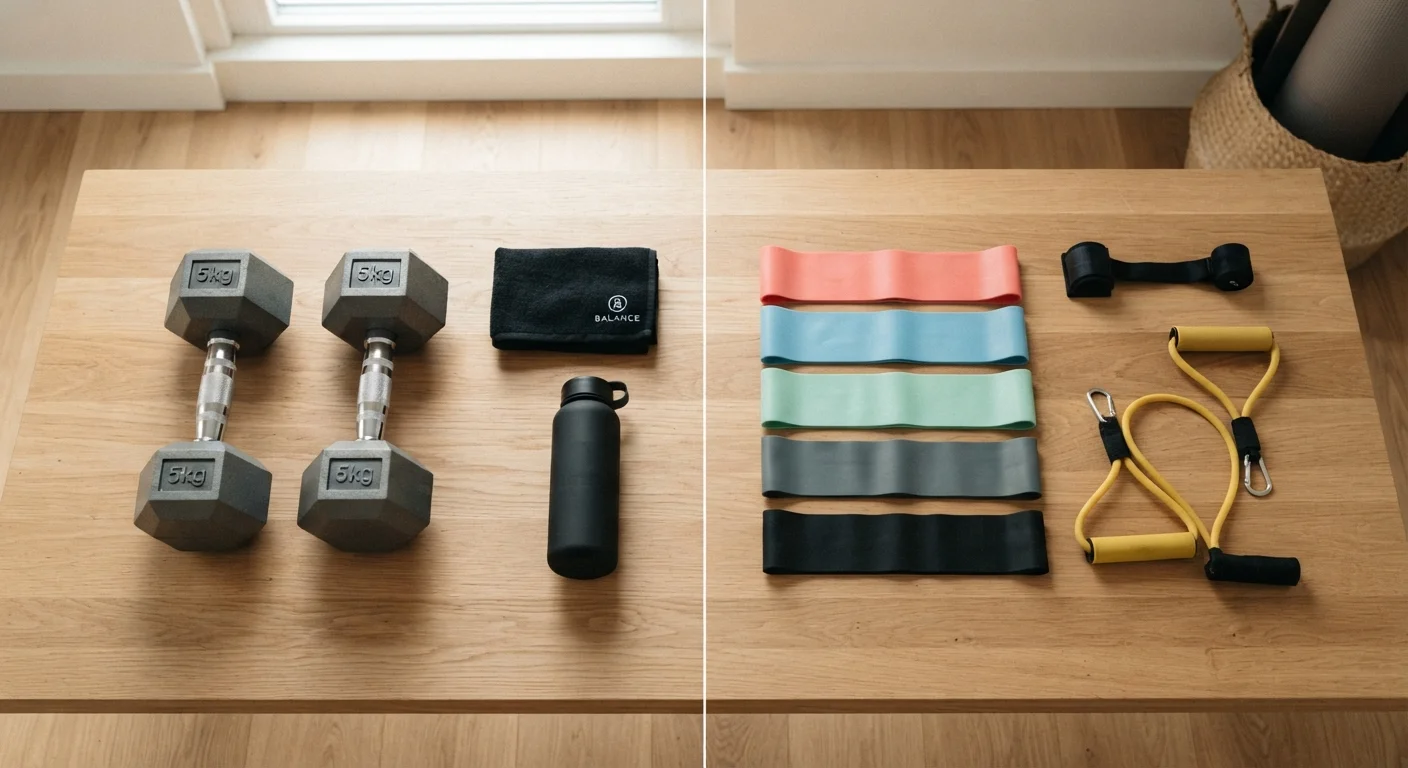
Key Takeaways
Option A
Free Weights
The time-tested standard for progressive strength training.
Best for: Lifters seeking measurable, incremental load increases and well-established muscle-building protocols.
Option B
Resistance Bands
The portable, joint-friendly alternative for versatile training anywhere.
Best for: People prioritizing convenience, joint comfort, or functional rehab-style movement patterns.
If you want the most precise, measurable strength progression
Free Weights
Fixed loads let you track and increase resistance in exact increments, which directly supports progressive overload - the core driver of strength gains.
If you train at home with limited space and budget
Resistance Bands
A full set of bands costs a fraction of comparable dumbbells and can be stored in a drawer, making consistent home training far more realistic.
If you're returning from injury or have joint sensitivities
Resistance Bands
Bands apply less compressive force on joints and provide accommodating resistance that reduces strain at vulnerable ranges of motion.
If you're building a long-term lifting practice with gym access
Free Weights
The wide range of available loads and well-researched exercise library make free weights the more scalable foundation for advanced training.
If you travel frequently and need consistent workouts on the road
Resistance Bands
Bands pack flat into any bag and replicate most major movement patterns, keeping your training on track regardless of location.
How Each Tool Creates Resistance
Understanding how free weights and resistance bands generate force helps you use each one more effectively - and choose the right one for a given exercise.
Free weights (dumbbells, barbells, kettlebells) rely on gravity. The resistance you feel is constant throughout the movement: a 25-pound dumbbell weighs 25 pounds at every point in the lift. This makes load quantification straightforward, which is a real advantage when following the principle of progressive overload - systematically increasing demand on your muscles over time.
Resistance bands work differently. Tension increases as the band stretches, meaning the movement gets harder toward the end of the range of motion. This is called accommodating resistance, and it changes the stimulus your muscles receive compared to lifting fixed loads. For some exercises - like rows, pull-aparts, or glute work - this variable tension is actually a benefit, loading muscles at the positions where they are strongest.
| Criterion | Free Weights | Resistance Bands |
|---|---|---|
| Resistance type | Constant (gravity-based) | Variable (increases with stretch) |
| Load precision | Exact, fixed increments | Approximate; varies by band and stretch |
| Portability | Heavy, bulky | Lightweight, fits in a bag |
| Typical cost | Higher (scales with weight range) | Lower (full set under $60) |
| Joint impact | Moderate compressive load | Lower compressive load |
| Progressive overload ease | Straightforward to track | Requires more estimation |
| Exercise variety | Very broad | Broad, with some limitations |
| Space required | Dedicated storage area | Minimal - drawer or small bag |
Portability, Cost, and Space
For many Americans training at home, practical factors matter as much as performance. Here, resistance bands hold a clear advantage.
A quality set of resistance bands typically costs between $20 and $60 and fits in a small bag or drawer. A comparable range of dumbbells - enough to cover light, moderate, and heavier loads - can cost several hundred dollars and requires dedicated floor space. If budget or square footage is a limiting factor, bands significantly lower the barrier to getting started.
Free weights, however, are highly durable and require no replacement if you purchase quality pieces. Bands can degrade over time, especially with heavy use or UV exposure, and should be inspected regularly for cracks or fraying before use.
For a fuller picture of how equipment choices fit into home training, see our guide on building muscle at home without a gym.
~$20-$60
Typical cost of a full resistance band set
General retail pricing for multi-resistance band sets; free weights of equivalent range typically cost several times more.
2 lbs
Average weight of a full resistance band kit
Most complete band sets weigh under 2 pounds total, making them practical for travel and small-space living.
~60%
U.S. adults not meeting strength training guidelines
According to CDC physical activity data, the majority of American adults do not meet recommended muscle-strengthening activity levels.
Joint Comfort and Accessibility
One of the most cited advantages of resistance bands - particularly among beginners, older adults, and people managing joint discomfort - is reduced compressive load. Because bands don't rely on gravity pulling a fixed weight straight down, exercises like rows, presses, or squats can feel less taxing on the knees, shoulders, and wrists.
This doesn't mean free weights are unsafe for most people - they aren't, when used with proper technique and appropriate loads. But for those starting fitness after 40 or easing back from an injury, bands can serve as a more forgiving entry point. Always consult a qualified healthcare or fitness professional before starting a new exercise program, especially if you have existing joint or musculoskeletal concerns.
Free weights also require greater coordination and stability, since you must control the weight in three-dimensional space. This recruits stabilizing muscles - which is a benefit - but also means form breakdown under fatigue carries a higher injury risk than with bands anchored to a fixed point.
Which Tool Fits Your Training Goals?
Neither tool is universally superior - the best choice depends on what you're trying to accomplish and your current circumstances.
Prioritize free weights if:
- Your goal is maximum strength or hypertrophy (muscle growth) and you want to systematically increase load.
- You have gym access and are comfortable with foundational lifting technique.
- You want a wide exercise variety and the ability to load movements heavily as you progress.
Prioritize resistance bands if:
- You're training at home with limited space or a tight budget.
- You need a joint-friendly option or are in a rehab or return-to-exercise phase.
- You travel frequently and need a portable solution that sustains your routine.
Many experienced exercisers use both. Bands are commonly added to barbell exercises (like squats or deadlifts) to change the resistance curve, and they're widely used for warm-ups, mobility work, and accessory exercises. See how both tools can fit into a structured week in our overview of designing a balanced fitness week.
Using Both Tools Together
Free weights and resistance bands aren't mutually exclusive. Many fitness routines incorporate bands for warm-up and mobility work, then transition to free weights for primary strength exercises. Combining both can address a wider range of training goals and add variety that helps sustain long-term adherence. If you're curious how this fits into a broader home setup, our article on home workouts vs. gym training explores the trade-offs in more depth.
This article is for general informational purposes only and does not constitute medical or fitness advice. Consult a qualified healthcare provider or certified fitness professional before beginning any new exercise program, particularly if you have existing health conditions or injuries.