

Key Takeaways
Why Home Strength Training Actually Works
A common belief is that building real muscle requires barbells, cable machines, and a paid membership. Research on resistance training tells a different story. Muscles respond to mechanical tension and metabolic stress - and bodyweight exercises deliver both. Whether you're pressing your chest off the floor or slowing down a squat, you're giving your muscles a stimulus they can adapt to.
If you've encountered the idea that home workouts are only for beginners, our article on common fitness myths breaks down why that assumption holds a lot of people back unnecessarily.
The real variables that drive muscle development are consistent effort, progressive challenge, adequate nutrition, and recovery - none of which require a gym. That said, home training does have trade-offs worth understanding. For a balanced view of what each environment offers, see our look at home workouts vs. gym training.
Start Simple, Stay Consistent
The most effective home workout is one you'll actually do repeatedly. Two solid sessions per week, sustained over months, will produce far better results than an ambitious plan abandoned after two weeks. Choose movements you can perform safely today and build from there.
What You Need Before You Start
The barrier to entry for home strength training is genuinely low. Before jumping into the steps below, gather a few basics and set realistic expectations.
What you will need
One decision worth making early is whether to supplement bodyweight work with any resistance tools. Both free weights and resistance bands can accelerate progress - if you're weighing those options, our comparison of free weights vs. resistance bands walks through how each fits different training goals.
Yoga or exercise mat
Provides cushioning and grip for floor-based exercises like planks and lunges.
Resistance bands (light, medium, heavy)
Add variable resistance to bodyweight movements, helping bridge the gap to heavier loading.
A sturdy chair or low table
Used as support for incline push-ups, tricep dips, and step-up exercises.
A simple workout log (notebook or app)
Tracks sets, reps, and progressions so you can apply overload systematically.
Your Step-by-Step Home Strength Routine
The steps below outline how to build and sustain a home strength training practice. Follow them in order when you're starting out; revisit earlier steps any time you hit a plateau or need to reset.
Master the four foundational movement patterns
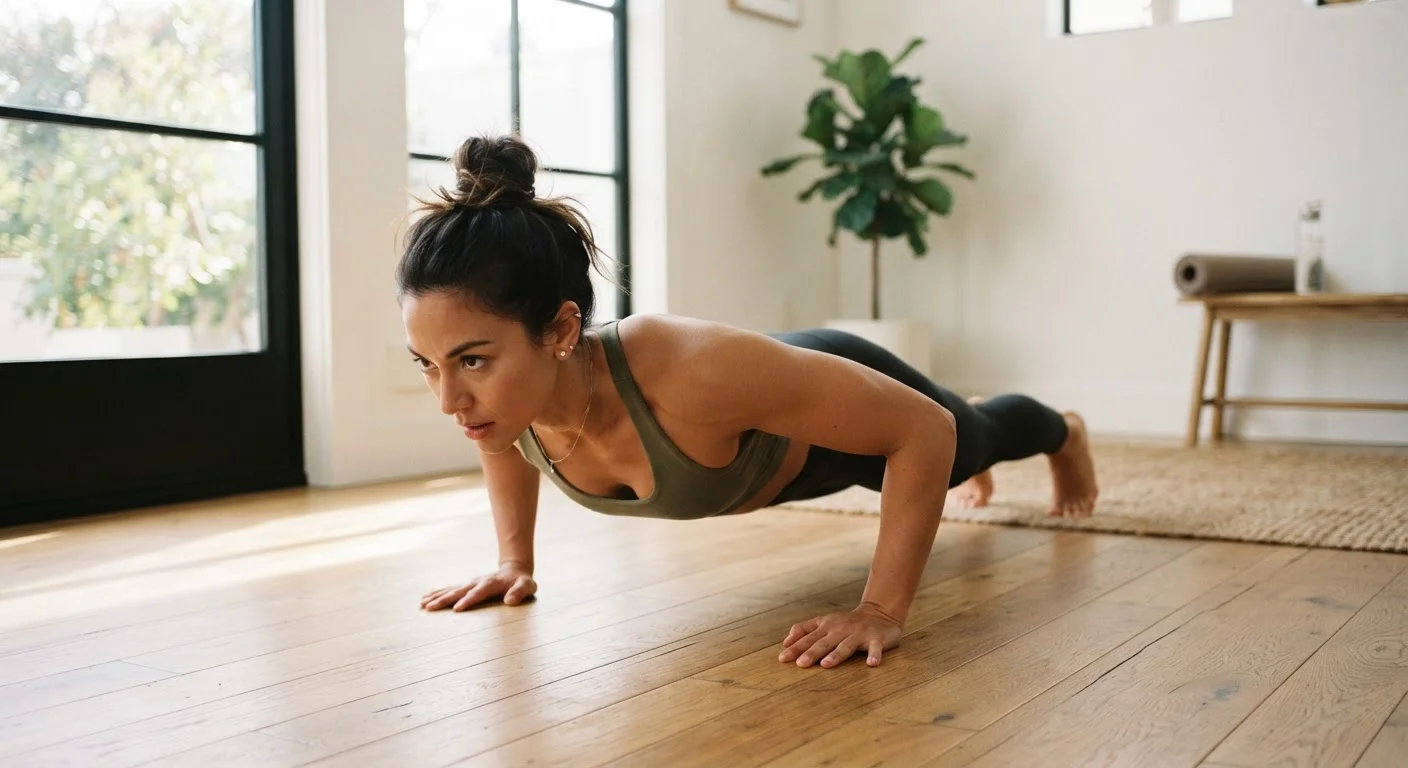
Before adding volume or complexity, build competence in four patterns that underpin most strength work: push (push-up), pull (inverted row under a table or resistance band row), hinge (hip hinge or single-leg deadlift), and squat (bodyweight squat). Spend your first one to two weeks performing two sets of each movement, stopping well short of muscle failure. Focus entirely on controlled motion and full range of movement.
Build your baseline session structure
Once you're comfortable with the patterns, structure each session around them. A simple and effective format is: 5-minute dynamic warm-up (arm circles, leg swings, bodyweight squats), followed by 3 sets each of a push, pull, hinge, and squat variation. End with 5 minutes of light stretching. This takes roughly 30-40 minutes and targets all major muscle groups. Rest 60 to 90 seconds between sets.
Apply progressive overload consistently
Progressive overload - gradually increasing the challenge over time - is the primary driver of strength and muscle development. At home, you can progress in several ways: add more reps, reduce rest time, slow down the lowering phase of each movement (3-4 seconds down), advance to a harder variation (e.g., incline push-up → standard push-up → decline push-up → archer push-up), or introduce resistance bands. Increase difficulty only when you can complete all sets with good form.
Prioritize recovery between sessions
Muscle tissue repairs and grows during rest, not during the workout itself. Schedule at least 48 hours between sessions that train the same muscle groups. Prioritize 7-9 hours of sleep, and ensure your daily eating pattern supports your activity level - adequate protein is especially important for muscle repair. Hydration also plays a role in how well your muscles function and recover.
Reassess and adjust every four weeks
Every four weeks, review your workout log. Ask: Are the same exercises still challenging? Are you completing all sets comfortably? If yes, it's time to progress - either by advancing the movement variation or adding a resistance band. If you've stalled or motivation has dropped, consider changing the order of exercises or swapping one variation for a similar one to restore novelty. Sustainable routines evolve; they aren't static.
Special Populations: Consult First
If you are pregnant, postpartum, over 65, managing a chronic condition such as osteoporosis or cardiovascular disease, or recovering from any injury, please consult a qualified healthcare provider before following this or any exercise program. General guidance cannot account for individual health circumstances, and your safety depends on professional input tailored to your situation.
Turning Sessions Into a Sustainable Habit
Individual workouts matter far less than the pattern of workouts over weeks and months. Scheduling your sessions in advance - even penciling them into a calendar - significantly improves follow-through. Aim for two to four sessions per week, with at least one rest or active recovery day between strength sessions targeting the same muscle groups.
Tracking your reps, sets, and any progressions in a simple notebook or app helps you see when it's time to increase difficulty. It also makes plateaus visible early, so you can adjust rather than stall. For help structuring this over a full week, our guide to building a weekly movement plan offers a practical framework you can adapt to your schedule.
Strength training complements, rather than replaces, everyday movement. Activities like stair climbing, walking, and active errands all contribute to your overall fitness - as explored in our piece on everyday activities that count as exercise.
This article is for general informational and educational purposes only and is not a substitute for professional medical advice. Consult a qualified healthcare provider before beginning any new exercise program, particularly if you have a health condition, injury, or have been inactive for an extended period.