

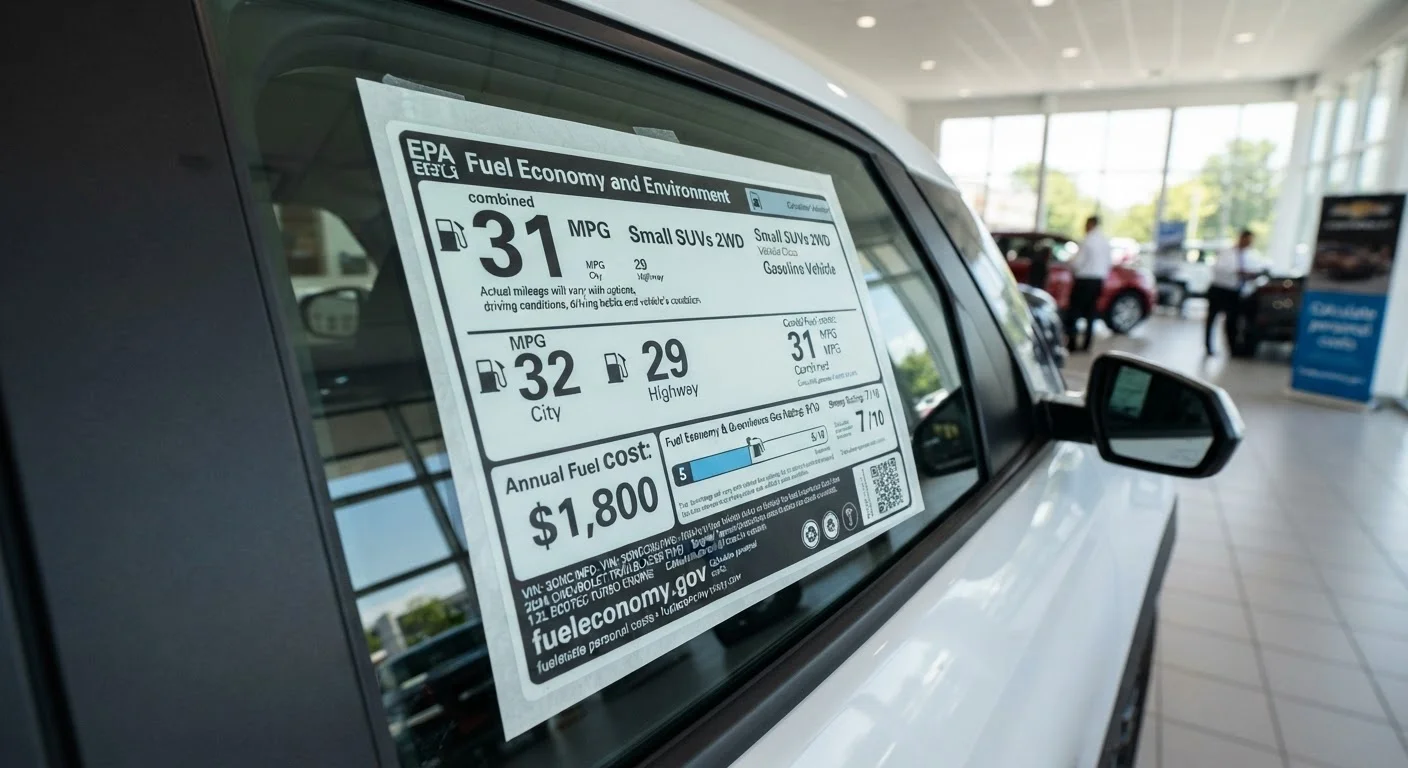
What the EPA Fuel Economy Label Actually Shows
Every new vehicle sold in the United States is required to display an EPA fuel economy label - commonly called the Monroney sticker - on its window. Understanding what this label communicates is the first step toward making a more informed purchase and managing your ongoing fuel costs. If you're new to thinking about gas mileage, this reference will give you the framework you need.
The label is divided into several key sections:
- City MPG: Estimated miles per gallon under stop-and-go urban driving conditions, simulated using standardized EPA test cycles.
- Highway MPG: Estimated MPG at sustained higher speeds with minimal braking - typically more favorable than city figures.
- Combined MPG: A weighted average calculated as 55% city driving and 45% highway driving. This is the headline figure most shoppers compare.
- Annual fuel cost estimate: A projection based on a fixed number of miles per year (typically 15,000) and an assumed national average fuel price - useful for rough comparisons, not precise budgeting.
- You Save / You Spend comparison: A 5-year cost comparison against the average new vehicle, based on the same standardized assumptions.
It's worth noting that real-world results routinely differ from label estimates. The EPA tests are conducted under controlled conditions that don't replicate every driver's habits, local terrain, or weather. For a deeper look at the gap, see why your gas mileage rarely matches the sticker.
MPGe and EV Labels: Reading the Alternative Fuel Ratings
Plug-in hybrid and all-electric vehicles use a different metric on their labels: MPGe, or miles per gallon equivalent. The EPA uses MPGe to place electric energy consumption on a common scale with gasoline, allowing apples-to-apples comparisons across powertrains.
MPG (Miles Per Gallon)
A measure of how far a vehicle travels on one gallon of fuel. Higher MPG means greater fuel efficiency and lower fuel costs per mile.
MPGe (Miles Per Gallon Equivalent)
A metric used for electric and plug-in hybrid vehicles that converts electrical energy consumption into a gallon-of-gasoline equivalent, enabling direct comparison with conventional vehicles.
Combined MPG
A weighted average of city and highway fuel economy, calculated as 55% city and 45% highway. It is the primary figure used on EPA labels for vehicle-to-vehicle comparison.
kWh per 100 miles
An efficiency metric for electric vehicles indicating how many kilowatt-hours of electricity are consumed per 100 miles driven. Lower values indicate greater efficiency.
PHEV (Plug-In Hybrid Electric Vehicle)
A vehicle that can run on battery power alone for a limited range and then switches to, or blends with, a gasoline engine. PHEVs can be charged via an external outlet.
Monroney Sticker
The federally required window label on new vehicles that discloses fuel economy ratings, estimated annual fuel costs, and other standardized information. Named after the legislation that mandated it.
One gallon of gasoline contains approximately 33.7 kilowatt-hours (kWh) of energy. The MPGe figure tells you how many miles the vehicle travels on that equivalent amount of electrical energy. A higher MPGe indicates greater efficiency.
For plug-in hybrid electric vehicles (PHEVs), labels show two separate sets of figures:
- Electric-only range: How far the vehicle can travel on battery power before the gasoline engine engages.
- Gasoline-only MPG: Standard MPG ratings for operation after battery depletion.
- Combined MPGe: An efficiency measure blending both modes.
For battery electric vehicles (BEVs), the label replaces the annual fuel cost with an annual electricity cost estimate and shows kWh consumption per 100 miles - a useful figure for comparing charging costs across vehicles and regions.
Keep in mind that EV range estimates, like gasoline MPG, are produced under controlled test conditions. Cold weather, highway speeds, and climate control use can all reduce real-world range meaningfully.
How to Use Fuel Economy Ratings as a Budgeting Tool
Label figures are most useful when treated as relative comparisons rather than absolute predictions. When evaluating vehicles, focus on the combined MPG or MPGe as your primary benchmark - it reflects a realistic mix of driving conditions better than city or highway figures alone.
To estimate your own annual fuel cost, use this straightforward calculation:
- Divide your estimated annual miles by the vehicle's combined MPG to get gallons consumed.
- Multiply gallons consumed by your local average fuel price.
For example: 12,000 miles ÷ 30 MPG = 400 gallons × $3.50 = $1,400 per year. Adjust the inputs to reflect your actual driving distance and local prices for a more accurate projection.
Beyond the initial purchase, ongoing maintenance directly affects whether a vehicle maintains its rated efficiency. Fuel economy naturally declines as vehicles age, but regular upkeep can slow that slide. Small factors also compound: underinflated tires quietly reduce MPG without any warning light appearing on your dashboard.
For a comprehensive view of every factor that shapes real-world fuel economy - from driving behavior to load management - see the definitive guide for budget-conscious drivers.
Label Estimates Are a Starting Point, Not a Guarantee
EPA fuel economy figures are produced under standardized laboratory conditions designed for consistent comparison - not to replicate every driver's real-world situation. Factors like local climate, terrain, driving style, vehicle load, and accessory use all affect actual results. Use label figures to compare vehicles against each other, then apply your own driving context to estimate personal costs more accurately.