

Key Takeaways
Rolling Resistance
Rolling resistance is the force a tire must overcome to keep rolling along the road surface. When a tire is underinflated, it deforms more with each rotation, creating greater friction against the pavement. This means your engine has to work harder - and burn more fuel - to maintain the same speed. Proper inflation reduces that deformation, allowing the tire to roll more freely.
Rolling resistance is quantified as a coefficient (Crr) representing the ratio of resistance force to the load on the tire. Even small changes in tire pressure measurably shift this coefficient.
The Hidden Connection Between Tire Pressure and MPG
Most drivers know that tires need air. Fewer realize that the amount of air directly shapes how much they spend at the gas pump. The link runs through a concept called rolling resistance - the energy a tire expends just to keep moving. When a tire is underinflated, its sidewalls flex more than they should, the contact patch with the road widens and distorts, and the engine has to push harder to maintain speed. That extra effort comes from burning more fuel.
The U.S. Department of Energy has estimated that properly inflated tires can improve fuel economy by up to 3%. That may sound modest, but on a vehicle averaging 30 MPG and driven 15,000 miles a year, even a 1-2% improvement represents real dollars over time - dollars that stay in your pocket rather than going toward gas.
This isn't a new discovery. It's a well-established mechanical relationship that applies to every passenger vehicle on the road. Yet tires are routinely underchecked. Understanding why the numbers matter makes the monthly pressure check feel less like a chore and more like a practical financial habit.
Up to 3%
Potential fuel economy improvement from proper inflation
According to the U.S. Department of Energy, keeping all four tires at the recommended pressure can improve MPG by up to 3% compared to underinflated tires.
~1 PSI/month
Natural pressure loss rate for typical tires
Tires lose roughly 1 PSI per month through normal permeation, making monthly checks a practical minimum for maintaining proper inflation.
1 PSI per 10°F
Pressure drop for each temperature decrease
The U.S. DOE notes that tire pressure drops approximately 1 PSI for every 10-degree Fahrenheit decrease in ambient air temperature.
Reading the Numbers Correctly
There are two pressure numbers associated with every tire, and confusing them is one of the most common mistakes drivers make.
- The number on the tire sidewall - typically labeled "Max. Press." - is the maximum pressure the tire's structure can safely contain. It is not a target operating pressure.
- The number on the door jamb sticker (or in the owner's manual) is the vehicle manufacturer's recommended inflation pressure, calibrated for ride quality, handling, tread wear, and fuel efficiency specific to your car's weight and design.
Running tires at the sidewall maximum inflates them past what the vehicle was engineered for. You'll get a harder ride, reduced grip (because the contact patch shrinks), and accelerated center-tread wear - without meaningful fuel savings. The door jamb number is the one to follow, always.
Some vehicles specify different pressures for front and rear tires, and if your car has a TPMS (Tire Pressure Monitoring System), understand that it typically warns you only when pressure drops 25% or more below the recommended level - well past the point where fuel economy has already been affected.
Use Your Door Jamb - Not the Tire
The recommended inflation pressure for your specific vehicle is printed on a sticker inside the driver's door jamb. This number accounts for your car's weight distribution, suspension design, and intended ride characteristics. The number molded into the tire sidewall is the tire's maximum structural limit - following it instead of the door jamb spec is a common and avoidable mistake.
Why Tires Lose Pressure Even Without a Puncture
Tires don't need a nail to lose air. Pressure naturally decreases through a process called permeation - air molecules slowly diffuse through the rubber compound over time. The general rule of thumb is that tires lose about 1 PSI per month under normal conditions. Cold weather accelerates the effect significantly: pressure drops roughly 1 PSI for every 10°F fall in temperature.
This is why fall is a particularly important time for a pressure check. A tire that was perfectly inflated in August can be noticeably low by November with no leak, no damage, and no warning light. Drivers who check their tires only when something looks wrong are perpetually operating in a slight deficit.
For broader context on how multiple maintenance factors interact with real-world fuel economy, see our guide to keeping your car fuel-efficient as it ages.
How to Check and Adjust Tire Pressure Properly
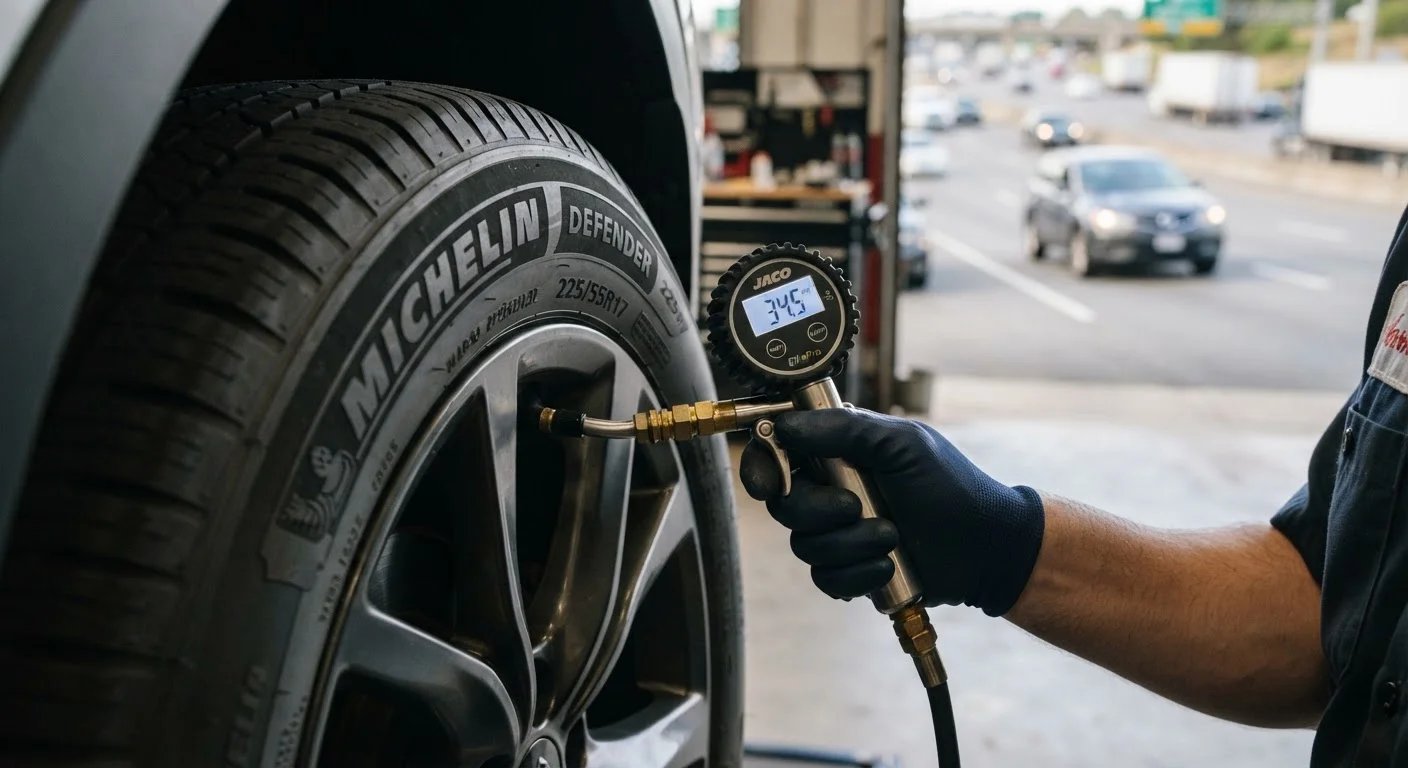
Checking tire pressure is a straightforward task that requires a simple tool - an inexpensive dial or digital gauge available at any auto parts store. Here's the correct approach:
- Check cold. Drive less than one mile before checking, or wait at least three hours after driving. Heat from driving temporarily raises pressure by several PSI, giving a false reading.
- Remove the valve cap from the tire's valve stem and press the gauge firmly onto the valve. A hissing sound means the gauge isn't fully seated.
- Compare to your door jamb sticker. If the reading is low, add air. If it's high, use the small pin on the back of most gauges - or the tip of a pen - to depress the valve and release air.
- Recheck after adjusting to confirm accuracy.
- Don't forget the spare. A flat spare is useless in an emergency.
If you'd like to see how tire pressure fits into the larger picture of what shapes your real-world MPG, our article on why gas mileage rarely matches the window sticker covers the full range of variables at play.
Putting It All Together: A Simple Habit With Measurable Returns
Tire pressure sits in an unusual category of car maintenance: it's fast, free, and has a direct and documented effect on how far a tank of gas takes you. There are no expensive parts, no mechanic visits required, and no special skill involved. The barrier is simply awareness and routine.
Checking pressure once a month - and adjusting when you're off by more than a couple of PSI - keeps rolling resistance in check, helps tires wear evenly, and supports safer handling. It's one piece of a broader fuel-efficiency picture that includes driving habits, load management, and general car maintenance.
No single change produces dramatic MPG gains on its own, but consistent tire inflation is one of the most reliable contributors to efficiency over time - and one of the easiest to act on today.