

Key Takeaways
Option A
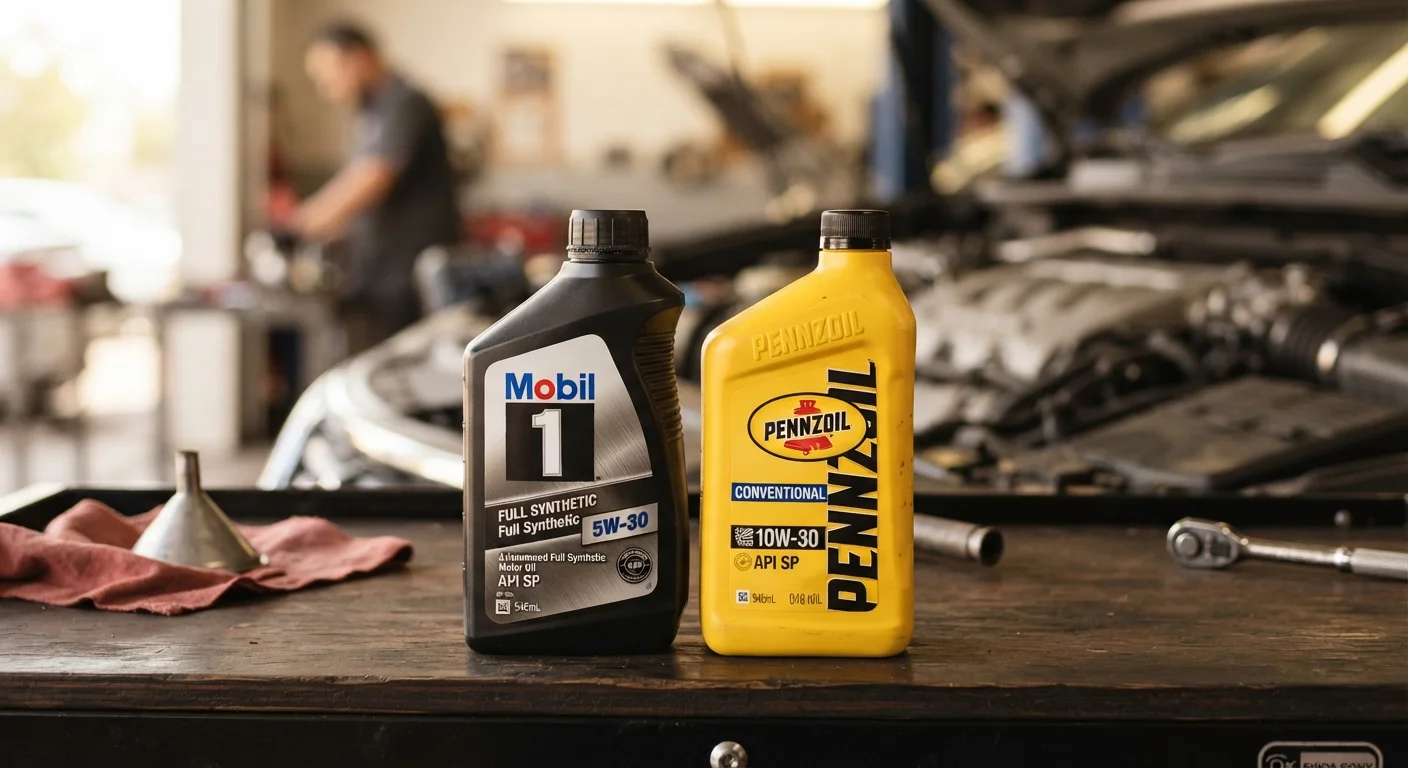
Synthetic Motor Oil
The engineered, long-interval option for modern engines.
Best for: Drivers with newer vehicles, turbocharged engines, or those who want fewer oil changes per year.
Option B
Conventional Motor Oil
The time-tested, budget-accessible standard.
Best for: Owners of older vehicles with simple engines who follow frequent maintenance schedules.
If you drive a newer vehicle with a turbocharged or high-performance engine
Synthetic Motor Oil
Modern turbocharged engines run hotter and require oil that resists breakdown under high stress. Most manufacturers specify full synthetic for these applications.
If you own an older, simpler engine and prefer lower upfront maintenance costs
Conventional Motor Oil
Conventional oil meets the requirements of many older engine designs, and frequent low-cost changes can be a practical strategy for some drivers.
If you drive in severe conditions - extreme heat, cold, frequent short trips, or heavy towing
Synthetic Motor Oil
Synthetic formulas offer broader temperature stability and better resistance to viscosity breakdown under stress, helping protect the engine when conditions are demanding.
If your vehicle has passed 100,000 miles and you want targeted engine protection
Synthetic Motor Oil
High-mileage synthetic blends contain seal conditioners and additives designed for engines with more wear, potentially reducing oil consumption and minor leaks.
What Makes These Two Oils Different
Motor oil's primary job is to lubricate engine components, reduce friction, carry away heat, and suspend contaminants until the next oil change. Both synthetic and conventional oil accomplish this - but they do so with different molecular structures, and that difference directly determines how long each stays effective.
Conventional motor oil is refined from crude petroleum. It contains a natural mix of hydrocarbon molecules of varying sizes, which means its performance characteristics are somewhat inconsistent at extreme temperatures. It tends to thin out faster in heat and thicken in cold.
Synthetic motor oil is either fully synthesized or highly refined to produce uniform, engineered molecules. This consistency gives it superior thermal stability, better cold-weather flow, and greater resistance to oxidation - the chemical process that causes oil to degrade and thicken over time.
Understanding this distinction helps explain why the two oil types have meaningfully different change intervals, and why swapping one for the other without checking your owner's manual can create issues. For a broader look at how oil fits into your vehicle's full maintenance picture, see Your Car's Maintenance Schedule, Explained.
Comparing Change Intervals Head to Head
The most practical difference between these oil types - and the one that affects your wallet most directly - is how often each needs to be changed.
| Criterion | Synthetic Motor Oil | Conventional Motor Oil |
|---|---|---|
| Typical change interval | 7,500-10,000+ miles | 3,000-5,000 miles |
| Cost per oil change | Higher upfront cost | Lower upfront cost |
| High-temperature stability | Excellent | Moderate |
| Cold-weather flow | Superior | Adequate to limited |
| Resistance to oxidation | High | Lower |
| Suited to turbocharged engines | Yes - commonly required | Generally not recommended |
| High-mileage formulas available | Yes | Yes |
| Compatible with oil life monitors | Yes | Less commonly |
These ranges are general guidelines. Your vehicle's owner's manual will specify the exact interval and viscosity grade required by your engine's design. Some newer vehicles with oil life monitoring systems can extend intervals even further when driving conditions allow. Never rely solely on the old "every 3,000 miles" rule, which no longer applies to most modern engines using synthetic oil.
7,500-10,000 mi
Typical synthetic oil change interval
Many vehicle manufacturers now specify full synthetic oil with intervals well beyond the traditional 3,000-mile guideline.
3,000-5,000 mi
Typical conventional oil change interval
The 3,000-mile interval remains common guidance for conventional oil, particularly under severe driving conditions.
~50%
Fewer annual oil changes with synthetic
Doubling the change interval roughly halves the number of service visits needed per year for average-mileage drivers.
When Conditions Override the Schedule
Published intervals assume what manufacturers call "normal" driving - consistent highway miles, moderate temperatures, and regular engine warm-ups. Many drivers, however, operate under conditions that accelerate oil degradation.
Severe driving conditions include:
- Frequent short trips under five miles (the engine never fully warms up, leaving moisture and combustion byproducts in the oil)
- Towing or hauling heavy loads regularly
- Driving in sustained extreme heat or sub-freezing cold
- Extended idling (delivery routes, stop-and-go urban commuting)
- Dusty or off-road environments
Under these conditions, both oil types should be changed more frequently than the standard interval. Synthetic oil retains an advantage here - its broader temperature tolerance and oxidation resistance give it more headroom - but it is not immune to degradation under sustained stress. If your driving skews toward the severe end, consult your owner's manual's "severe service" schedule, which most manufacturers include separately. Seasonal extremes also play a role; Seasonal Car Maintenance: What Changes Between Summer and Winter covers which checks matter most as temperatures swing.
The Cost Picture and Long-Term Value
Synthetic oil costs more per quart than conventional oil, and a full synthetic oil change at a shop typically runs higher than a conventional one. However, the per-change cost does not tell the whole story.
If synthetic oil allows you to go 10,000 miles between changes compared to 5,000 miles for conventional, you are making half as many trips to the shop annually. Over the course of a year, the total expenditure can be comparable - and sometimes lower - with synthetic, depending on your driving volume and local service pricing.
More importantly, the engine protection synthetic provides over longer intervals can reduce the risk of wear-related repairs. Why Skipping Small Services Leads to Big Repair Bills explains in detail how deferred oil changes compound into expensive failures. For high-mileage vehicles specifically, the calculus shifts slightly - see Keeping a High-Mileage Car Reliable: What the Maintenance Math Looks Like for guidance on prioritizing services as mileage climbs. Proper oil maintenance also supports fuel economy; Keeping Your Car Fuel-Efficient as It Ages explores how maintenance habits affect efficiency over time.
Can You Switch Between Oil Types?
Modern synthetic and conventional motor oils are generally compatible, and switching between them will not damage your engine. However, once you switch to full synthetic, some mechanics recommend staying consistent rather than alternating back and forth. If your owner's manual specifies synthetic oil, using conventional oil is not recommended - it may not meet the engine's protection requirements. Always verify with your manual or a trusted mechanic before changing oil types.