

| Regulatory Body | FDA (federal) + AAFCO model guidelines (state-adopted) |
| Required Label Elements | 6 (product name, quantity, manufacturer info, guaranteed analysis, ingredient list, adequacy statement) (AAFCO Official Publication) |
| Ingredient List Order | Descending by pre-cooking weight |
| AAFCO Life Stages Recognized | Growth, adult maintenance, reproduction, all life stages (AAFCO Dog Food Nutrient Profiles) |
| Feeding Trial vs. Formulation | Two methods for nutritional adequacy claims; feeding trials involve actual dogs |
| Guaranteed Analysis Measures | Min. crude protein, min. crude fat, max. crude fiber, max. moisture |
How Dog Food Labels Are Regulated
Dog food sold in the United States is regulated at two levels: federally by the Food and Drug Administration (FDA) and, for labeling standards, by guidelines developed through the Association of American Feed Control Officials (AAFCO). AAFCO is not a government agency - it's a membership organization of state and federal regulators that publishes model regulations states can adopt. Most states follow AAFCO labeling standards closely, which means the information on your dog's food bag is governed by a fairly consistent national framework.
Every commercially sold dog food label must include six required elements: a product name, the net quantity of contents, the manufacturer's name and address, a guaranteed analysis, an ingredient list, and a nutritional adequacy statement. Understanding these elements - particularly the last three - gives you the clearest window into what you're actually feeding your dog.
| Regulatory Body | FDA (federal) + AAFCO model guidelines (state-adopted) |
| Required Label Elements | 6 (product name, quantity, manufacturer info, guaranteed analysis, ingredient list, adequacy statement) (AAFCO Official Publication) |
| Ingredient List Order | Descending by pre-cooking weight |
| AAFCO Life Stages Recognized | Growth, adult maintenance, reproduction, all life stages (AAFCO Dog Food Nutrient Profiles) |
| Feeding Trial vs. Formulation | Two methods for nutritional adequacy claims; feeding trials involve actual dogs |
| Guaranteed Analysis Measures | Min. crude protein, min. crude fat, max. crude fiber, max. moisture |
Decoding the Ingredient List
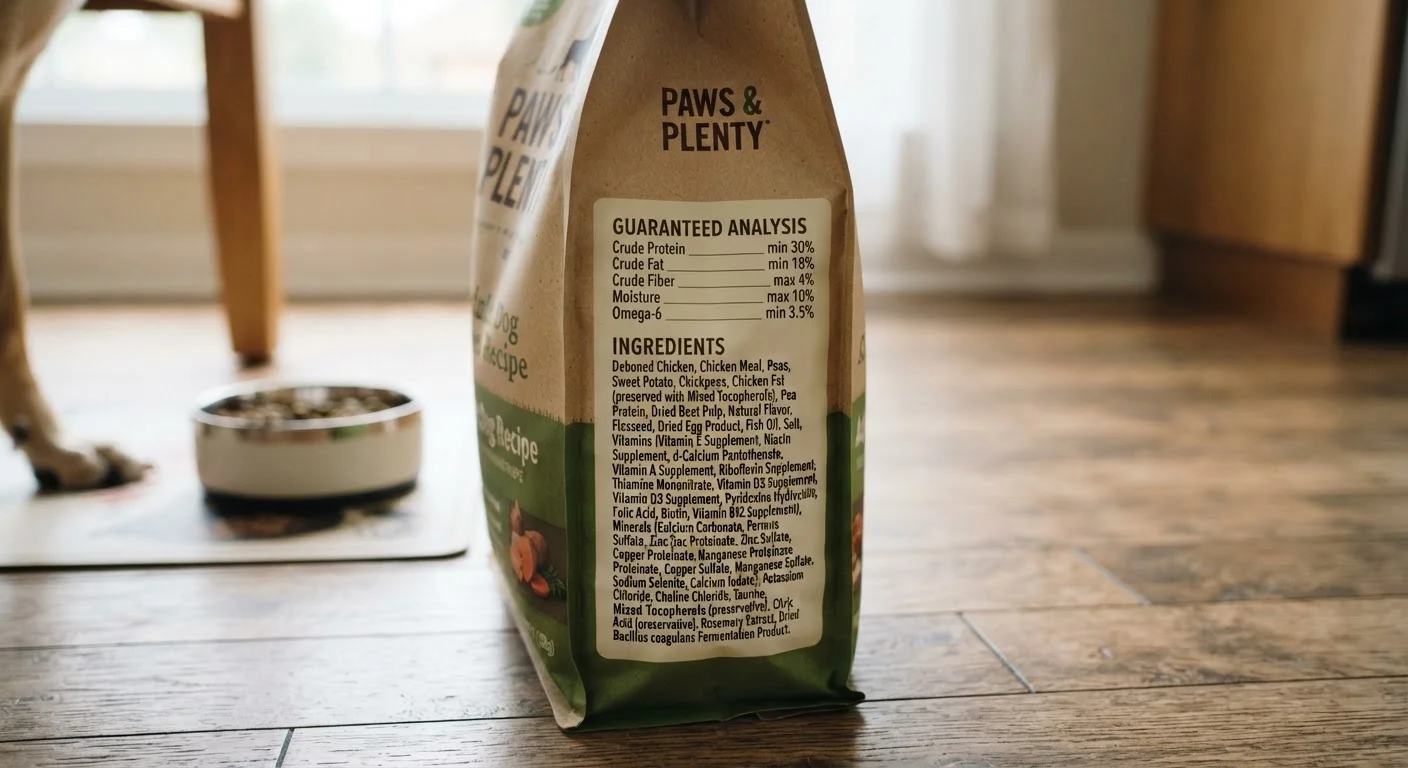
Ingredients are listed in descending order by pre-cooking weight, not by the proportion of nutrients they contribute after processing. This matters because whole meats like chicken or beef contain significant moisture, which makes them appear higher on the list. Once cooked, their contribution may be proportionally smaller than a concentrated ingredient like chicken meal - which is dried, concentrated protein - listed further down.
Some important points to understand:
- Ingredient splitting: A single ingredient can appear multiple times under different names (e.g., "corn," "corn gluten meal," "corn flour"). Combined, these ingredients might outweigh the first-listed protein source.
- By-products: The term "by-product" refers to parts of the animal other than skeletal muscle meat. Some by-products - liver, kidney, lung - are nutritionally dense. The word itself is not inherently a quality indicator.
- Meals: Ingredients ending in "meal" (e.g., chicken meal) are rendered, concentrated protein sources. They typically deliver more protein per pound than whole meat counterparts.
- Natural vs. artificial preservatives: Look for tocopherols (vitamin E) or ascorbic acid (vitamin C) as preservatives, which are common in foods marketed without artificial additives.
For a useful comparison with how cat food labeling works, see our guide to feline nutrition labels.
AAFCO
The Association of American Feed Control Officials - a membership organization of regulators that establishes model labeling and nutrient standards for pet foods in the US. Most states adopt AAFCO guidelines, creating a broadly consistent national framework.
Nutritional Adequacy Statement
A required label statement indicating whether a food meets AAFCO nutrient profiles for a specific life stage, and whether that claim was established by formulation or a feeding trial.
Crude Protein / Crude Fat
Chemical estimates of protein and fat content listed in the guaranteed analysis. 'Crude' reflects the measurement method, not actual digestibility or nutritional quality.
Dry Matter Basis
A method of comparing nutrient levels between foods with different moisture contents by mathematically removing all moisture from the calculation, allowing apples-to-apples comparisons between wet and dry foods.
By-Product
Animal-derived ingredients other than skeletal muscle meat - such as organ meats, bone, or other edible tissues. By-products vary widely in nutritional value; the term alone does not indicate low quality.
Ingredient Splitting
A labeling phenomenon where a single ingredient appears in multiple forms under different names, spreading its total weight across several list positions to make it appear less dominant than it may actually be.
What the Nutritional Adequacy Statement Really Tells You
The nutritional adequacy statement - sometimes called the AAFCO statement - is one of the most meaningful pieces of information on a dog food label, yet it's often overlooked. It tells you whether the food is formulated to be nutritionally complete and balanced, and for which life stage.
There are two ways a manufacturer can make this claim:
- Formulation method: The recipe meets AAFCO's published nutrient profiles on paper, based on calculated ingredient levels. No feeding trial was conducted.
- Feeding trial method: The food was fed to dogs under AAFCO protocols and demonstrated it could support health through that life stage. This is generally considered stronger evidence of real-world adequacy.
Look for language like: " is formulated to meet the nutritional levels established by the AAFCO Dog Food Nutrient Profiles for ." Life stages recognized by AAFCO include growth (puppies), adult maintenance, reproduction, and "all life stages" - the last of which must meet the most demanding profile (growth and reproduction).
"All Life Stages" Has a Specific Meaning
A food labeled "for all life stages" must meet AAFCO's growth and reproduction nutrient profile - the most nutrient-dense standard. This makes it appropriate for puppies and pregnant or nursing dogs, but it may deliver more calories and certain nutrients than a typical healthy adult dog needs. Check with your vet if you're unsure whether an all-life-stages food is the right fit for your adult dog's specific needs.
If a label says "for intermittent or supplemental feeding only," the food is not complete and balanced and should not be used as a sole diet.
Guaranteed Analysis and Feeding Guidelines
The guaranteed analysis panel lists minimum percentages of crude protein and crude fat, plus maximum percentages of crude fiber and moisture. "Crude" means the measurement is a chemical estimate of a nutrient class, not a precise measure of digestibility or quality. A food with high crude protein isn't automatically superior - the digestibility and biological value of those proteins matter too.
To compare wet and dry foods on an equal basis, you need to calculate dry matter basis values by removing moisture from the equation. For example, a wet food with 10% protein and 78% moisture: subtract moisture (100 − 78 = 22), then divide protein by dry matter (10 ÷ 22 = ~45% protein on a dry matter basis). This makes meaningful comparisons possible.
Feeding guidelines on packaging are starting estimates, not prescriptions. They're typically calculated for average activity levels and body weights. Your dog's actual needs depend on age, breed, activity, reproductive status, and health conditions. Your veterinarian is the appropriate resource for individualized feeding recommendations.
If you're curious about how these labeling principles compare to human food nutrition panels, our article on reading a nutrition label covers similar concepts for human foods. And if you're evaluating alternative diets such as raw feeding, the real story on raw diets for dogs covers what the evidence currently supports.
This article provides general educational information about dog food labeling. It is not a substitute for personalized veterinary nutrition advice. Always consult your veterinarian before making significant changes to your dog's diet.