

Key Takeaways
Why Indoor Cats Need Deliberate Enrichment
A cat kept entirely indoors is shielded from traffic, predators, and infectious disease - but the same four walls that protect her can also limit her in important ways. Wild and feral cats spend the majority of their waking hours hunting, patrolling territory, and investigating their surroundings. The domestic indoor cat has none of those demands, yet her nervous system still expects them.
When that expectation goes unmet, the result is often what veterinary behaviorists describe as understimulation - a state linked to excessive grooming, redirected aggression, destructive scratching, overeating, and litter box avoidance. In short, a bored cat is rarely a well-behaved or contented one. Understanding this helps reframe enrichment not as an optional luxury but as a genuine welfare need. You can learn more about how environment shapes temperament in our guide to everything that shapes a cat's personality.
The Core Principles of Feline Environmental Enrichment
Effective enrichment addresses several behavioral categories simultaneously: physical activity, predatory expression, social engagement, sensory stimulation, and choice and control. That last category is often overlooked - cats are strongly motivated by autonomy. Providing multiple resting spots, hiding areas, and activity zones lets a cat self-regulate her own arousal levels throughout the day.
Create dedicated vertical climbing paths throughout your home.
Height gives cats a sense of security and territorial ownership. Cats denied vertical access often compete more aggressively for floor-level resources and show higher baseline stress. Multi-level structures also encourage physical exercise without requiring outdoor access.
Use foraging and puzzle feeders for at least one meal per day.
Delivering food without effort removes one of the few cognitively demanding activities from a cat's day. Foraging feeders slow eating, reduce caloric surplus from inactivity, and provide a controlled outlet for hunting instincts. Even simple setups produce meaningful behavioral benefits.
Rotate enrichment items on a weekly schedule rather than leaving everything available permanently.
Cats habituate quickly to static stimuli - a toy left out for weeks becomes invisible. Regular rotation maintains novelty without requiring constant new purchases. Even reintroducing a previously stored toy after two weeks can trigger enthusiastic engagement.
Provide multiple distinct resting and hiding zones at different heights and in different rooms.
Choice and control are fundamental to feline wellbeing. When a cat can always locate a private retreat, she is less likely to respond to household stressors - new visitors, loud appliances, other pets - with aggression or hiding that indicates chronic anxiety.
Schedule two structured interactive play sessions every day using wand-style toys.
Free-access toy piles don't replicate the unpredictable movement of prey. Active human-led play sessions engage a cat's full predatory sequence and also strengthen the human-animal bond, which itself has documented welfare benefits. Ending with a small food reward helps the cat complete the hunt cycle.
Maximize window access and outdoor sensory input safely.
Visual, auditory, and olfactory stimuli from outdoors serve as low-effort passive enrichment throughout the day. Screened windows or "catio" enclosures allow fresh air and nature sounds without exposure to outdoor hazards. This category of enrichment requires almost no daily effort once set up.
When setting up or auditing your home, think less about the number of items you own and more about whether each category above is meaningfully covered. A living room full of unused toys scores poorly; a modest space with a window perch, a puzzle feeder, and a daily interactive play session scores much higher.
Practical Setups That Make a Real Difference
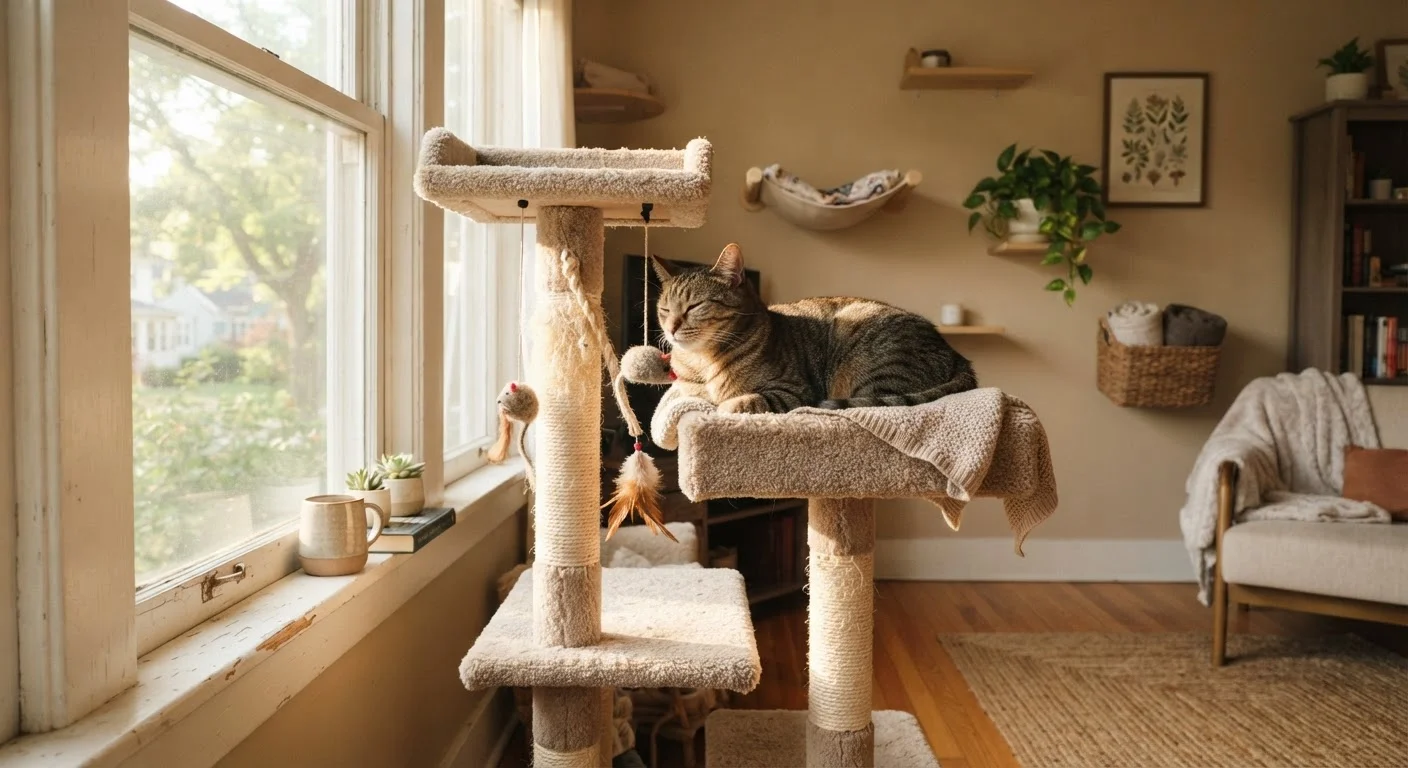
Vertical space is among the highest-value investments you can make. Cats feel safer and more confident when they can survey a room from above. Wall-mounted shelves arranged as a climbing path, a tall multi-level cat tree near a window, or even cleared bookshelf ledges can dramatically expand a cat's perceived territory without requiring additional floor space - important in apartments.
Windows are a cat's television. A securely screened window with a padded perch gives access to bird movement, outdoor sounds, and shifting light - all meaningful sensory input. Placing a bird feeder within view of that window amplifies the effect considerably.
Puzzle feeders and food-dispensing toys address predatory drive directly. Rather than receiving meals in a bowl, cats must work to extract kibble or wet food portions - mimicking the effort of a hunt. Research in applied animal behavior suggests this type of feeding enrichment can reduce frustration-based behaviors and support healthier weight management, though individual results vary. Pair this approach with guidance from our article on wet food, dry food, or both to make sure your cat's diet also supports her activity level.
Scratching posts and surfaces deserve specific attention. Scratching is not destructive behavior - it is a normal feline need for claw maintenance, muscle stretching, and scent-marking. Offering both vertical and horizontal scratching surfaces in areas your cat already frequents (not tucked in a corner) gives her an appropriate outlet.
Check Your Plants Before Adding Greenery
Adding live plants to a cat's environment can provide appealing visual and olfactory enrichment - but many common houseplants are toxic to cats. Before introducing any plant into a home with an indoor cat, verify its safety. Our reference guide to household plants, foods, and products toxic to cats covers the most common hazards to watch for.
Interactive Play and Social Enrichment
No object-based enrichment fully replaces interactive play with a human or feline companion. Wand toys, feather teasers, and laser pointers (always ended with a tangible prey item so the cat can "catch" something) engage a cat's full predatory sequence: stalk, chase, pounce, grab. Two focused 10-15 minute sessions per day are more effective than leaving toys scattered on the floor all day, which quickly loses novelty.
If your household schedule allows, a second cat can be a meaningful source of social and physical stimulation - though introductions require care. Our structured guide to introducing a second cat without the chaos walks through the process safely. Not every cat welcomes a companion, so temperament assessment matters before making that decision.
Finally, don't underestimate the value of varied human interaction: short training sessions using positive reinforcement, novel-object exploration, and gentle handling practice all contribute to a mentally active cat. For new cat owners building out a full setup, the room-by-room preparation checklist offers a practical foundation to build enrichment from day one.
This article provides general information about cat care and enrichment. It is not a substitute for professional veterinary or behavioral advice. Consult a licensed veterinarian or certified animal behaviorist if your cat shows signs of significant behavioral distress or health changes.