

Key Takeaways
Our Verdict
Debt consolidation is generally the lower-risk option for borrowers with stable income and qualifying credit, as it reorganizes debt without the severe credit damage of settlement. Debt settlement may seem appealing when balances are unmanageable, but its credit, tax, and fee consequences are substantial and long-lasting. Neither is a shortcut - both require honest assessment of your financial situation and, ideally, professional guidance.
| Best for | Recommended |
|---|---|
| Borrowers with manageable debt and decent credit seeking simplicity | Debt Consolidation |
| Those facing severe hardship with no realistic path to full repayment | Debt Settlement (with caution) |
| People who want structured support without new loans | Debt Management Plan (nonprofit counseling) |
What Each Approach Actually Does
Despite often being lumped together in advertising, debt consolidation and debt settlement are fundamentally different strategies. Understanding the mechanics of each is essential before deciding anything.
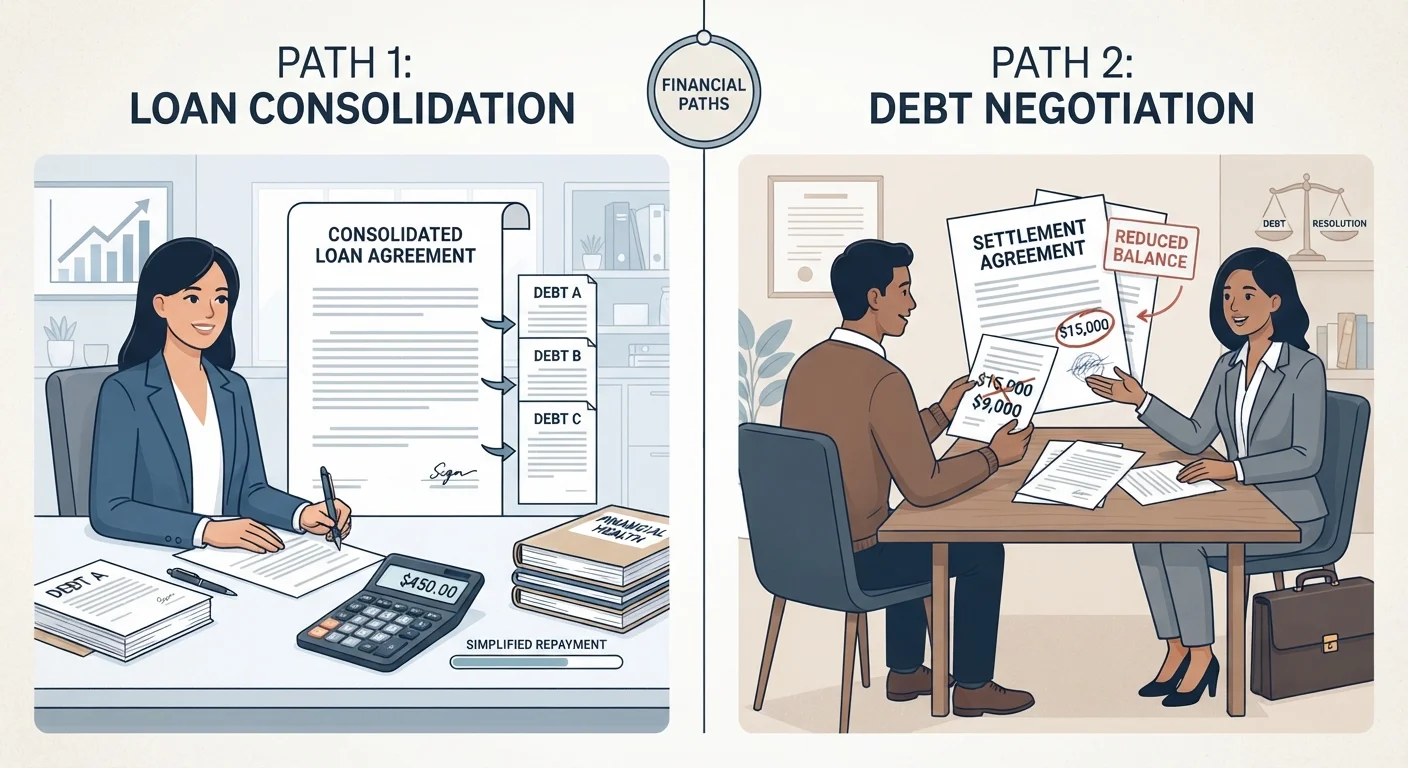
Debt consolidation means combining multiple debts - typically unsecured debts like credit cards or personal loans - into a single new loan, ideally at a lower interest rate. You still repay the full amount you owe; the goal is to simplify payments and reduce the total interest paid over time. Common vehicles include personal loans, balance transfer credit cards, and home equity loans.
Debt settlement is a negotiation process in which you (or a company acting on your behalf) attempt to convince creditors to accept less than the full balance owed, usually as a lump-sum payment. Creditors typically only engage seriously when accounts are significantly delinquent - meaning settlement usually requires you to stop making payments first, which triggers serious credit damage. For a grounding in the terminology used in both processes, see key debt and credit terms explained.
How Each Affects Your Credit
Credit impact is one of the starkest differences between these two paths.
With consolidation, assuming you qualify for a new loan and continue making on-time payments, your credit profile is generally preserved. You may see a temporary dip from the hard inquiry associated with a new loan application, and closing older accounts can affect your credit mix and average account age. Over time, consistent payments on the consolidation loan typically support - rather than harm - your credit score.
Debt settlement follows a different trajectory. Because creditors rarely negotiate on current accounts, settlement programs usually require you to become delinquent. Missed payments are reported to the credit bureaus immediately and remain on your credit report for seven years. Even after a settlement is reached, the account is typically reported as "settled for less than the full amount" - a notation that signals risk to future lenders. If rebuilding credit after the process matters to you, understanding tools like secured vs. unsecured credit cards can help you plan the recovery phase.
| Debt Consolidation | Debt Settlement | |
|---|---|---|
| Core mechanism | Combines debts into one new loan | Negotiates to pay less than owed |
| Amount repaid | Full balance (plus interest) | Reduced balance (lump sum) |
| Credit score impact | Minimal if payments are maintained | Severe; delinquency required |
| Credit report notation | Normal loan/account history | "Settled for less" - stays 7 years |
| Tax consequences | Generally none | Forgiven debt may be taxable income |
| Typical fees | Origination or transfer fees (3-5%) | 15-25% of enrolled or settled debt |
| Timeline | Loan term, usually 2-7 years | Typically 2-4 years of negotiation |
| Creditor participation | Required upfront (new loan issued) | Not guaranteed; creditor can refuse |
Hidden Costs and Risks to Know
The financial consequences go beyond credit scores.
Watch Out for For-Profit Settlement Companies
Many for-profit debt settlement firms charge substantial fees and make promises they cannot guarantee. The Federal Trade Commission has noted that some companies collect fees before settling any debt, leaving consumers worse off financially. Before engaging any paid service, consult a nonprofit credit counseling agency - many offer free or sliding-scale consultations.
Consolidation risks: If you use a home equity loan to consolidate unsecured debt, you're converting debt that couldn't cost you your home into debt that can. Also, consolidation loans can carry origination fees, and balance transfer cards typically charge a transfer fee (often 3-5% of the balance). Without addressing the habits that created the debt, many borrowers accumulate new balances on the cleared cards - effectively doubling their problem.
Settlement risks: The IRS generally treats forgiven debt as taxable income. If a creditor forgives $8,000 of your balance, you may owe income tax on that $8,000 - a detail rarely emphasized in settlement company marketing. Additionally, for-profit settlement companies typically charge fees ranging from 15-25% of the enrolled debt or the settled amount. There is no guarantee that creditors will settle, and during the negotiation period (often 2-4 years), interest and penalties continue to accumulate on delinquent accounts.
For a structured, lower-risk alternative to both approaches, debt management plans through nonprofit agencies are worth understanding before committing to anything.
Choosing a Direction: Key Questions to Ask
No single strategy is right for everyone. A few honest questions can help clarify which direction - if either - makes sense for your situation.
- Can you qualify for a consolidation loan at a rate lower than your current debts? If your credit is already strained, the rates offered may not provide meaningful savings.
- Is your hardship temporary or ongoing? Consolidation assumes you can make consistent payments going forward. Settlement may be considered when income disruption makes full repayment genuinely unrealistic.
- How much does your credit score matter to you in the near term? If you expect to apply for a mortgage, car loan, or rental within the next several years, the credit damage from settlement can be a significant obstacle.
- Have you explored all alternatives? Self-directed strategies like the debt avalanche or snowball methods may be viable if balances are manageable. Nonprofit credit counseling is free or low-cost and can provide a realistic picture of all your options.
This article is for general informational and educational purposes only and does not constitute personalized financial, tax, or legal advice. Consult a qualified financial professional or nonprofit credit counselor before making decisions about debt management strategies.