

Key Takeaways
Option A
Debt Avalanche
The mathematically optimal approach to minimizing total interest paid.
Best for: People who are motivated by long-term savings and can stay consistent without quick wins.
Option B
Debt Snowball
The behaviorally driven method that builds momentum through early victories.
Best for: People who need visible progress to stay on track and have multiple smaller debts.
If you want to pay the least interest over the life of your debts
Debt Avalanche
By attacking the highest-rate debt first, you reduce the principal that compounds fastest, which typically saves the most money overall.
If you've struggled to stay motivated with debt payoff in the past
Debt Snowball
Eliminating smaller balances quickly delivers visible results, and research supports the idea that psychological momentum helps people follow through.
If your highest-interest debt is also your smallest balance
Debt Avalanche
In this scenario both methods produce the same first target, so you get quick wins and optimal math simultaneously.
If you have a large number of small debts cluttering your financial picture
Debt Snowball
Clearing multiple accounts rapidly simplifies your finances and reduces the cognitive load of managing many minimum payments.
If you have a stable income and high-rate debt like credit cards or personal loans
Debt Avalanche
Consistent monthly cash flow makes it easier to commit to a longer timeline before seeing a balance reach zero, maximizing your interest savings.
How Each Strategy Works
Both methods share the same foundation: make minimum payments on every debt, then direct any extra money toward one specific target. The difference lies entirely in which debt gets that extra attention.
Debt Avalanche: You rank debts by interest rate, highest to lowest, and throw every spare dollar at the top-rate account. Once that balance reaches zero, you roll its payment - minimums plus extra - onto the next highest-rate debt. The cascade continues until all debts are cleared.
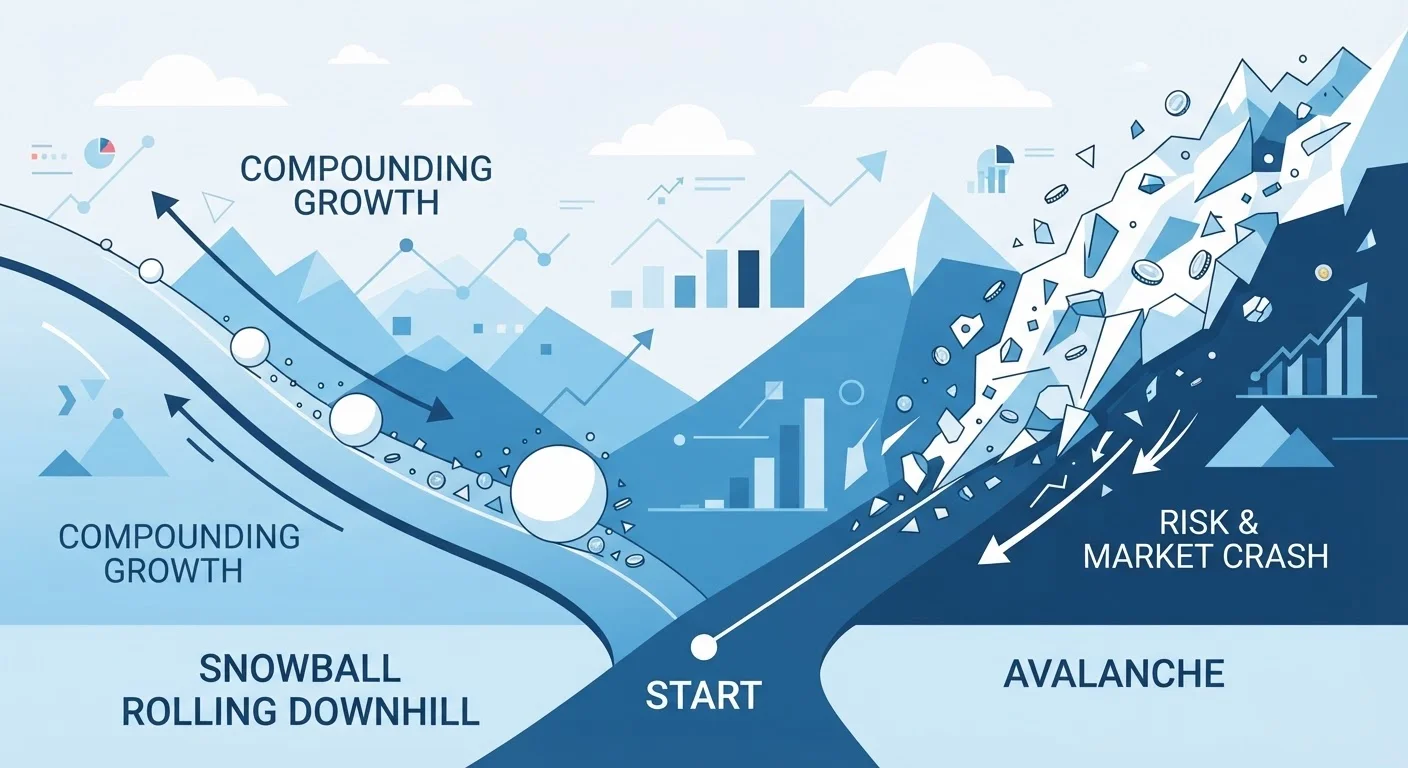
Debt Snowball: You rank debts by outstanding balance, smallest to largest, ignoring interest rates. Extra payments go toward the smallest balance first. When it's paid off, that freed-up payment rolls to the next smallest. The compounding payment amount grows - like a snowball - with each account eliminated.
To understand why interest rate sequencing matters so much for total cost, see how credit card interest compounds over time.
| Criterion | Debt Avalanche | Debt Snowball |
|---|---|---|
| Payoff order | Highest interest rate first | Smallest balance first |
| Total interest paid | Generally lower | Generally higher |
| Time to first zero balance | Potentially longer | Typically faster |
| Psychological momentum | Builds slowly | Builds quickly |
| Best debt profile | High-rate debt with large balances | Many small accounts to clear |
| Motivation style suited | Long-term, analytical thinkers | Goal-oriented, needs quick wins |
| Complexity | Slightly more planning required | Straightforward to implement |
The Math: What the Numbers Actually Show
Consider a simplified example: three debts - a $500 medical bill at 0% interest, a $3,000 credit card at 22% APR, and an $8,000 personal loan at 11% APR. You have $200 extra per month to apply.
Under the avalanche, you target the 22% card first. It accrues interest fastest, so eliminating it early cuts total interest significantly before moving to the loan, then the medical bill.
Under the snowball, you pay off the $500 medical bill first - likely in just a couple of months - then move to the credit card, then the loan. You'll feel progress quickly, but the 22% card continues accruing interest during those early months.
In a scenario like this, the avalanche typically saves several hundred dollars and may reduce total payoff time by a few months. The exact gap depends on balances, rates, and your extra payment amount. The key point: the difference is real but not always dramatic. For many people, the behavioral benefit of the snowball outweighs the interest cost.
22%+
Average credit card APR in recent years
Federal Reserve data has tracked average credit card interest rates exceeding 20% APR, underscoring why rate-sequencing matters for payoff strategy.
~$6,500
Median credit card balance per US household
Federal Reserve consumer finance surveys indicate many US households carry meaningful revolving balances, making payoff method selection consequential.
Higher
Completion rate linked to small-win milestones
Academic research in consumer behavior suggests people are more likely to follow through on debt payoff when early milestones are reached quickly.
Psychology Versus Optimization: Which Factor Wins?
A 2016 study published in the Journal of Marketing Research found that consumers who focused on paying off smaller individual debts made faster overall progress - not because of math, but because of motivation. Visible wins reduced dropout rates.
The avalanche demands patience. If your highest-rate debt also carries a large balance, you may go many months without a single account reaching zero. That can feel like running a marathon with no mile markers. For some people, that's fine. For others, it leads to abandonment of the plan entirely.
The most effective strategy is the one you actually maintain. A partial avalanche that gets abandoned after four months produces worse results than a snowball followed consistently for three years.
If you're unsure about your broader cash flow before committing to an accelerated payoff plan, it may help to first review how you're allocating income. Comparing budgeting systems can clarify how much you realistically have available to put toward debt each month.
Both Methods Require Extra Payment Capacity
Neither the avalanche nor the snowball produces meaningful results on minimum payments alone. The strategy only accelerates payoff when you consistently apply an additional fixed amount to your target debt. Even a modest extra $50-$100 per month compounds meaningfully over time - but the amount must be sustainable within your actual budget. If your cash flow is too tight for any surplus, addressing income or spending gaps first is a prerequisite.
How to Choose - and What to Do Once You Have
Ask yourself two questions: How motivated do I stay without visible results? And: How large is the interest-rate gap between my debts?
If your rates are clustered close together - say, 18%, 20%, and 22% - the mathematical difference between avalanche and snowball is small. In that case, choose whichever keeps you engaged. If you carry one high-rate debt significantly above the others, the avalanche's savings case becomes stronger.
Once you've chosen, set up automatic minimums on every account so you never miss a payment, then direct extra funds manually or via a separate transfer rule to your target account. Track your target balance monthly - watching a single number decline is motivating regardless of which method you use.
If you're starting from a place of overwhelm or multiple accounts in default, the snowball's simplicity may be the cleaner entry point. You can always switch to an avalanche approach once accounts are consolidated and manageable. You might also want to understand alternatives - debt consolidation and settlement are separate tools with distinct risks worth understanding before committing to a DIY payoff plan.
Freeing up cash for debt payoff sometimes requires tightening your budget first. A pay-yourself-first budgeting approach can help ensure debt payments are treated as non-negotiable before discretionary spending.
This article is for general informational and educational purposes only. It is not personalized financial, tax, or legal advice. Readers should consult a qualified financial professional before making decisions based on their individual circumstances.