

Key Takeaways
Speed Limit as a Ceiling
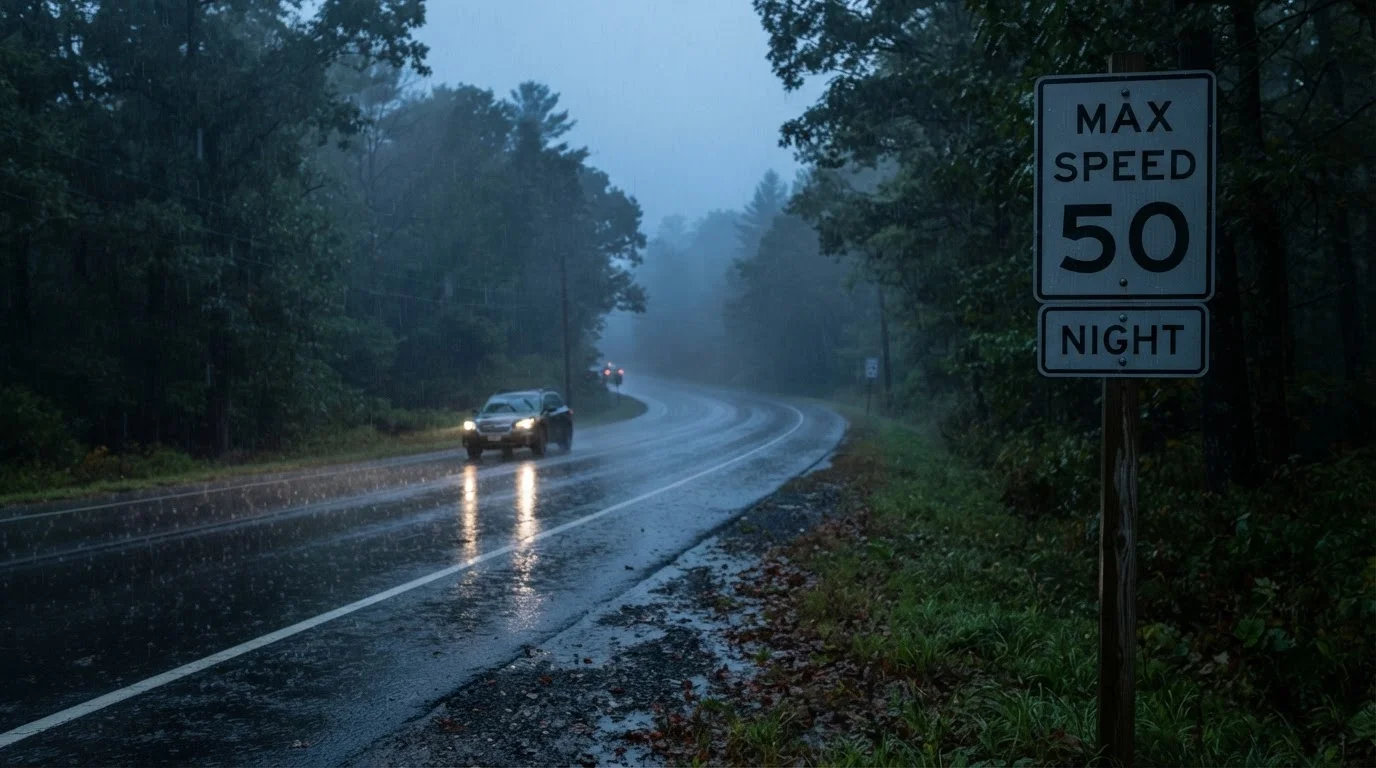
A posted speed limit is the maximum legal speed allowed under ideal road and weather conditions - not a recommended target for all situations. Driving at the posted limit when conditions are poor (wet roads, heavy traffic, reduced visibility) can be just as dangerous as speeding. Safe driving means choosing a speed appropriate to actual conditions, which is often lower than the sign says.
In most U.S. states, traffic law requires drivers to operate at a 'reasonable and prudent' speed given existing conditions, regardless of what the posted limit says. This is known as the Basic Speed Law.
What Speed Limits Actually Represent
Speed limits are set by traffic engineers using a process that considers road geometry, lane width, sight distance, and the surrounding environment. A key input in many cases is the 85th percentile speed - the speed at or below which 85% of vehicles travel under free-flow, favorable conditions. The posted number represents a legal ceiling for those favorable conditions, not a floor or a default setting.
That distinction matters enormously in practice. When engineers determine a 55 mph limit on a rural two-lane highway, they are assuming clear skies, dry pavement, light traffic, and an alert driver in a well-maintained vehicle. Change any one of those variables and the margin of safety built into that limit begins to shrink. Change several at once - say, fog plus rain plus a curve - and the posted number may bear little relationship to what's actually safe.
Understanding this framing is the first step toward driving more defensively. The sign tells you the legal maximum. The road, the weather, and the traffic tell you the appropriate speed.
Conditions That Demand a Lower Speed
Several categories of conditions routinely require drivers to operate below the posted limit. Recognizing them - and adjusting proactively - is a core safe-driving skill.
Weather and Road Surface
Wet pavement significantly extends stopping distances, and hydroplaning can occur even at moderate speeds on tires with reduced tread depth. Ice and packed snow can increase stopping distance by four to ten times compared to dry asphalt. Fog reduces the distance at which you can identify and react to hazards. In each case, the physics of the situation demand a lower operating speed regardless of what the sign says. See our breakdown of stopping distances at highway speeds for a closer look at how speed and braking interact.
Traffic Density and Surrounding Vehicles
Heavy, stop-and-go traffic requires shorter following gaps and faster reaction times. Driving at the speed limit in congested conditions reduces the buffer you need to respond to sudden braking ahead. Following distance principles become harder to maintain as speeds rise - another reason to ease off in dense traffic even when the road technically allows more.
Road Type and Geometry
Sharp curves, narrow lanes, steep grades, and unpaved surfaces all change the effective safe speed. A winding mountain road posted at 45 mph may have specific curve advisories posted well below that. Those advisory signs - the yellow ones - are engineering-based recommendations, not suggestions to ignore.
Visibility
Nighttime driving reduces your ability to see and react to hazards. Research consistently shows that crashes are disproportionately fatal after dark, partly because drivers continue at daytime speeds despite reduced sight lines. Overdriving your headlights - traveling faster than you can stop within the distance illuminated - is a recognized hazard.
Scan Conditions Before You Accelerate
Before matching the flow of traffic or reaching the posted limit, take a quick inventory: Is the road surface wet, icy, or broken? Is visibility limited by weather, glare, or curves? Are pedestrians, cyclists, or merging vehicles present? If any answer is yes, build in a speed buffer. Adjusting down by even 5-10 mph in marginal conditions can meaningfully extend your reaction window.
The Physics Behind the Principle
Speed's relationship to crash severity is not linear - it's exponential. The kinetic energy your vehicle carries doubles when speed increases by about 41% (because energy scales with the square of velocity). That means a collision at 60 mph involves roughly four times the energy of one at 30 mph. More energy means greater forces on occupants, longer stopping distances, and less time for drivers to perceive and respond to hazards.
Reaction time alone - the gap between seeing a hazard and beginning to brake - typically consumes around 1.5 seconds for an alert driver. At 60 mph, a vehicle travels roughly 132 feet during that time before braking even begins. Add wet pavement or driver fatigue and that distance grows further. The math is unforgiving, which is why speed-choice decisions in suboptimal conditions carry disproportionate consequences.
~4x
Crash energy at 60 mph vs. 30 mph
Because kinetic energy scales with the square of velocity, doubling your speed roughly quadruples the energy involved in a collision.
132 ft
Distance traveled during reaction time at 60 mph
At a typical alert-driver reaction time of about 1.5 seconds, a vehicle covers roughly 132 feet before braking even begins - and that's before accounting for stopping distance.
4-10x
Stopping distance increase on ice vs. dry pavement
Traffic safety research consistently shows that ice and packed snow can extend braking distances to four to ten times what dry asphalt requires at the same speed.
Drivers who habitually treat the speed limit as a target, rather than a ceiling, leave themselves little margin when unexpected conditions arise. Building in that margin - by choosing a contextually appropriate speed - is one of the most effective risk-reduction tools available.
Adjusting Speed Without Creating New Hazards
Reducing speed appropriately is not the same as slamming on the brakes or crawling unpredictably. Smooth, gradual deceleration - well ahead of a hazard or changed conditions - is safer than sudden corrections. Signaling lane changes, maintaining consistent spacing, and positioning your vehicle predictably all complement speed management.
It is also worth noting that driving significantly below the flow of traffic when conditions don't warrant it can itself create hazards. The goal is appropriate speed for conditions, not the lowest possible speed. On a dry, clear highway with light traffic, operating significantly below the limit without cause can create gaps in traffic flow that other drivers navigate around erratically. Context governs in both directions.
Drivers who also practice fuel-conscious habits may notice overlap here: smooth acceleration and deceleration reduce both crash risk and fuel consumption. Our overview of hypermiling techniques touches on where fuel-saving strategies and safety intersect - and where they diverge. For a wider view of behaviors that elevate crash risk, aggressive driving patterns and their crash risks is a useful companion read.
This article is for general informational purposes only and does not constitute legal or professional driving advice. Traffic laws vary by state and jurisdiction - consult your state's motor vehicle authority or a qualified professional for guidance specific to your situation.