

| Most common right-of-way rule at four-way stops | First to arrive, first to proceed; yield to the right if simultaneous |
| Roundabout right-of-way | Circulating traffic inside the roundabout always has priority |
| Yield sign requirement | Slow and be prepared to stop; full stop only if traffic or pedestrians are present |
| Left-turn rule at four-way stop (opposing vehicles) | Turning left yields to oncoming vehicle going straight |
| Roundabout crash reduction | Studies suggest roundabouts reduce serious injury crashes compared to signalized intersections (Insurance Institute for Highway Safety (IIHS)) |
| Simultaneous arrival tie-breaker | Driver on the left yields to driver on the right |
Why Right-of-Way Rules Matter More Than You Think
Intersection-related crashes account for a significant share of serious collisions on U.S. roads each year, and a common thread running through many of them is a misunderstanding - or outright ignorance - of right-of-way rules. These rules don't exist to create bureaucratic order; they exist because two vehicles cannot occupy the same space at the same time. Knowing who yields, who proceeds, and when to wait is as foundational to safe driving as knowing how to brake.
Whether you're a newly licensed driver or a 20-year veteran of commuter traffic, a quick refresher on roundabouts, four-way stops, and yield signs can sharpen your instincts and reduce hesitation at the moments that matter most. This guide breaks each scenario down clearly, so you know exactly what to do before you reach the intersection.
For a broader foundation of safe driving habits, see our complete introduction to safe road behavior.
| Most common right-of-way rule at four-way stops | First to arrive, first to proceed; yield to the right if simultaneous |
| Roundabout right-of-way | Circulating traffic inside the roundabout always has priority |
| Yield sign requirement | Slow and be prepared to stop; full stop only if traffic or pedestrians are present |
| Left-turn rule at four-way stop (opposing vehicles) | Turning left yields to oncoming vehicle going straight |
| Roundabout crash reduction | Studies suggest roundabouts reduce serious injury crashes compared to signalized intersections (Insurance Institute for Highway Safety (IIHS)) |
| Simultaneous arrival tie-breaker | Driver on the left yields to driver on the right |
Four-Way Stops: The Order of Priority
A four-way stop - marked with a stop sign at each corner - requires every driver to come to a complete stop before proceeding. The sequence of who goes next follows a clear hierarchy:
- First to arrive, first to go. The driver who stopped first has priority. If you arrived before others, you proceed first once it is safe to do so.
- Simultaneous arrival: yield to the right. If two vehicles stop at the same time, the driver on the left yields to the driver on the right. This is one of the most frequently forgotten rules in everyday driving.
- Simultaneous arrival facing each other (straight vs. turn). If two vehicles arrive at opposite sides at the same time and both plan to go straight, both may proceed. If one is turning left, that driver must yield to the oncoming vehicle going straight.
A complete stop means your vehicle is not still rolling. Rolling through a stop sign - sometimes called a "California stop" - is a traffic violation in every U.S. state and eliminates your right-of-way priority. After stopping, scan left, right, and left again before entering the intersection.
Hesitation and aggression are both dangerous at four-way stops. If you're unsure who arrived first, err on the side of yielding. Confident, predictable behavior - brief eye contact with other drivers where possible, clear turn signals, steady acceleration - reduces confusion for everyone. See how aggressive driving patterns can escalate these already tense moments.
Right of way
The legal entitlement of a vehicle, cyclist, or pedestrian to proceed through an intersection or road section before others. Right of way is granted or yielded - it is never taken by force.
Yield
To slow down and give priority to other vehicles or pedestrians. A yield does not always require a full stop, but the driver must be prepared to stop if necessary.
Roundabout
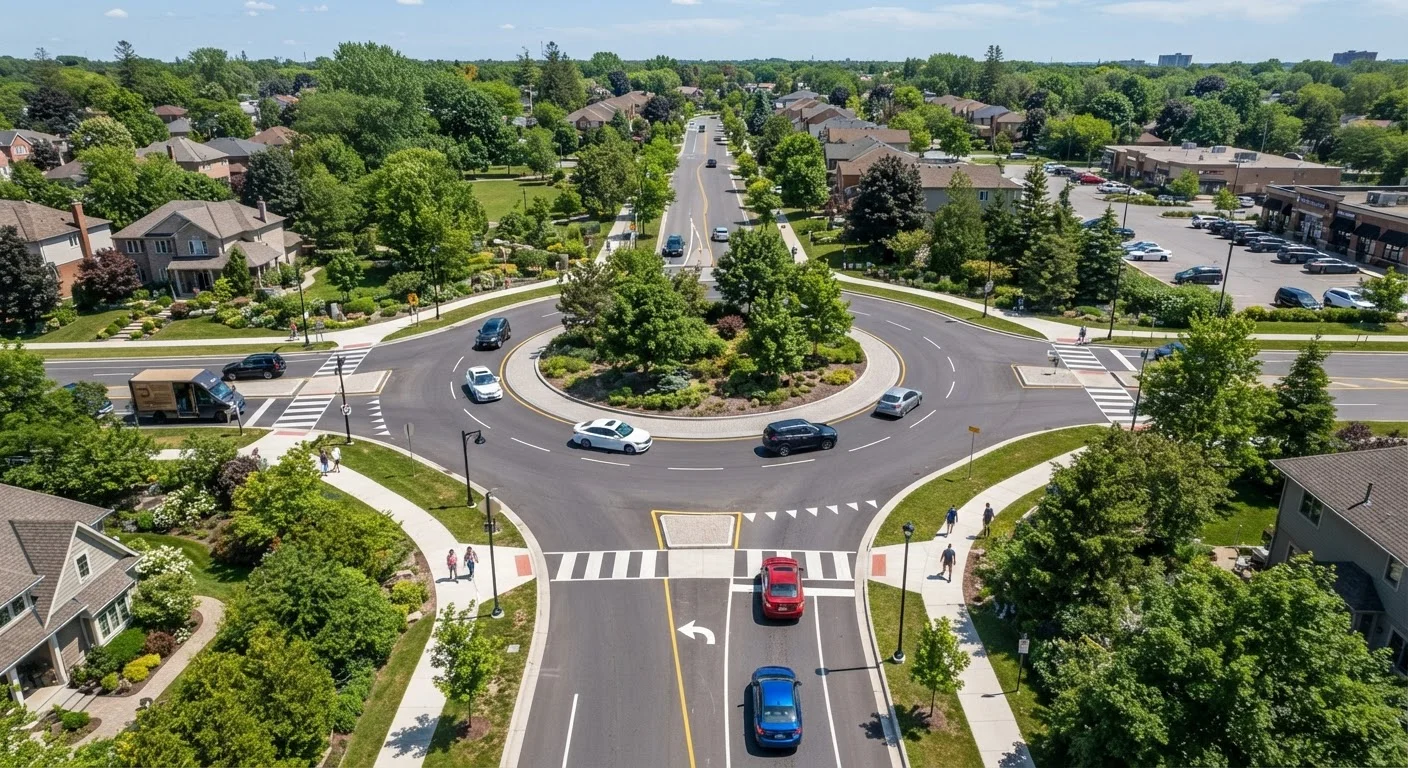
A circular, one-way intersection where entering traffic yields to vehicles already circulating inside the circle. Roundabouts are designed to reduce conflict points and lower vehicle speeds.
Four-way stop
An intersection where all approaches are controlled by stop signs, requiring every driver to stop completely before proceeding according to arrival-order and yield-to-the-right rules.
Circulating traffic
Vehicles already moving inside a roundabout. These vehicles have the right of way over vehicles approaching from outside the circle.
Roundabouts: Yielding to Circulating Traffic
Roundabouts are single-direction circular intersections designed to keep traffic flowing without traffic signals. They are statistically safer than traditional signalized intersections for serious injury crashes, largely because vehicle speeds are lower and the most dangerous collision types (T-bone and head-on) are largely eliminated.
The core rule is simple: traffic already inside the roundabout has the right of way. When you approach a roundabout, you will see a yield sign. You must slow down, watch for a safe gap in the circulating traffic, and enter only when it is clear. Do not stop inside the roundabout unless traffic forces you to.
Common Roundabout Mistakes
- Entering without yielding. Assuming a gap exists without confirming it is one of the leading causes of roundabout collisions.
- Wrong lane choice. In multi-lane roundabouts, use the right lane for right turns and straight-through exits, and the left lane for left turns or U-turns. Check posted signs and pavement markings before entering.
- Stopping inside the circle. Unless an emergency requires it, stopping inside a roundabout disrupts flow and can cause rear-end collisions.
Signal your exit: use your right turn signal as you approach your exit lane so drivers waiting to enter understand your intentions.
Yield Signs: When to Pause, Not Stop
A yield sign means you must be prepared to stop and give the right of way to other vehicles or pedestrians, but you are not required to come to a complete stop if the path is clearly open. This distinction matters - unnecessary stops where there is no conflicting traffic can create rear-end hazards behind you.
Yield signs appear in several common situations:
- Roundabout approaches (as covered above)
- Highway on-ramps, where merging traffic yields to highway traffic
- T-intersections, where the terminating road yields to the through road
- Pedestrian crossings in certain configurations
The practical skill here is reading your approach speed correctly. Slow down early enough to evaluate whether a gap exists. If you must stop, do so at or behind the painted stop line or yield line. Once the intersection is clear, proceed smoothly.
Yield situations often involve the same split-second judgment calls as highway merging. Our guide on highway merging done right explores how to read gaps and time entry effectively - skills that transfer directly to yield scenarios.
Before heading out to any unfamiliar route, a pre-trip safety check ensures your mirrors, lights, and sight lines are ready for whatever intersections you encounter.