

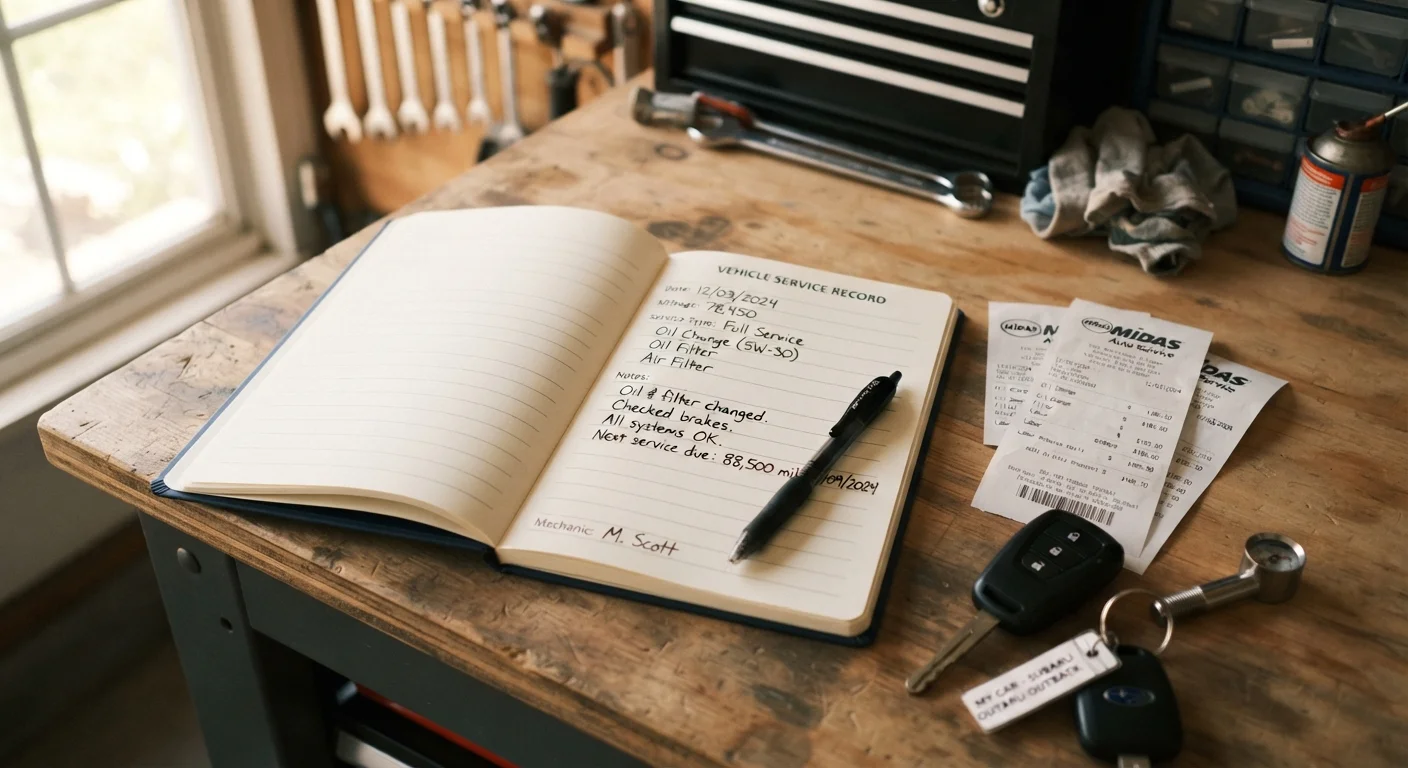
Why a Maintenance Log Is Worth Keeping
Most drivers remember their last oil change - roughly. But when a mechanic asks when the transmission fluid was last swapped, or a prospective buyer wants proof of regular service, "roughly" isn't reassuring. A written maintenance record changes that.
A well-kept log does three practical things. First, it eliminates guesswork about when a service is due, which helps you catch issues before they become expensive failures. Second, it gives any mechanic who works on your vehicle a reliable baseline rather than starting from zero. Third, it supports resale value - buyers and dealers respond to documented care history because it lowers their risk.
If you're building habits around vehicle ownership for the first time, this foundational guide covers the terminology and routines worth pairing with a log.
What to Log: The Core Categories
A useful maintenance record doesn't need to be elaborate. A simple notebook, a spreadsheet, or a dedicated app all work. What matters is consistency. Track the following for every service event:
- Date and odometer reading - the two anchors every future calculation depends on.
- Service performed - be specific. "Oil change" is acceptable; "oil change, 5W-30 conventional, filter replaced" is better.
- Parts used or replaced - note brand and specification only if they affect future choices (e.g., a specific battery group size or tire size).
- Shop or technician - useful if you need warranty follow-up or want to return to a trusted provider.
- Cost - tracking spending over time reveals whether a repair frequency is increasing, which can signal a deeper issue.
- Next service due - mileage or date, whichever comes first, written at the time of the service.
Beyond routine services, log any warning lights that appeared, what triggered them, and how they were resolved. This pattern-over-time view is especially useful for high-mileage vehicles, where several systems may need attention around the same period.
Services Most Drivers Forget to Document
Oil changes get recorded because they happen often. It's the less frequent services that tend to fall through the cracks - and those are often the most expensive to repeat unnecessarily or skip too long.
Make sure your log captures:
- Coolant flushes and antifreeze top-offs
- Brake fluid replacement
- Transmission fluid and differential fluid changes
- Serpentine belt, timing belt, or timing chain inspection and replacement
- Cabin and engine air filter swaps
- Spark plug replacement
- Tire rotations, alignments, and balance checks
- Battery tests and replacements (note the date of manufacture stamped on the battery)
Many of these are covered in detail in our guide to overlooked maintenance tasks. If you handle any of these yourself, the same logging discipline applies - in fact, having dated receipts for parts you purchased yourself is often enough to satisfy a future buyer.
For guidance on which tasks are reasonable to do at home versus which require professional tools and training, see this breakdown of DIY limits.
Organizing and Storing Your Records
The format matters less than the habit. Choose whatever you'll actually maintain. That said, here are the trade-offs:
| Format | Pros | Cons |
|---|---|---|
| Paper logbook in the glovebox | Always with the car; easy to show buyers | Can be lost if car is sold or damaged |
| Spreadsheet (cloud-synced) | Searchable; accessible from any device | Requires some setup; not tactile |
| Dedicated app | Reminders built in; automatic mileage tracking possible | App may change or discontinue |
Many drivers use a combination: a physical folder for receipts and a simple digital note for quick reference. Whatever system you pick, store actual receipts - they're the most credible proof of service when reselling.
Consistent record-keeping also feeds directly into fuel efficiency awareness. Noticing that your fuel economy dropped around the same mileage as a missed air filter change is the kind of pattern a log makes visible. For more on the connection between maintenance and efficiency, explore the Fuel & Efficiency hub.
This article is for general informational purposes only. For guidance specific to your vehicle, consult your owner's manual or a qualified automotive technician.