

Key Takeaways
Why Carry-On Only Travel Is Worth the Effort
Checking a bag adds time, cost, and uncertainty to every trip. Checked baggage fees on domestic US flights commonly run $30-$40 per bag each way, and that's before factoring in the 20-30 minutes spent at baggage claim on arrival. Over a few trips a year, the savings from carry-on only travel add up quickly - and that's money better spent at the destination.
Beyond fees, carrying on means you control your bag the entire time. Lost luggage, delays in baggage transfer between connecting flights, and the risk of your bag arriving in the wrong city all disappear. For budget-conscious travelers already following a pre-trip planning checklist, eliminating checked bag fees is one of the simplest line items to cut.
The practical challenge - fitting seven days of clothing into a bag that fits in an overhead bin - is genuinely solvable. It requires planning before you pack, not just optimism at the last minute.
Check Your Airline's Carry-On Size Limits
Carry-on size rules vary by airline and can differ between domestic and international routes. Before you pack, verify the specific dimensions and weight limits for every carrier on your itinerary. Budget airlines in particular enforce these rules strictly and may charge fees at the gate for oversized bags.
What You'll Need Before You Start
Getting the right gear makes a measurable difference. You don't need expensive equipment, but a few items will significantly improve how much you can fit and how organized your bag stays throughout the trip.
What you will need
Packing Cubes (set of 3-4)
Compress and compartmentalize clothing into organized sections, making it easier to locate items and maximize usable space.
Compression Packing Cubes
Remove excess air from bulkier items like sweaters and jeans, reducing their volume by up to 60%.
Luggage Scale
Verify your carry-on meets airline weight limits before leaving home, avoiding surprises at check-in.
Dry-Shampoo or Travel Toiletry Solids
Replace liquid toiletries with TSA-friendly solid alternatives to free up space in your liquids bag.
Step-by-Step: Packing a Week Into One Carry-On
Follow these steps in order. The sequence matters - packing decisions made early (like outfit planning and fabric selection) directly determine whether the later physical packing steps succeed.
Plan Outfits Around a Core Color Palette
Before touching your suitcase, write out every day's outfit on paper or your phone. Choose a core palette of two or three neutral colors - navy, grey, black, or tan work well - and build around them. This ensures every piece mixes and matches, so five clothing items can generate ten or more distinct combinations.
Aim for this rough count for a seven-day trip: 2 bottoms (pants or skirts), 4-5 tops, 1 layering piece (lightweight jacket or cardigan), 1 dress or versatile outfit, 3-4 pairs of socks and underwear, and 1 pair of shoes worn on travel day plus 1 alternate pair packed.
Choose Fabrics That Pack Small and Recover Well
Fabric choice is the single biggest variable in whether a week's wardrobe fits. Prioritize merino wool (resists odor between wears), nylon blends, and lightweight polyester - these compress well and spring back to shape. Avoid thick cotton, denim, or structured blazers unless they're the only bottom or jacket you're bringing.
Merino wool in particular is worth knowing about: a single merino shirt can often be worn two to three times before requiring a wash, effectively cutting your top count in half.
Roll, Don't Fold - Most Items
Rolling is more space-efficient than flat folding for most clothing types. Lay the item flat, fold in the sides if it's wide, then roll tightly from hem to collar. Rolled clothes also wrinkle less than folded items because there are no sharp crease lines.
Exceptions: structured shirts, blazers, and anything with a collar benefit from a modified flat fold (the ranger roll or bundle packing method). For dress shirts, fold in the sleeves across the back, then roll the whole bundle.
Load the Bag in the Right Order
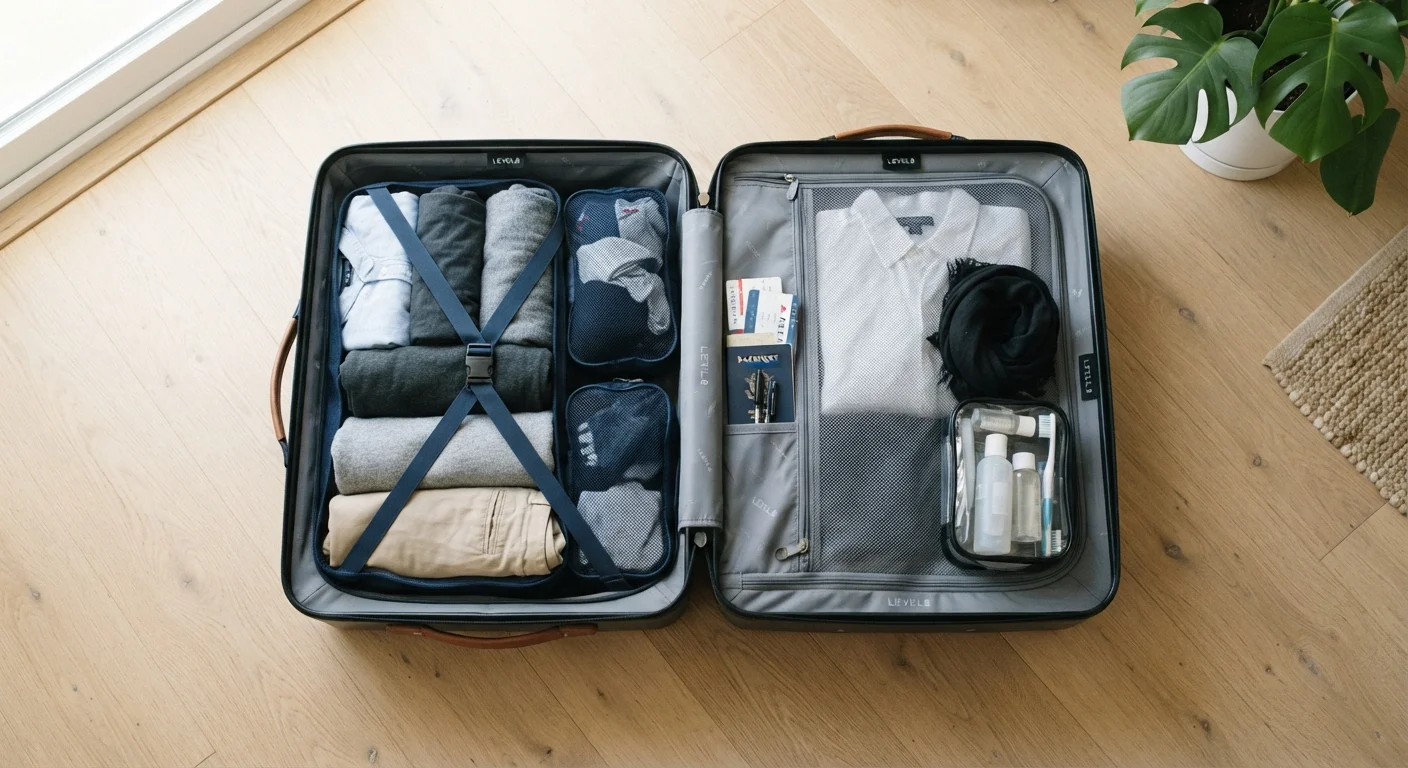
Start with shoes against the back panel (the side that will face the overhead bin). Place heaviest items - jeans, shoes, toiletry bag - closest to the wheels or at the bottom. Rolled clothing goes in the middle layer, packed tightly side by side like logs rather than stacked. Lightweight, last-minute items (scarves, chargers, snacks) fill gaps at the top and in exterior pockets.
Place packing cubes vertically rather than flat - this lets you see all contents at a glance without unpacking everything.
Minimize Your Shoes
Shoes are the most space-consuming items in any bag. For most seven-day trips, two pairs is the practical maximum in a carry-on: one worn on travel day (your bulkiest pair), one packed. Choose a neutral pair that works across casual, walking, and semi-dressed occasions. Sandals or flat shoes pack more efficiently than boots or thick-soled sneakers.
If you need a dressier option for one occasion, a lightweight fold-flat shoe or a dressy sandal takes up minimal space compared to a full heel or dress shoe.
Wear Your Bulkiest Items on Travel Day
Whatever doesn't fit in the bag goes on your body. Your heaviest jacket, thickest-soled shoes, and bulkiest sweater should be worn through the airport. Once on the plane, stow the jacket in the overhead or use it as a blanket. This trick alone can free up a full packing cube of space inside your carry-on.
Do a Final Weight and Size Check
Before leaving home, use a luggage scale to confirm your bag meets the weight limit for every airline on your trip. Then measure the bag's dimensions and compare against the carrier's published limits - not just the manufacturer's claim of 'carry-on size.' If you're connecting through multiple carriers, the strictest size limit applies.
Traveling carry-on only is one of the most reliable ways to reduce travel stress and avoid fees. For a complete picture of where those savings fit in your overall travel budget, see the day-by-day travel budget guide.
Use Your Hotel's Laundry Options Mid-Trip
If you're staying four or more nights, doing a quick mid-trip laundry refresh - whether at a coin laundry, hotel service, or sink-washing quick-dry fabrics - effectively doubles your wardrobe without adding a single extra item. This is especially practical on longer trips and lets you pack even lighter.
Keeping It Organized During the Trip
Packing well is only half the challenge - staying organized while traveling prevents the 'explosion suitcase' effect that makes repacking for the return trip a headache. Keep dirty clothes in a separate packing cube or a lightweight mesh bag from day one. This also makes it easy to identify what's clean without unpacking everything.
When moving between destinations, repack using the same order you used at home: shoes at the back, heavy items low, rolled clothes filling the middle. It takes five extra minutes and makes every hotel room transition smoother.
Short trips demand the same discipline as longer ones - sometimes more, because there's less room for error. The principles covered in maximizing a long weekend trip apply directly here: plan deliberately, pack purposefully, and resist the urge to add 'just in case' items that never get used.
Liquids Still Follow TSA's 3-1-1 Rule
Even with a perfectly packed carry-on, your toiletries must comply with TSA's 3-1-1 liquid rule: containers of 3.4 oz (100ml) or less, fitting in one quart-sized clear bag. Oversized liquids will be confiscated at security. Consider solid toiletry alternatives - shampoo bars, solid deodorant, and toothpaste tablets - to reclaim that space.