

Key Takeaways
Why Most Travel Budgets Fall Apart Before Day Three
The most common reason travel budgets collapse isn't overspending on a single splurge - it's structural. Most travelers set one lump-sum figure, subtract major bookings, and assume the rest will 'work out.' It rarely does, because daily travel spending is uneven by nature: some days cost twice as much as others, some costs are invisible until you're already on the ground, and the gap between an estimate and reality widens fast when you're jet-lagged and hungry in an unfamiliar city.
A day-by-day budget treats each 24-hour period as its own financial unit. It forces you to confront the real cost of a transit day versus a sightseeing day versus a slow beach day - and it gives you a decision framework when you're tempted to veer off plan. This guide walks through the exact steps to build one that holds up when reality hits.
Averages Can Mislead You
Published 'average daily cost' figures for destinations are often blended from wildly different traveler types - backpackers, business travelers, and luxury tourists all in one number. Always filter cost research by accommodation type and travel style closest to your own. Using an inflated average as your baseline will cause you to underpack your budget for the experiences you actually want.
If group travel is part of your plans, note that shared accommodation and transport can materially change the math - see how shared costs work in group travel budgets before finalizing your individual figures.
What You'll Need Before You Start
What you will need
Spreadsheet (Google Sheets or Excel)
Build and maintain your day-by-day budget with formulas that auto-calculate totals and remaining balances.
Travel budgeting app (e.g., Trail Wallet or TravelSpend)
Log daily expenses on the go in local currency with automatic conversion tracking.
Destination cost research sources (travel forums, expat blogs)
Gather realistic, recent, style-matched daily cost estimates for your specific destination.
Building Your Day-by-Day Budget
List every spending category you'll encounter
Start with a blank spreadsheet and list every category where money will leave your pocket during the trip - not just the obvious ones. Standard categories include accommodation, food and drink, local transportation (buses, taxis, subway), paid attractions and activities, international data or SIM card, laundry, tips and gratuities, souvenirs, and travel insurance (if not pre-paid). Add a catch-all 'miscellaneous' line for small unplanned costs like a bottle of water at a museum or a locker fee at a train station.
Skipping categories at this stage is the primary reason budgets fail. See our guide to spending categories that quietly erode travel budgets for a fuller list of often-overlooked costs.
Research real per-day costs for your destination and travel style
Find cost estimates that match how you actually travel. Budget travel forums, recent traveler blogs, and destination-specific subreddits typically provide more granular, current data than tourism websites. Search for posts from travelers with a similar accommodation preference - hostel dorms, mid-range hotels, and vacation rentals each produce very different daily totals. Note costs in local currency, then convert using a mid-market exchange rate (not the airport kiosk rate).
If your trip spans multiple cities or countries, repeat this research for each location - costs between cities in the same country can vary by 30-50%.
Build a calendar of your days, not a single average
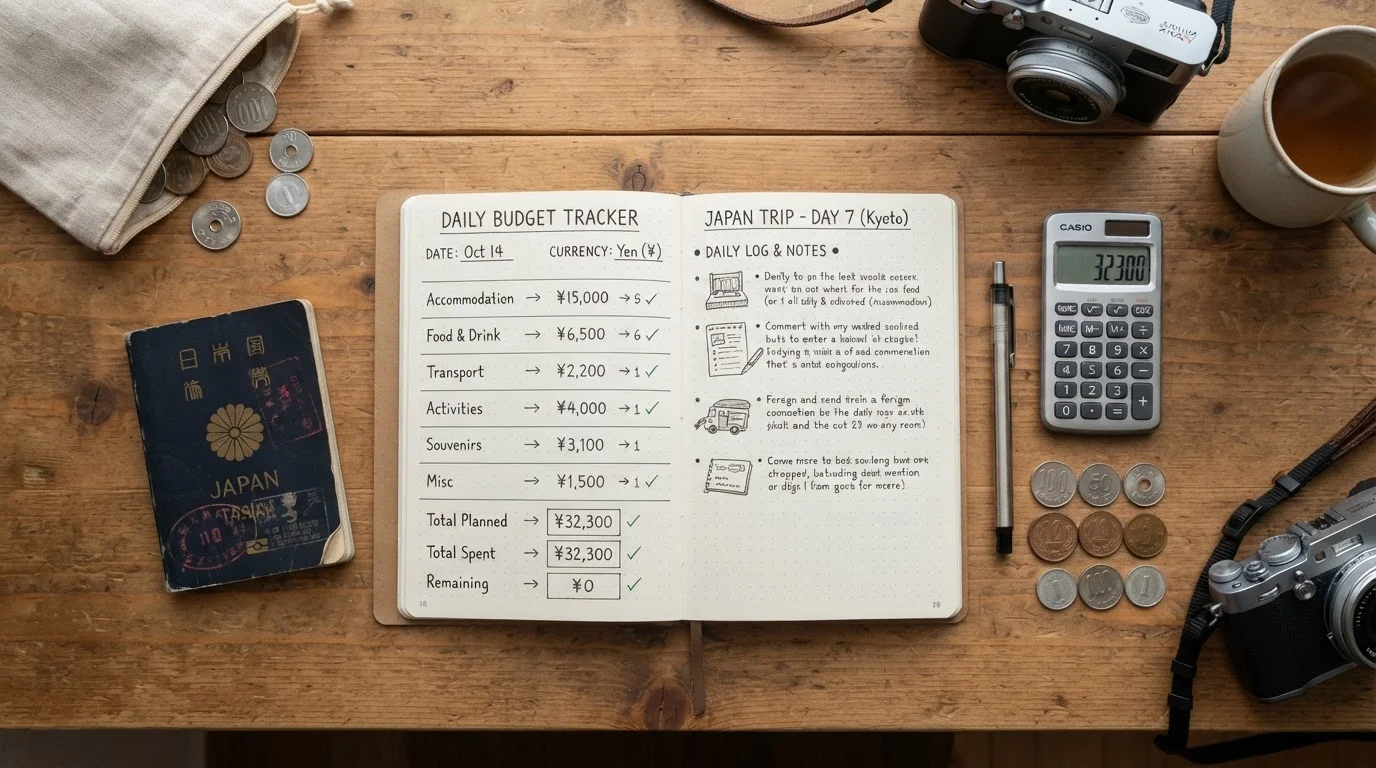
Open your spreadsheet and create one row per day, labeled by date and location. Assign estimated costs to each category for each day. This approach immediately reveals asymmetry: your arrival day likely includes an airport transfer and possibly a convenience-store meal at 11 p.m., while a full sightseeing day might have high activity costs but lower food spend if you're eating street food. A beach day might cost almost nothing outside accommodation.
Do not flatten these into a single daily average - the variance is precisely the information you need to avoid underfunding high-spend days. Flexible travel dates can also shift which days land as expensive transit days versus cheaper settling-in days.
Separate pre-paid fixed costs from daily variable costs
Flights, pre-booked accommodation, travel insurance, and rail passes are fixed costs you've already committed - remove them from your daily budget tracking once paid. What remains is your daily variable budget: the cash and card spending you control in real time on the ground. This separation prevents the psychological trap of feeling 'under budget' because you haven't spent your flight cost yet.
If you're still in the saving phase, see Travel Funds That Actually Work for guidance on building toward both fixed and variable totals before you book.
Add a contingency buffer of at least 15%
Sum your total projected variable spend, then multiply by 1.15 (or 1.20 for destinations with less predictable pricing or longer trip durations). This buffer covers minor medical expenses, price increases since your research, unexpected transport delays, and the costs of simply enjoying an unplanned experience without guilt. Keep the buffer in a separate, accessible account - not mixed with day-to-day spending money - so it's available when needed but not tempting to dip into casually.
[important_callout]Set a daily spending limit and track against it in real time
Divide your total variable budget (including buffer) by the number of trip days to get a working daily limit. Each day, log every purchase - ideally in real time or before bed at the latest. If you go over on a heavy activity day, you'll see immediately how much you need to scale back over the next few days to stay on course. This is the difference between a budget that guides behavior and one that just documents the damage afterward.
For the full pre-departure checklist that pairs with this approach, see our pre-trip planning checklist for budget-conscious travelers.
[tip_callout]Keeping the Budget Alive During the Trip
Building the budget is only half the work. Maintenance habits determine whether it survives contact with reality. A few practices make the biggest difference:
- Log daily, not weekly. By the time a week has passed, you've lost the context needed to recall what you actually spent and why.
- Review your remaining buffer mid-trip. At the halfway point, check how your actual spending compares to projections. If you're running ahead of pace, adjust activity choices for the second half rather than hoping it evens out.
- Avoid dynamic currency conversion (DCC). When a card terminal abroad offers to charge you in US dollars, decline - the conversion rate embedded in that offer is typically worse than your card's rate. This is one of the sneakier ways travelers overpay without realizing it.
- Eat strategically on high-spend days. On days with paid activities, shift toward markets, grocery stores, or street food for meals. See how to eat well on the road without blowing your food budget for practical options by destination type.
The goal isn't to spend as little as possible - it's to spend intentionally, so the money goes toward experiences that matter and not toward avoidable waste. A day-by-day budget is simply the tool that keeps those priorities visible throughout the trip.
This article provides general travel budgeting information for educational purposes only. Costs, exchange rates, and conditions vary and can change without notice. Always verify current conditions with official and local sources before traveling.