

Key Takeaways
Our Verdict
Each flea and tick prevention category has a distinct mechanism, safety profile, and practical trade-off. Spot-ons offer targeted application with monthly convenience; oral medications remove skin-contact concerns; collars provide long-duration protection but require careful handling in multi-pet households. No single format is universally superior - the right choice depends on your dog's health history, household composition, and lifestyle, and should always be guided by a licensed veterinarian.
| Best for | Recommended |
|---|---|
| Dogs with frequent water exposure or whose owners prefer a skin-applied option | Topical spot-on treatments |
| Households with cats or owners who want no residue concerns on furniture or family | Oral medications |
| Dogs in high-exposure environments needing continuous, long-duration coverage | Flea and tick collars (prescription or veterinarian-recommended formulas) |
How Flea and Tick Preventives Work
Flea and tick prevention products aren't one-size-fits-all - they operate through meaningfully different mechanisms depending on their active ingredients and delivery format. Understanding the basics helps you ask better questions at your next vet visit, rather than choosing based on price or packaging alone.
Most modern preventives target the nervous system of insects and arachnids (ticks are arachnids, not insects) using compounds that are selectively toxic to invertebrates at the doses used. The three main delivery categories - topical spot-ons, oral treatments, and collars - each get those compounds into or around your dog's body in different ways, with different onset times, durations, and handling requirements.
For a broader picture of your dog's preventive care calendar, see our guide to dog vaccination schedules, which covers how parasite prevention fits alongside core vaccines at different life stages.
Topical Spot-On Treatments
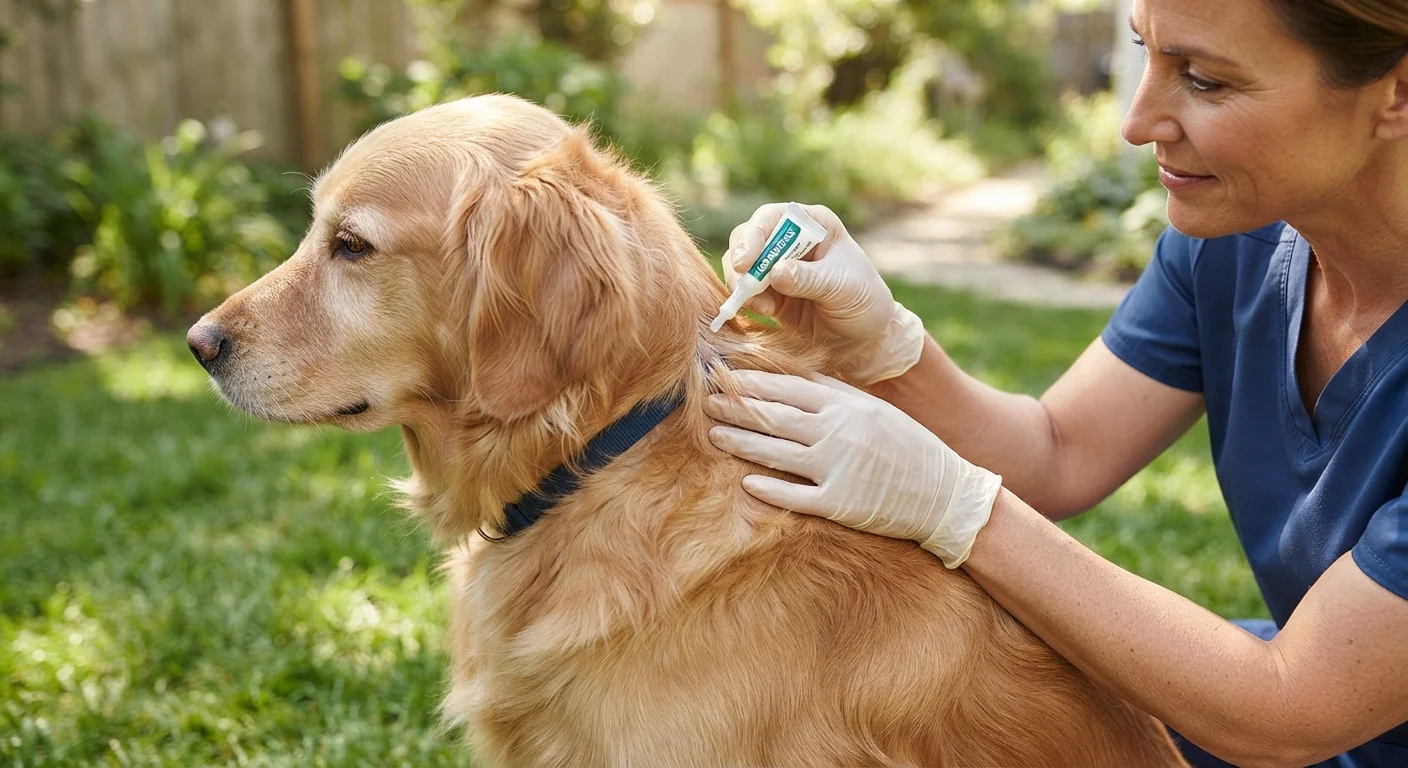
Spot-ons are liquid formulas applied directly to the skin, typically at the back of the neck where a dog cannot easily lick them. Once applied, the active ingredient spreads through the skin's surface oils (a process called translocation) or is absorbed into the bloodstream, depending on the specific compound.
Common active ingredient classes include:
- Pyrethroids (e.g., permethrin) - synthetic versions of naturally occurring compounds found in chrysanthemum flowers. These repel and kill both fleas and ticks. Important: permethrin is highly toxic to cats. In multi-pet households, treated dogs and cats should be kept separated until the product is fully dry.
- Fipronil - disrupts the central nervous system of fleas and ticks by blocking GABA-gated chloride channels, causing uncontrolled nervous activity and death in the parasite.
- Imidacloprid - a neonicotinoid compound that affects insect nerve receptors. Primarily effective against fleas rather than ticks.
Most spot-ons require reapplication every 30 days and may have reduced effectiveness if the dog is bathed frequently or swims regularly. Check the product's water-resistance window - it varies.
Permethrin and Cats Don't Mix
Many topical spot-on products formulated for dogs contain permethrin, which is highly toxic to cats even in small amounts. If you have cats in your home, check every ingredient label carefully before applying a spot-on to your dog, and keep pets separated until the treated area is completely dry. When in doubt, ask your veterinarian to recommend a cat-safe alternative.
Oral Flea and Tick Medications
Oral preventives are given by mouth, either as flavored chewables or tablets, and work systemically - meaning the active compound circulates in the dog's bloodstream. When a flea or tick feeds, it ingests the compound and is killed.
Key ingredient classes in oral products:
- Isoxazolines (a class that includes several prescription compounds) - these block glutamate-gated chloride channels in invertebrates, causing paralysis and death in fleas and ticks. They are among the most widely studied classes in this category and typically require a prescription.
- Nitenpyram - a fast-acting oral compound that kills adult fleas within hours but has no lasting residual effect; it's often used as a quick-knockdown tool rather than ongoing prevention.
- Spinosad - derived from a naturally occurring soil bacterium, it targets flea nervous systems and is primarily used for flea control rather than tick prevention.
Because oral medications work through the bloodstream, there are no surface residue concerns for family members or other pets. However, some dogs with a history of neurological conditions may not be candidates for certain isoxazoline products - your veterinarian will screen for this. Always disclose your dog's full health history before starting any new preventive.
Ask Your Vet About Your Dog's Full Profile
Before selecting an oral preventive - especially an isoxazoline-class product - share your dog's complete health history, including any history of seizures or neurological sensitivity. Most dogs tolerate these medications well, but individual screening matters. Your vet can also advise on appropriate timing relative to your region's flea and tick season.
Flea and Tick Collars
Prevention collars release active ingredients continuously from a polymer matrix embedded in the collar material. Depending on the formulation, the compound either sits on the skin surface or is absorbed transdermally and redistributed through skin oils.
Common collar ingredients:
- Flumethrin and imidacloprid (found in some prescription collars) - this combination targets both ticks and fleas through different mechanisms, providing extended protection that some formulations maintain for up to eight months.
- Tetrachlorvinphos (TCVP) - an organophosphate found in some over-the-counter collars. Organophosphates carry a broader toxicity profile and are generally considered higher-risk, particularly for children who handle the dog frequently.
Collar-based prevention is practical for dogs who resist monthly applications, but collars require careful handling: wash hands thoroughly after contact, store unused portions in their original packaging, and - critically - remove the collar before children play closely with the dog if the product label advises it.
Just as choosing the right preventive requires understanding your dog's temperament and household setup, so does decisions like crate training versus free roaming - small household decisions compound into your dog's overall wellbeing.
How to Compare Your Options
The table below summarizes the main practical differences across the three prevention categories. These are general characteristics - specific products within each category may differ, and a veterinarian's recommendation should always take precedence over general comparisons.
| Topical Spot-On | Oral Medication | Flea & Tick Collar | |
|---|---|---|---|
| How it works | Absorbed through or spread across skin | Circulates in bloodstream | Released continuously from collar matrix |
| Primary coverage | Fleas and ticks (varies by ingredient) | Fleas and ticks (varies by ingredient) | Fleas and ticks (varies by ingredient) |
| Typical duration | ~30 days | 30 days (some shorter) | Up to 8 months (varies) |
| Cat household safety | Risk with pyrethrins/permethrins | Generally lower contact risk | Requires careful handling |
| Water resistance | Varies; bathing may reduce efficacy | Not affected by water | Moderate; heavy soaking may reduce |
| Prescription typically required | Sometimes | Often (isoxazolines) | Sometimes (OTC options exist) |
| Application effort | Monthly parting of fur required | Oral dosing; treat-like options available | One-time fitting; check fit regularly |
This article is for general informational purposes only and does not constitute veterinary or medical advice. Always consult a licensed veterinarian before starting, changing, or discontinuing any flea or tick prevention product for your dog.