

Key Takeaways
Option A
Crate Training
The structured, den-like approach for dogs who benefit from clear boundaries.
Best for: Puppies, newly adopted dogs, anxious dogs, or dogs still learning household rules.
Option B
Free Roaming
The open, trust-based approach for dogs with proven impulse control.
Best for: Adult dogs with established house manners, low destructive tendencies, and solid recall.
If you have a puppy or newly adopted dog
Crate Training
Young and newly rehomed dogs lack the impulse control and household familiarity needed for safe free roaming. A crate provides structure and prevents costly or dangerous mistakes.
If your adult dog has never destroyed anything unsupervised
Free Roaming
A dog with a solid track record of calm, non-destructive behavior indoors is likely ready for expanded freedom, especially during shorter absences.
If your dog shows signs of anxiety or crate resistance
Crate Training
A properly conditioned crate - never used as punishment - can become a genuine refuge for anxious dogs. Skipping structure often worsens anxiety-driven behavior.
If you are away from home for long stretches daily
Free Roaming
Extended crating (beyond four to six hours for adults) is not appropriate. Dogs left this long benefit more from a dog-proofed room or the full home, paired with midday check-ins or a dog walker.
If you are transitioning from crate to more freedom
Free Roaming
Gradual expansion - one room at a time, supervised first - lets you confirm readiness before giving full access, reducing setbacks.
What Each Approach Actually Involves
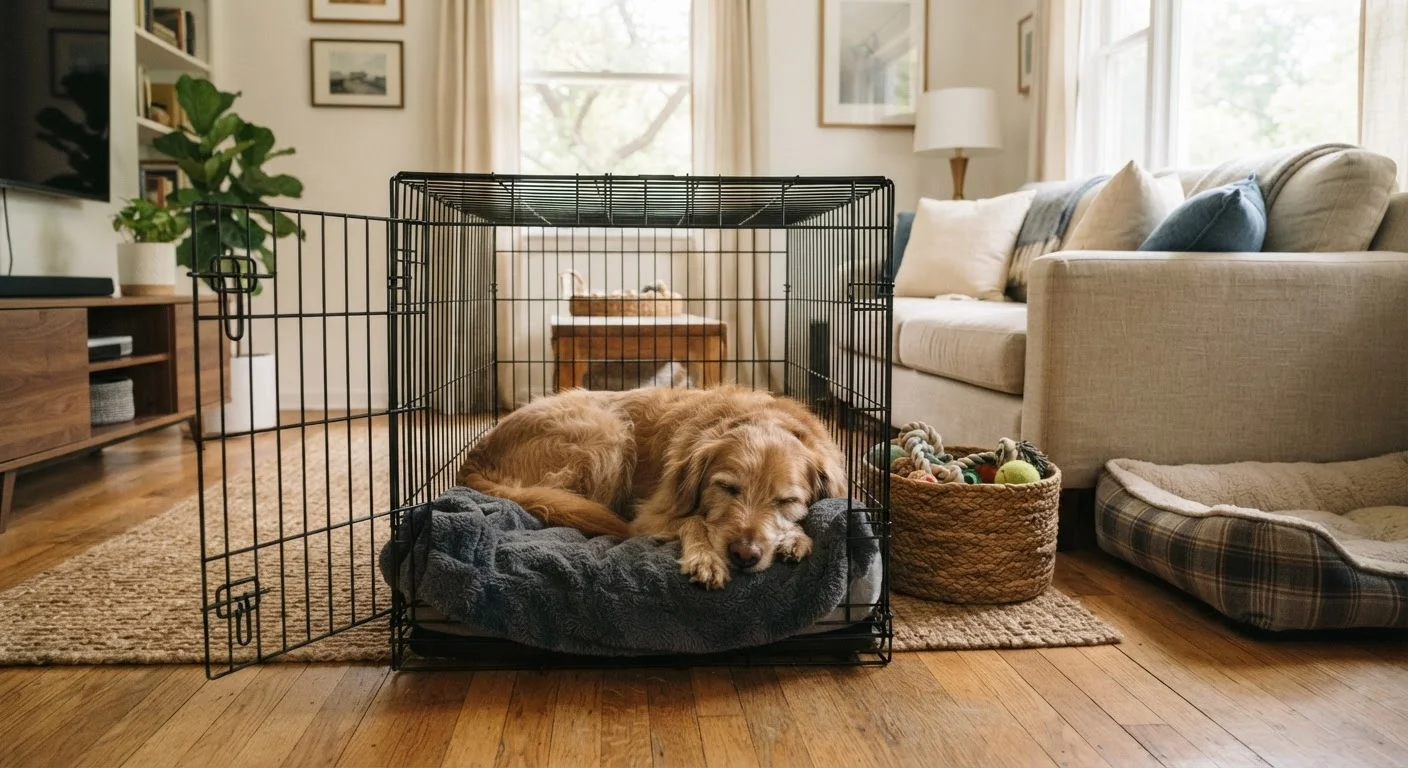
Crate training means introducing a dog to a secure, size-appropriate enclosure as a regular part of their routine. Done correctly, it capitalizes on a dog's natural tendency to seek out small, enclosed spaces for rest and security. The crate is not a punishment tool - it is a designated zone that helps dogs self-regulate when the household is busy or when they are left alone.
Free roaming means the dog has access to some or all of the home without confinement, relying on established behavior patterns rather than physical management. This can mean full home access or a dog-proofed section of the house, depending on the owner's comfort level and the dog's history.
Both require intentional management. Free roaming is not simply the absence of a crate - it is a level of trust that should be earned incrementally. And crate training is not simply locking a dog up - it is a training process that typically unfolds over days or weeks of positive conditioning. See our guide to early dog ownership for context on how these decisions fit into the broader picture of bringing a dog home.
| Criterion | Crate Training | Free Roaming |
|---|---|---|
| Best life stage | Puppies, newly adopted dogs | Mature, trained adult dogs |
| Housebreaking support | Strong - leverages denning instinct | Depends on existing training |
| Max unsupervised duration | 4-6 hours (adults); less for puppies | Flexible, if dog-proofed |
| Anxiety in anxious dogs | Can help or worsen - individual | May reduce or increase - individual |
| Safety from household hazards | High when crate is used correctly | Requires thorough dog-proofing |
| Training investment required | Moderate - positive conditioning needed | High - relies on prior training success |
| Suitability for long work days | Low - extended crating not advised | Higher, with dog-walker support |
How Temperament and Life Stage Shape the Decision
A dog's age is one of the strongest predictors of readiness for free roaming. Puppies under roughly 12 months are still developing impulse control and have not yet fully learned which household items are off-limits. Unsupervised access to a full home at this stage often leads to chewing, soiling, and safety hazards - all of which create setbacks in the broader training relationship.
Temperament matters just as much as age. High-energy breeds - particularly those in the herding, sporting, and working groups - may struggle with unsupervised freedom simply because boredom leads to problem-solving that owners rarely appreciate. Exercise needs vary significantly by breed group, and an under-exercised dog is more likely to cause damage whether crated or free-roaming.
Dogs showing separation-related distress - pacing, whining, destructive behavior focused near exits - present a more complex picture. For these dogs, the physical setup is secondary to addressing the underlying anxiety. A crate can help some anxious dogs feel contained and safe; for others, confinement intensifies distress. A veterinary behaviorist or certified applied animal behaviorist is the appropriate resource when anxiety is the core issue.
~4-6 hrs
Recommended maximum daily crate duration for adult dogs
Veterinary and animal welfare organizations generally advise against crating adult dogs for longer stretches during waking hours without a break.
12-16 hrs
Average daily sleep time for adult dogs
Dogs sleep considerably more than humans, which means a properly sized, comfortable crate often aligns well with natural rest patterns when used appropriately.
Practical Trade-Offs Worth Knowing
Crate training advantages: Accelerates housebreaking because dogs naturally avoid soiling their sleeping area. Prevents destructive behavior and access to hazards when unsupervised. Provides a portable safe space useful during travel or veterinary stays. Gives anxious dogs a predictable retreat.
Crate training limitations: Requires a conditioning period - a dog forced into a crate without positive introduction may develop negative associations. Not suitable for extended periods; adult dogs should generally not be crated for more than four to six hours during waking hours. Dogs with severe claustrophobia or prior crate-related trauma may not adapt well.
Free roaming advantages: Allows more natural movement and mental stimulation. Better suited for long work days when crating would exceed appropriate durations. Strengthens the trust relationship between dog and owner when the dog is genuinely ready.
Free roaming limitations: Requires confidence that the dog will not access hazardous items - cleaning products, certain houseplants, electrical cords, human food. Mistakes in a free-roaming setup can be costly and, in some cases, dangerous. It should be phased in gradually rather than granted all at once. Well-meaning management decisions can sometimes backfire when they outpace where the dog actually is in training.
A Gradual Path from Crate to Full Freedom
For most dogs, the healthiest long-term trajectory moves from structured crating toward increasing free-roaming access as trust is established. A common and effective approach:
- Start with the crate as the default when unsupervised, using positive reinforcement - treats, meals, and calm praise - to build a genuine comfort response.
- Expand to a single room once the dog is reliable in the crate. A gated kitchen or laundry room removes major hazards while giving more space.
- Add one room at a time, always supervised at first, watching for any signs of anxiety, destructive behavior, or inappropriate elimination.
- Grant full home access only after consistent success across multiple environments and varying absence lengths.
This staged approach also makes it easier to course-correct. If a dog struggles at any stage, stepping back is not a failure - it is an accurate read of where that dog currently is. For multi-dog or multi-pet households, transitions in the home environment add another layer of consideration to any confinement setup.
This article is for general informational purposes only and is not a substitute for guidance from a qualified veterinarian or certified animal behaviorist. If your dog shows signs of significant anxiety or behavioral difficulty, consult a professional.