

Key Takeaways
Why Good Intentions Can Make Things Worse
Most dogs don't develop persistent pulling, jumping, or barking because their owners ignored the problem. They develop it because their owners tried to fix it - but used methods that accidentally rewarded the behavior they wanted to stop. Understanding why these fixes backfire is the first step to replacing them with approaches that actually work.
Dog behavior is shaped by consequences. Whatever immediately follows a behavior determines whether that behavior is more or less likely to happen again. When the consequence of jumping is physical touch, eye contact, or a verbal response - even an irritated one - a socially motivated dog often registers that as a reward. The behavior gets stronger, not weaker.
If you've brought home a new dog recently, the realities of early dog ownership can help set realistic expectations around how long behavior shaping actually takes. And if exercise is part of your management strategy, knowing how much physical activity your dog's breed actually needs matters - a under-exercised dog will have far more energy to invest in unwanted behaviors.
93%
Dog owners reporting at least one persistent behavior problem
According to survey data cited in the American Veterinary Society of Animal Behavior's position statements, the vast majority of owners encounter ongoing behavioral challenges regardless of training history.
~0.5 sec
Window for effective behavioral feedback
Behavioral learning research consistently shows that a dog associates a consequence with whatever behavior occurred in the approximately half-second before the consequence was delivered.
The Most Common Training Mistakes - and How to Correct Course
The mistakes below appear across all breeds and life stages. They're common not because owners are careless, but because the logic behind them seems reasonable until you understand how dogs actually process feedback.
Repeating commands multiple times before the dog complies.
Why it happens: Owners assume that saying 'sit, sit, sit' adds clarity or emphasis, and patience feels like kindness in the moment.
Shouting or scolding a dog that barks excessively.
Why it happens: Raising your voice feels like a natural human response to noise, and owners hope the dog will recognize displeasure.
Pushing a jumping dog down with hands or knees, then continuing to interact.
Why it happens: Owners want to physically stop the jump but haven't yet disconnected that correction from ongoing social engagement.
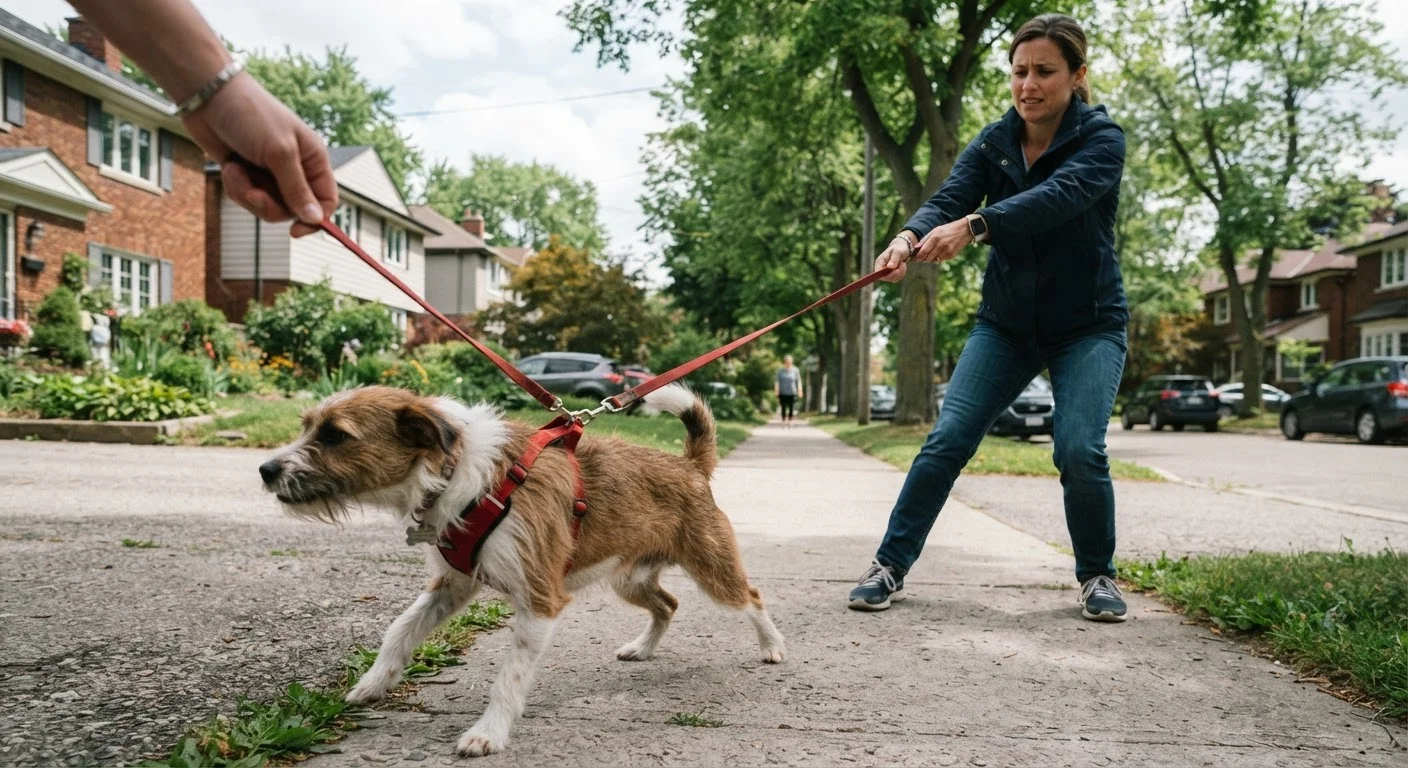
Letting the dog move forward after pulling on the leash.
Why it happens: Walks feel urgent - owners want to reach the park, get home, or avoid an awkward situation - so they allow forward motion despite tension in the leash.
Using the leash correction after - rather than during - the unwanted behavior.
Why it happens: Human reaction time is slow, and by the time an owner responds, the moment has already passed.
Training consistently for a week, then stopping when improvements appear.
Why it happens: Early wins feel like the problem is solved, and practice sessions fall away as life gets busy.
Punishment Can Increase Problem Behaviors
Physical corrections such as leash jerks, alpha rolls, or scruff grabs are not supported by current behavioral science and may increase fear, anxiety, and aggression in dogs. If your dog's behavior feels dangerous or unmanageable, consult a certified professional dog trainer or veterinary behaviorist before attempting further corrections on your own.
One pattern connects almost all of these errors: the fix inadvertently provides something the dog values - movement, attention, touch, social engagement - at the exact moment the unwanted behavior occurs. The dog doesn't decode your frustration; it logs the consequence.
Consistency across your entire household is equally critical. If one person enforces the four-paws-on-floor rule for jumping while another greets the dog warmly mid-jump, the dog receives intermittent reinforcement - which, counterintuitively, makes the behavior more persistent, not less.
Intermittent Reinforcement Is Hard to Undo
When an unwanted behavior is rewarded even occasionally - such as a dog that jumps and is sometimes greeted warmly - the behavior becomes more resistant to extinction, not less. This is the same mechanism behind gambling behavior in humans. Consistency across every interaction, including guests and family members, is essential to prevent accidental reinforcement from derailing your progress.
For owners working through multiple training challenges at once, it can help to consider how your dog's living arrangement affects stress and behavior. The choice between crate training and free roaming influences a dog's baseline anxiety and readiness to learn. Similarly, early socialization history shapes how a dog responds to strangers at the door - a key factor in both jumping and barking patterns.
This article provides general educational information about dog behavior and training. It is not a substitute for individualized guidance from a certified professional dog trainer or veterinary behaviorist, particularly for dogs displaying fear-based or aggressive behaviors.