

Key Takeaways
Missed Debt Payment
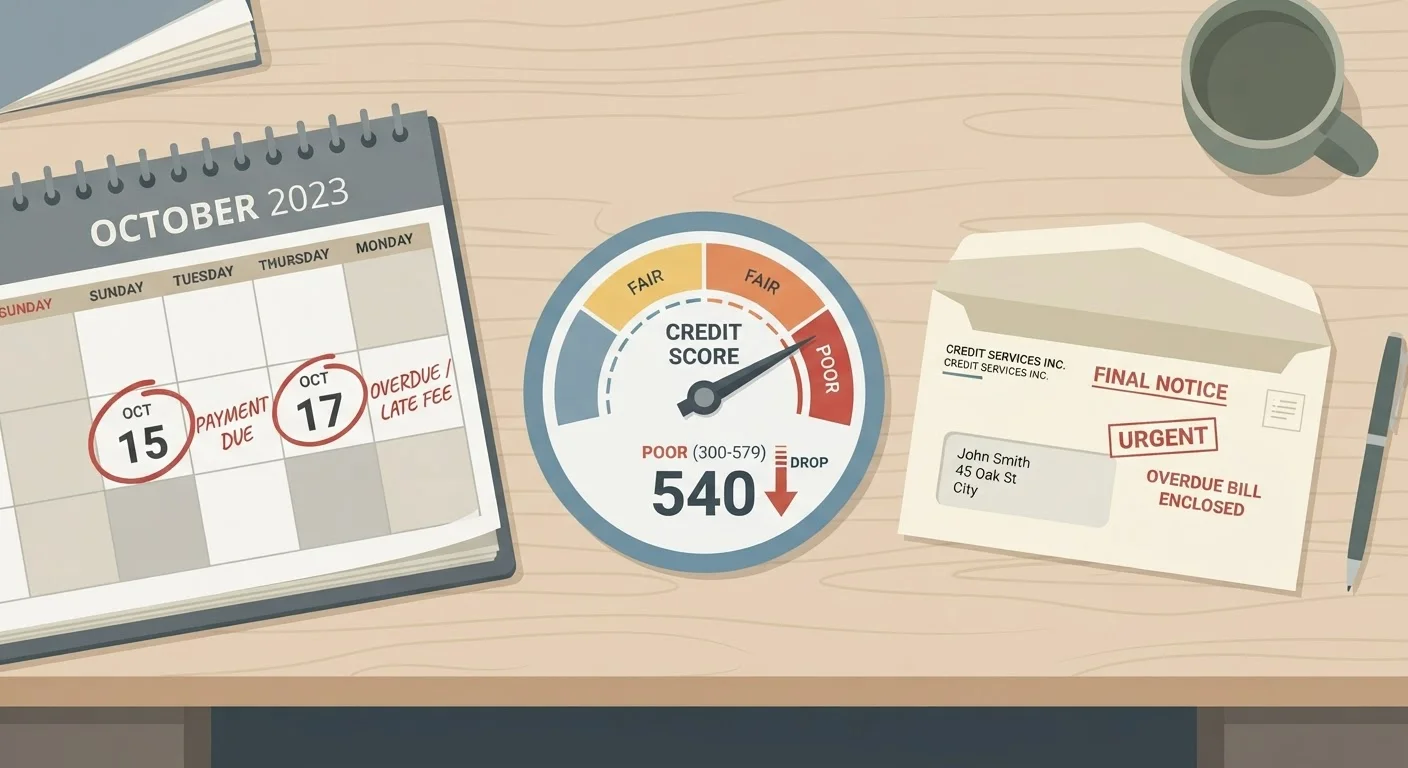
A missed debt payment occurs when you fail to make at least the minimum required payment by the due date on any credit account - including credit cards, loans, or lines of credit. The consequences follow a predictable timeline: late fees and penalty interest come first, then a credit score hit, and eventually potential collections activity. Understanding this sequence helps you intervene early and limit the damage.
Credit bureaus generally don't receive a delinquency report until a payment is at least 30 days past due. However, your lender may impose fees and a penalty APR the day after a missed due date, well before your credit score is affected.
Day 1 Through Day 29: Fees and Rate Changes
The moment your payment due date passes without a payment, the clock starts. Most lenders apply a late fee within one to a few business days - typically ranging from $25 to $40 on credit cards, though terms vary by lender and account type. This fee is charged on top of what you already owe.
Many credit card agreements also include a penalty APR - a higher interest rate, sometimes above 29%, that can trigger after a single missed payment. This rate may apply to your existing balance and any future charges, significantly increasing how much interest accrues. Check your cardmember agreement to understand when and whether this applies to your account.
One thing that doesn't happen yet: your credit report is unaffected. The major credit bureaus - Equifax, Experian, and TransUnion - don't receive a delinquency notice until a payment is at least 30 days overdue. That window matters. If you pay before the 30-day mark, you avoid a credit report entry entirely, even if you've already been charged a late fee.
Act Before Day 30 to Protect Your Credit
If you've missed a due date, paying within 29 days prevents any delinquency from appearing on your credit report. Even if you can't pay the full balance, making the minimum payment before that 30-day mark stops the most significant damage from occurring. Set a calendar reminder or autopay for the minimum to reduce this risk going forward.
Day 30 and Beyond: Credit Score Consequences
At the 30-day mark, your lender typically reports the missed payment to credit bureaus. This is where the damage to your credit score begins. Payment history is the single largest factor in most credit scoring models, accounting for roughly 35% of your FICO score.
The score drop from a first late payment varies, but borrowers with higher scores often see sharper declines - sometimes 50 to 100+ points - precisely because a clean history makes the new delinquency stand out more. For someone with a lower starting score, the drop may be smaller in absolute terms, but their options for recovering credit access are already more limited.
Each additional billing cycle you remain delinquent triggers a new, more severe category on your report: 60-day late, 90-day late, and so on. Each escalation is reported separately and compounds the damage. To understand how these marks fit into the broader picture of score erosion, see habits that quietly erode your credit score.
35%
Share of FICO score tied to payment history
According to FICO, payment history is the single largest factor in standard credit score calculations.
7 years
How long negative marks stay on credit reports
Under the Fair Credit Reporting Act, most negative items - including late payments and charge-offs - can remain on a credit report for up to seven years.
120-180 days
Typical window before a charge-off occurs
Most lenders charge off delinquent accounts after four to six months of non-payment, though timelines vary by creditor and account type.
Month 4 to 6: Charge-Offs and Collections
If a debt goes unpaid for roughly 120 to 180 days, the original lender will typically charge off the account. A charge-off is an accounting action - the lender declares the debt unlikely to be collected and writes it off as a loss. It does not erase what you owe. For a plain-language explanation of charge-off and related terms, see key terms every debt conversation relies on.
After a charge-off, the outstanding balance is often sold to a third-party debt collector. That collector now owns the debt and has the legal right to pursue collection, including contacting you by phone or mail, and potentially pursuing legal remedies depending on the amount and state law. A collections entry then appears on your credit report as a separate, additional negative mark - separate from the original lender's delinquency record.
Both the charge-off and the collections account can remain on your credit report for up to seven years from the original delinquency date. This is why early action - even a partial payment arrangement - matters so much. It stops the escalation before the account reaches this stage.
What You Can Actually Do About It
The most effective move at any stage is straightforward: contact your lender before or immediately after missing a payment. Many creditors offer hardship forbearance, temporary payment deferrals, or modified repayment plans that aren't advertised on their websites. Proactive borrowers often have more options than those who wait for collection calls.
If you're already past due, prioritize getting current on the accounts closest to the 30-day and 90-day thresholds, since those milestones drive the most damage. Once you're stabilized, a structured payoff approach can accelerate recovery. The debt avalanche and snowball methods offer two frameworks worth understanding based on your balances and interest rates.
For those earlier in the process - managing debt for the first time - building the habits that prevent missed payments is far less costly than recovering from them. The fundamentals of payment timing, minimum amounts, and credit utilization are covered in managing debt as a first-timer.
Hardship Programs Are More Common Than You Think
Many banks, credit unions, and credit card issuers maintain formal hardship programs for borrowers facing temporary financial difficulty. These may include reduced interest rates, waived fees, or deferred payments. These programs are rarely advertised prominently, so you typically need to call and ask directly. Eligibility and terms vary by lender.
This article is for general informational purposes only and does not constitute personalized financial or legal advice. Consult a qualified financial professional for guidance specific to your situation.