

Key Takeaways
The Drawer Isn't the Problem
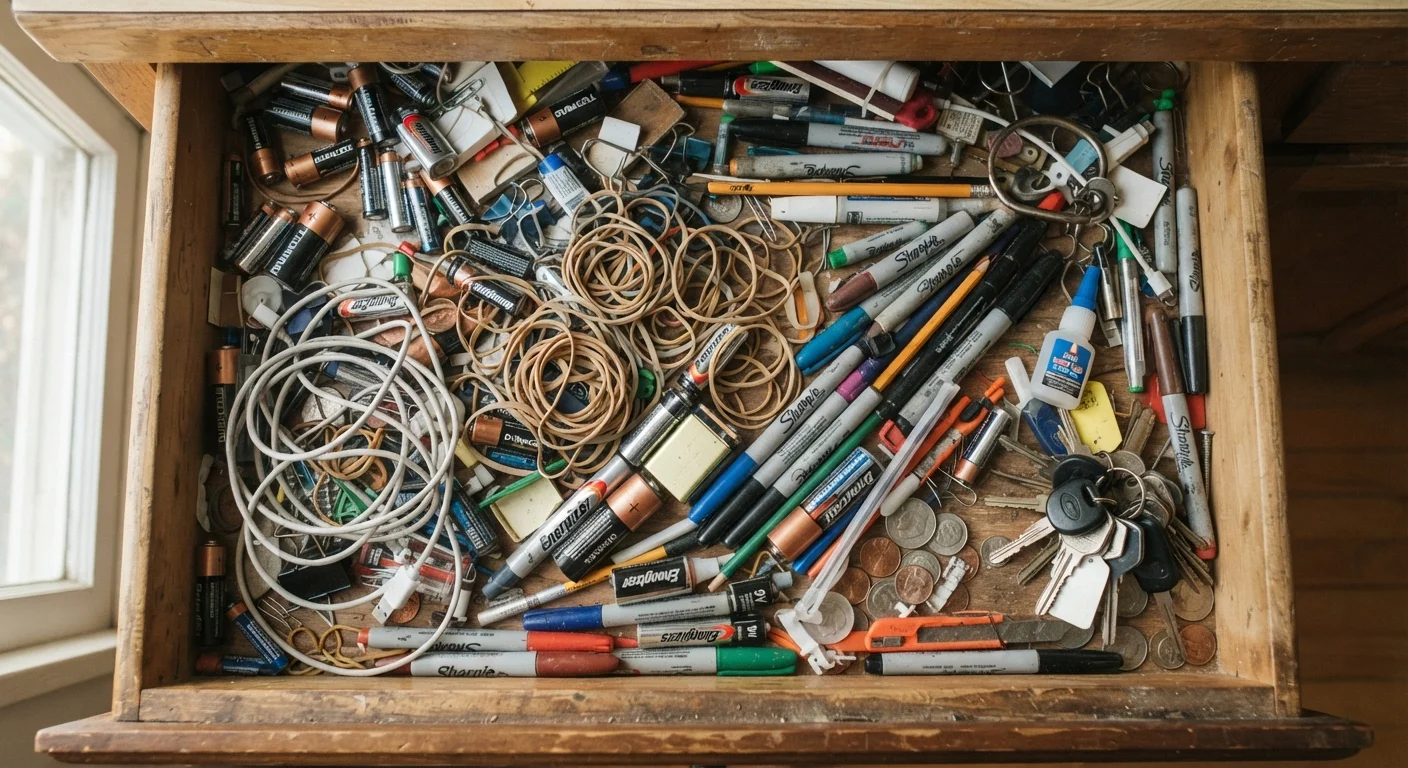
Almost every home has one: a drawer that collects batteries with uncertain charge, takeout menus for restaurants that closed years ago, and at least three mystery keys. The frustrating part isn't that it exists - it's that it fills right back up days after you've cleaned it out.
The junk drawer is less a storage choice and more a symptom. It reveals how your household currently handles items that don't have a clear, committed home. Until that underlying pattern changes, the drawer will keep refilling regardless of how many times you reorganize it. Understanding the specific habits driving that cycle is the first step toward actually breaking it - and the payoff extends well beyond one drawer. As research into disorganization's real costs suggests, persistent clutter carries measurable consequences for time, money, and daily stress.
Treating the drawer as a default landing zone for any item without an obvious home.
Why it happens: When you're in a hurry, dropping something in the drawer feels like a temporary solution - but 'temporary' rarely gets revisited.
Reorganizing the drawer without addressing why items ended up there in the first place.
Why it happens: A clean-out feels productive and complete, so it's easy to stop there rather than examining the underlying habit driving accumulation.
Keeping items 'just in case' without evaluating how likely that case actually is.
Why it happens: Loss aversion makes discarding feel risky, so vague future utility becomes justification for keeping almost anything.
Allowing the drawer to serve multiple, undefined purposes for every household member.
Why it happens: Without shared rules, everyone uses the space differently - one person's 'organized' is another person's dump zone.
Skipping a regular review, assuming a one-time clean-out will last.
Why it happens: Maintenance feels less rewarding than a big declutter, so it tends to get postponed indefinitely.
Building Habits That Stick
Cleaning the junk drawer is satisfying. Keeping it clean requires a different kind of effort - one focused on systems rather than sorting sessions. The goal isn't a perfectly curated drawer; it's a household where items flow in and out of defined places without piling up.
23 min
Average time lost daily to disorganization
According to organizational research cited by the National Association of Productivity and Organizing Professionals, disorganization costs the average person roughly 23 minutes of searching time per day.
1 in 4
Adults who report buying duplicates due to clutter
Surveys on household habits consistently find that a significant share of consumers repurchase items they already own because they can't locate them - a direct financial cost of disorganization.
A useful starting point is a two-minute evening reset: any item left on a counter or dropped in the drawer gets returned to its designated spot before the day ends. This habit works because it interrupts accumulation before it compounds. Pair it with a clear rule about what the drawer is actually for - a small category of genuinely miscellaneous items, not an overflow bin for everything unresolved.
For homes where paper adds to the chaos, managing documents separately prevents receipts, manuals, and notes from crowding out the drawer's actual contents. And if you're weighing whether to declutter continuously or in occasional focused sessions, comparing the two main declutter philosophies can help you find a rhythm that fits your household.
Organizing Products Won't Fix the Habit
Drawer dividers, label makers, and small bins are useful tools - but they don't address why clutter accumulates in the first place. Buying organizational products before establishing new habits often results in neatly arranged clutter. Focus on the decision-making habit first, then add physical tools to support it.
The junk drawer problem is ultimately a decision-deferral problem. Every item inside it represents a moment when someone chose not to decide where something belongs. Build the habit of deciding on contact - and the drawer, finally, has a chance to stay clear.