

Key Takeaways
Being Organized
Being organized means your home functions in a way that lets you find what you need, complete daily tasks, and recover from mess without significant stress or wasted time. It is not a specific aesthetic, a particular product, or a level of visual tidiness - it is a functional state that looks different in every household. A system is organized if it reliably works for the people using it, regardless of what it looks like to an outside observer.
Organizational psychology distinguishes between 'visual organization' (appearance of order) and 'functional organization' (efficiency of retrieval and use) - the two do not always overlap, and functional organization is the stronger predictor of reduced cognitive load.
The Functional Definition of Organization
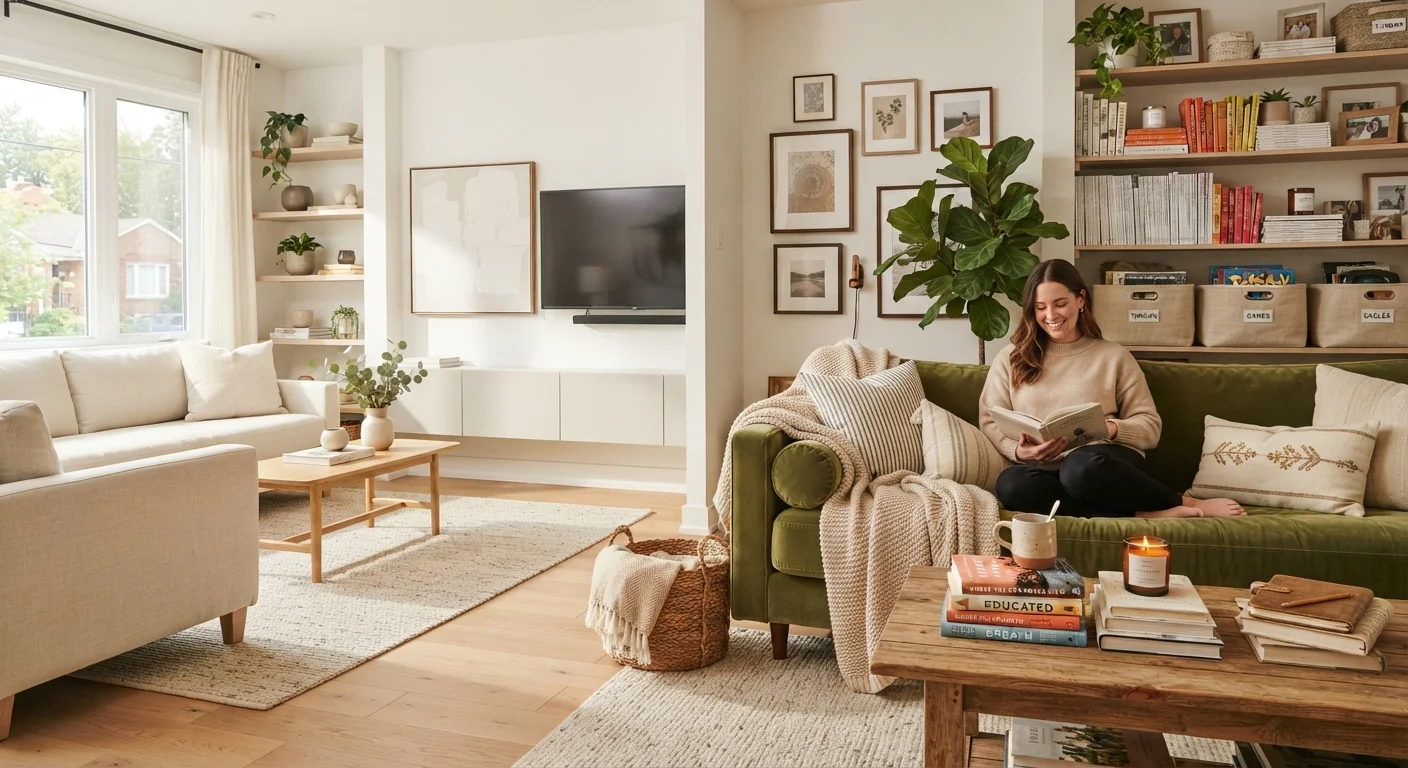
Most people picture organization as a magazine spread: matching containers, bare countertops, color-coded shelves. That image is aspirational, but it has little to do with whether a home actually functions well. A household is organized when its members can reliably find what they need, move through daily routines without friction, and recover from normal disorder without significant effort.
That definition shifts the measure from appearance to performance. A kitchen where every utensil lives in a labeled drawer may look organized but require ten minutes to locate a peeler. A kitchen where tools cluster near the stove in a ceramic crock may look casual but support fast, efficient cooking. The second kitchen is more organized in any meaningful sense.
This distinction matters because chasing a visual standard that does not match your habits sets you up for repeated failure - you organize, the system collapses, and you conclude that you are simply 'not an organized person.' In most cases, the system was wrong, not the person.
Visual Tidiness Isn't the Only Metric
A home can appear tidy but still be functionally disorganized - items may be stored inconsistently, making them hard to find under pressure. Conversely, a home with visible clutter may have a clear, reliable internal logic that works well for its occupants. Evaluating your system by how it performs, rather than how it looks, leads to more honest and useful improvements.
Why Organization Looks Different for Every Household
Several real factors shape what an effective system looks like for any given home. Understanding them helps you design around your actual life rather than an imagined one.
Cognitive style
Some people think spatially and navigate well with visual cues - open shelving, transparent bins, and items left in sight work well for them. Others find visible items distracting and function better when things are stored out of sight in consistent locations. Neither preference is a flaw; each requires a different storage approach.
Household composition
A single adult, a couple with opposing tidiness thresholds, and a family with young children all have different organizational needs and realistic maintenance capacity. Systems designed for one profile often fail when applied to another. A home where household members disagree on standards benefits from negotiated minimums rather than one person's ideal.
Routine patterns
The most durable systems are built around what people actually do, not what they intend to do. If mail consistently lands on the kitchen counter, a mail station there works better than a designated office inbox that nobody uses. Designing with real behavior - not aspirational behavior - is the single most reliable predictor of a system holding over time.
~30 min
Average daily time lost searching for misplaced items
Researchers studying household productivity have estimated that adults spend roughly 30 minutes per day locating misplaced objects, highlighting the real cost of disorganized systems.
2-3 areas
High-friction zones that generate most household disorder
Organizational consultants commonly observe that the majority of a home's recurring mess originates from just a few high-use transition zones such as entryways, kitchen counters, and mail drop spots.
Where Small Changes Deliver the Biggest Returns
You do not need to reorganize your entire home to experience meaningful improvement. Most daily friction comes from a small number of high-use areas: entryways, kitchen work zones, bathroom counters, and wherever paperwork accumulates. Addressing just two or three of these points typically produces a noticeable shift in how smoothly a household runs.
A useful exercise: track for one week where you waste time searching, where you leave things 'just for now,' and where clutter re-accumulates fastest. Those are your highest-leverage targets. Improving them is far more effective than organizing a rarely-used spare room to perfection.
Zone-based organization offers a structured way to apply this logic across a whole home - assigning a clear function to each area so items always have an obvious destination.
Start With One Friction Point, Not the Whole Home
Resist the urge to reorganize everything at once. Choose the single area that costs you the most time or stress each day - a chaotic entryway, a cluttered junk drawer - and build a simple, maintainable system there first. Success in one area builds both confidence and practical insight you can apply elsewhere.
Building a System That Actually Lasts
One-time organizational overhauls rarely stick because they treat disorder as a problem to solve rather than a condition to manage. Lasting organization depends on two things: systems that are easy to maintain, and regular small resets before disorder compounds.
Maintenance does not mean daily deep-cleaning. It means building micro-habits into existing routines - wiping a surface while waiting for coffee, returning items to their zone before leaving a room, or doing a five-minute weekly scan of a high-traffic area. These small actions prevent the accumulation that makes re-organizing feel overwhelming.
It is also worth auditing your system periodically. Households change - new members, new jobs, new routines - and a system that worked at one life stage may need adjustment. If a section of your home is consistently messy despite good intentions, that is usually a signal that the system needs redesign, not that more discipline is required.
For a broader look at how different organizational frameworks handle these challenges, an honest overview of popular organization systems can help you identify which approach fits your household's style. And if you are building organizational habits from scratch, a ground-up guide for first-time households provides a comprehensive starting point.