

Key Takeaways
Why Kid Clutter Is Its Own Category
Clutter in a home with children operates differently from adult clutter. It multiplies faster, migrates further, and resists conventional solutions because the people generating it change their preferences every few months. A storage system built for a five-year-old may be useless by age seven.
Understanding this helps reframe the goal. Rather than achieving a permanently tidy home - an unrealistic standard in most active households - the aim is to build systems flexible enough to absorb the chaos without letting it dominate. As our research-backed look at why clutter overwhelms explains, visual disorder has measurable effects on focus and stress, which makes managing it worthwhile even if perfection isn't achievable.
The practices below focus on structure over perfection - and on getting kids involved so the systems actually hold.
Proven Practices for Managing Household Clutter with Children
These approaches work across a range of household sizes, ages, and layouts. Adapt them to your specific situation rather than applying them wholesale.
Rotate toys instead of storing them all at once
When every toy is accessible simultaneously, children are often overwhelmed by choice and less engaged with any single item - a phenomenon sometimes called 'toy overload.' Rotating a subset of toys in and out of a storage area keeps the playspace manageable and renews interest in items that have been out of sight. It also dramatically reduces floor coverage at any given time.
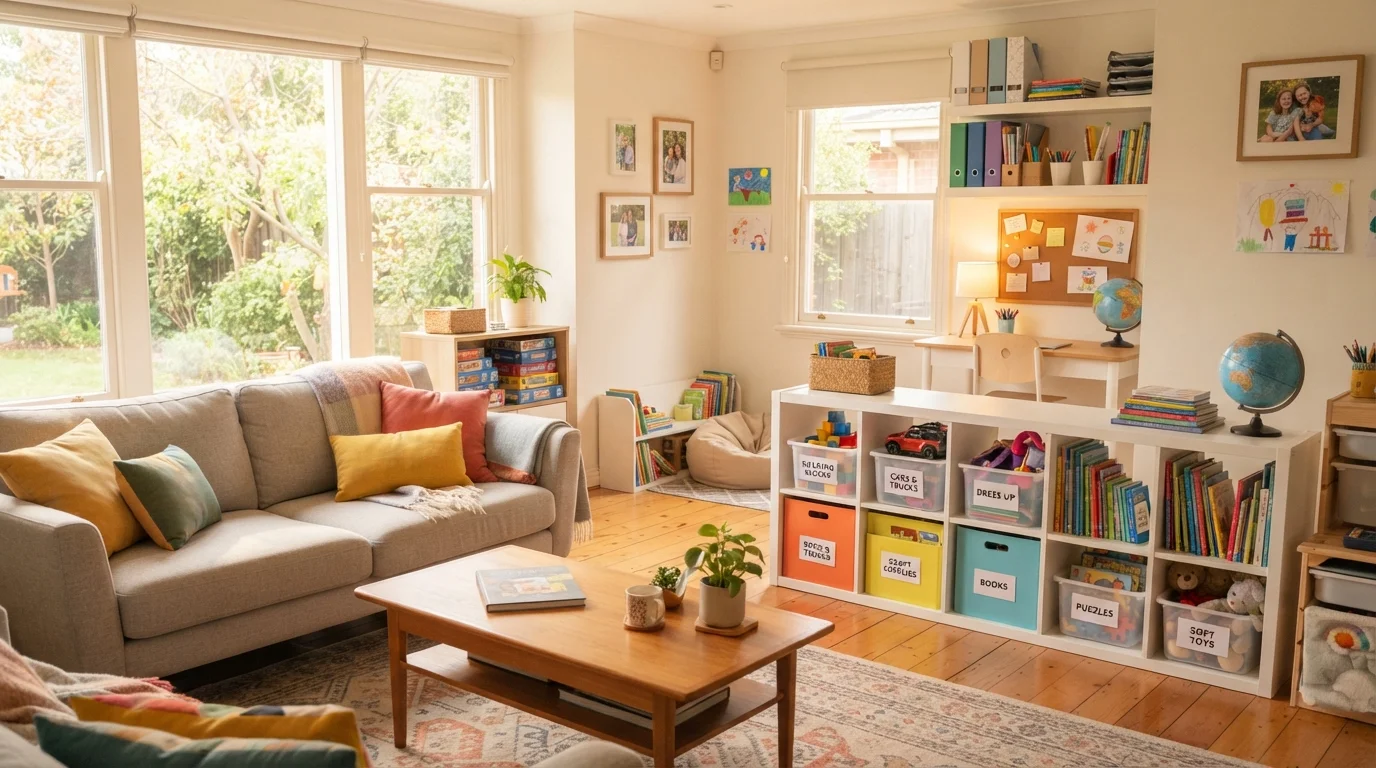
Assign a specific home for every category of item
Generic tidying instructions ('clean up your room') fail because children - and adults - need to know exactly where things go. Zone-based thinking gives every item a designated place, which makes both putting away and locating things faster. It also makes it easier to notice when a category has grown beyond its allotted space. Our guide to zone-based organization breaks this approach down in full.
Involve children in decluttering decisions
Systems imposed without input are rarely maintained by the people they're meant to serve. Children who participate in choosing what to keep, donate, or discard develop a genuine sense of ownership over their space. This doesn't mean children make all the decisions, but giving them meaningful choices at age-appropriate levels increases cooperation and builds lasting habits.
Implement a daily five-minute reset
Infrequent deep-cleaning sessions are ineffective in active family homes because clutter compounds faster than a once-a-week session can address. A short, daily reset - done at the same time each day - prevents accumulation from reaching the point where tidying feels overwhelming. Consistency matters more than duration.
Apply a one-in, one-out rule for new items
Children receive new toys, books, and supplies regularly through gifts, school events, and shopping trips. Without a corresponding reduction, the total volume grows steadily regardless of how well the existing system is organized. A consistent one-in, one-out policy keeps the inventory stable over time. Our comparison of one-in-one-out and seasonal purging explores when each approach fits best.
Keep shared spaces governed by the simplest possible rules
Complex organizational rules break down quickly in shared family spaces because not every household member will remember or follow them consistently. The more straightforward the rule, the more durable it is. Simplicity also reduces friction during the tidying process, making it less likely to be skipped.
Tackling Schoolwork and Paper Buildup
Paper is one of the most stubborn clutter categories in family homes. Between permission slips, graded assignments, art projects, and school newsletters, the volume can become unmanageable within weeks. The key is deciding in real time rather than accumulating and sorting later.
Create a simple inbound tray near the entry or kitchen - one per child - where all school-generated paper lands on arrival. Once a week, spend five minutes per child sorting: recycle what's done, file or digitize anything worth keeping (artwork, standout assignments, records), and act on anything that requires a response. For detailed guidance on managing the broader paper problem at home, see our article on how to actually manage documents at home.
Photograph Before You Discard
For artwork or school projects too large to store, taking a photo before recycling preserves the memory without the physical footprint. Apps designed for document and artwork scanning can create organized digital albums by child and school year. This is especially helpful for sentimental items that would otherwise accumulate in boxes indefinitely.
Schoolwork decluttering also benefits from a once-a-year portfolio review. Keep a dedicated folder or archive box per child and let them choose a small number of items to save at the end of each school year. This limits sentimental accumulation without dismissing it.
Quick Wins You Can Start Today
You don't need a full reorganization weekend to improve your home's daily function. These actions deliver noticeable results with minimal setup time.
For households managing disagreements about tidiness standards alongside child-related clutter, the strategies in organizing a home when households disagree offer a useful complement to the systems above.