

Key Takeaways
Passive Safety Systems
Passive safety systems are vehicle features that protect occupants during a crash without requiring any action from the driver or passengers. Unlike active safety systems (such as anti-lock brakes), passive systems - including seatbelts, airbags, and crumple zones - activate automatically at the moment of impact. They work together as a coordinated network rather than independently.
Engineers refer to this integrated approach as 'occupant restraint system design,' where each component's performance parameters are calibrated to complement the others within a defined crash pulse sequence.
The Engineering Logic Behind Passive Safety
When a vehicle collides with another object, an enormous amount of kinetic energy must go somewhere. The engineering challenge isn't eliminating that energy - physics prevents it - but controlling where and how it is absorbed so occupants survive. That's the central purpose of passive safety systems.
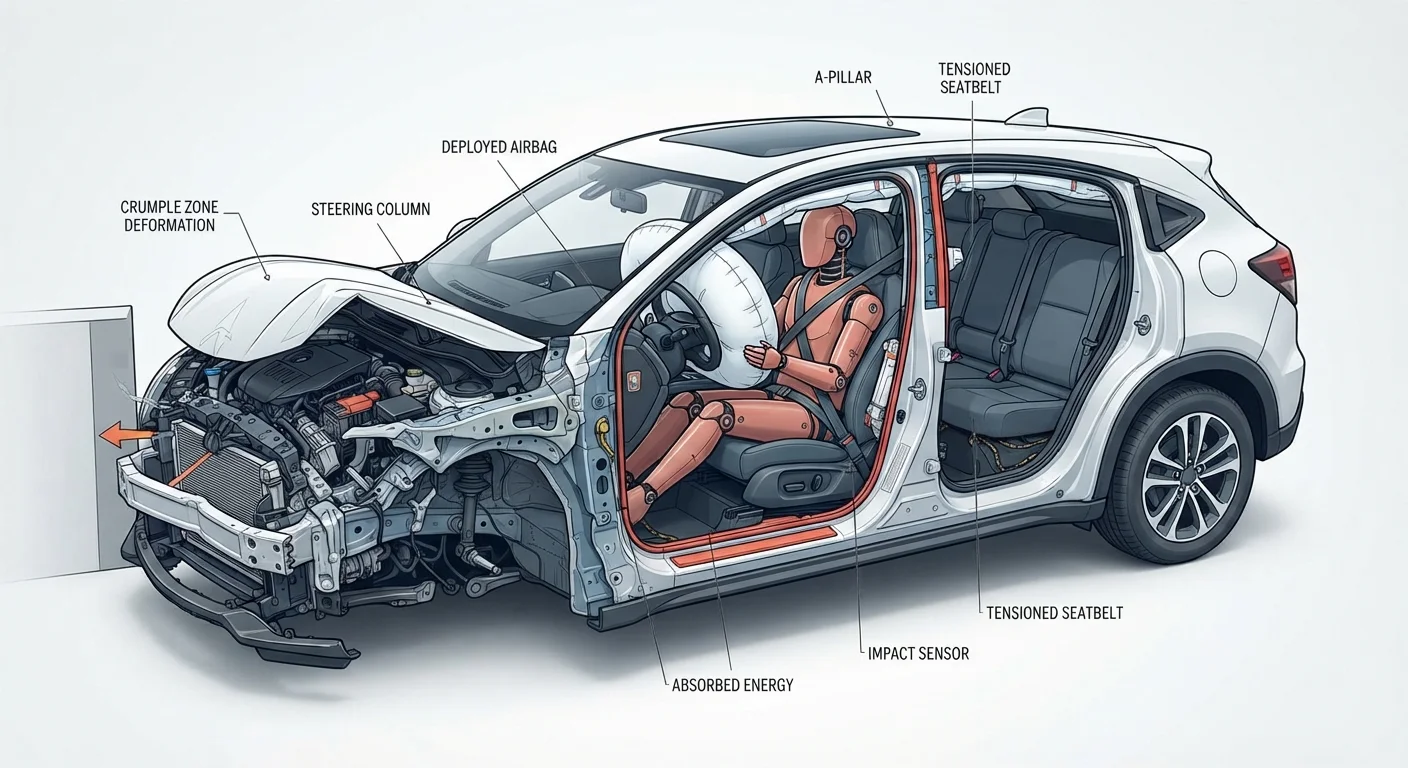
The term passive is key: these systems require no deliberate action from you. The moment a crash occurs, a carefully timed sequence begins. Crash sensors fire. Crumple zones deform. Seatbelt pretensioners lock and retract. Airbags inflate. Each step happens in fractions of a second, and each depends on the others performing correctly. Understanding this sequence explains why the popular assumption - that airbags alone can protect you - is dangerously incomplete.
~45%
Reduction in front-seat fatality risk from seatbelts
NHTSA estimates that seatbelts reduce the risk of death for front-seat passenger vehicle occupants by approximately 45 percent in crashes.
30ms
Time for a front airbag to fully inflate
Front airbags typically reach full inflation within roughly 30 milliseconds of crash sensor activation - faster than a human blink reflex.
~50%
Of traffic fatalities involved unrestrained occupants
NHTSA data consistently shows that roughly half of passenger vehicle occupant fatalities each year involve people who were not wearing seatbelts.
Crumple Zones: Managing Energy Before It Reaches You
Crumple zones are sections of a vehicle's structure - most prominently the front engine bay - engineered to deform in a predictable, controlled manner during a collision. Rather than transmitting the full force of impact rigidly into the passenger cabin, the crumple zone absorbs and dissipates that energy through the work of deformation.
Think of it this way: a stiff, rigid structure transfers shock instantly. A controlled crumple extends the duration of the crash event, lowering the peak deceleration force experienced by the people inside. Engineers call this managing the crash pulse. The passenger cell itself - the structural cage around the occupants - is deliberately built to remain rigid while the surrounding zones collapse.
This energy management creates the window of time, measured in milliseconds, during which seatbelts and airbags can do their work effectively.
Seatbelts: The Foundation the Rest Depends On
No other passive safety component performs its function correctly if the occupant isn't properly restrained by a seatbelt. This is the most important sentence in this article.
Modern seatbelts include a pretensioner - a small pyrotechnic device that instantly retracts slack from the belt at the moment of impact - and a load limiter that allows controlled belt webbing to pay out gradually, managing the force applied to the occupant's chest and abdomen. Together, these features keep you in the correct seated position throughout the crash event.
That positioning is not incidental. Airbag deployment is calibrated for an occupant who is seated upright and restrained. An unbelted person slides forward under inertia before the airbag deploys, placing them in precisely the wrong location when a bag inflates at over 200 mph. The result can be severe head and chest trauma - caused by the safety system itself interacting with an unrestrained body.
Consistent, correct seatbelt use on every trip - regardless of trip length - is what makes the rest of the system functional. The risks that make restraint essential don't disappear on short drives; many serious crashes occur within a few miles of home. For context on how driving behavior affects collision risk, see our breakdown of aggressive driving patterns and the crash risks they create.
Check Your Seatbelt Fit Every Time
A seatbelt only performs correctly when worn properly: the lap belt should sit low across the hip bones, not the abdomen, and the shoulder belt should cross the chest and collarbone - never tucked behind your back or under your arm. Improper positioning can redirect crash forces to vulnerable areas and reduces the belt's ability to keep you in position for airbag deployment.
Airbags: Supplemental, Not Standalone
The full name printed in most vehicle owner's manuals is Supplemental Restraint System (SRS) - a deliberate reminder that airbags supplement the seatbelt, not replace it. Front airbags deploy in moderate-to-severe frontal collisions. Side-curtain airbags address lateral impacts and rollover events. Knee airbags help control lower-body movement. Each is positioned and calibrated to work with a belted occupant in the expected seated position.
Deployment is triggered by accelerometers that detect sudden deceleration consistent with a crash. The signal travels to an inflator module in milliseconds, releasing a controlled chemical reaction that rapidly fills the bag with gas. Just as rapidly, vents in the bag allow it to deflate, cushioning rather than trapping the occupant. The entire inflation-and-deflation cycle can occur in under 100 milliseconds.
Modern vehicles typically feature six or more airbags. Each adds a layer of protection for a specific crash scenario, but none of them function as intended for an occupant who has moved out of position due to not wearing a seatbelt.
Why the System Only Works as a System
Remove any one component from this chain and the others are compromised. A crumple zone that absorbs energy correctly still delivers that managed deceleration force to an unbelted occupant. An airbag that deploys perfectly can injure someone who isn't seated where the engineers assumed they would be. A seatbelt without a properly structured vehicle around it has limits on the forces it can manage alone.
Vehicle safety standards in the United States - governed by the National Highway Traffic Safety Administration (NHTSA) - and independent crash-testing programs evaluate vehicles on how well all these elements function together under standardized collision scenarios. Ratings reflect system performance, not individual component performance.
The practical takeaway is straightforward: buckle every occupant on every trip, ensure children are in appropriate, correctly installed child restraints, and understand that the engineering invested in your vehicle's passive safety only reaches its potential when you use the seatbelt.
This article is for general educational purposes only. Always consult your vehicle's owner's manual and qualified automotive safety professionals for guidance specific to your vehicle.