

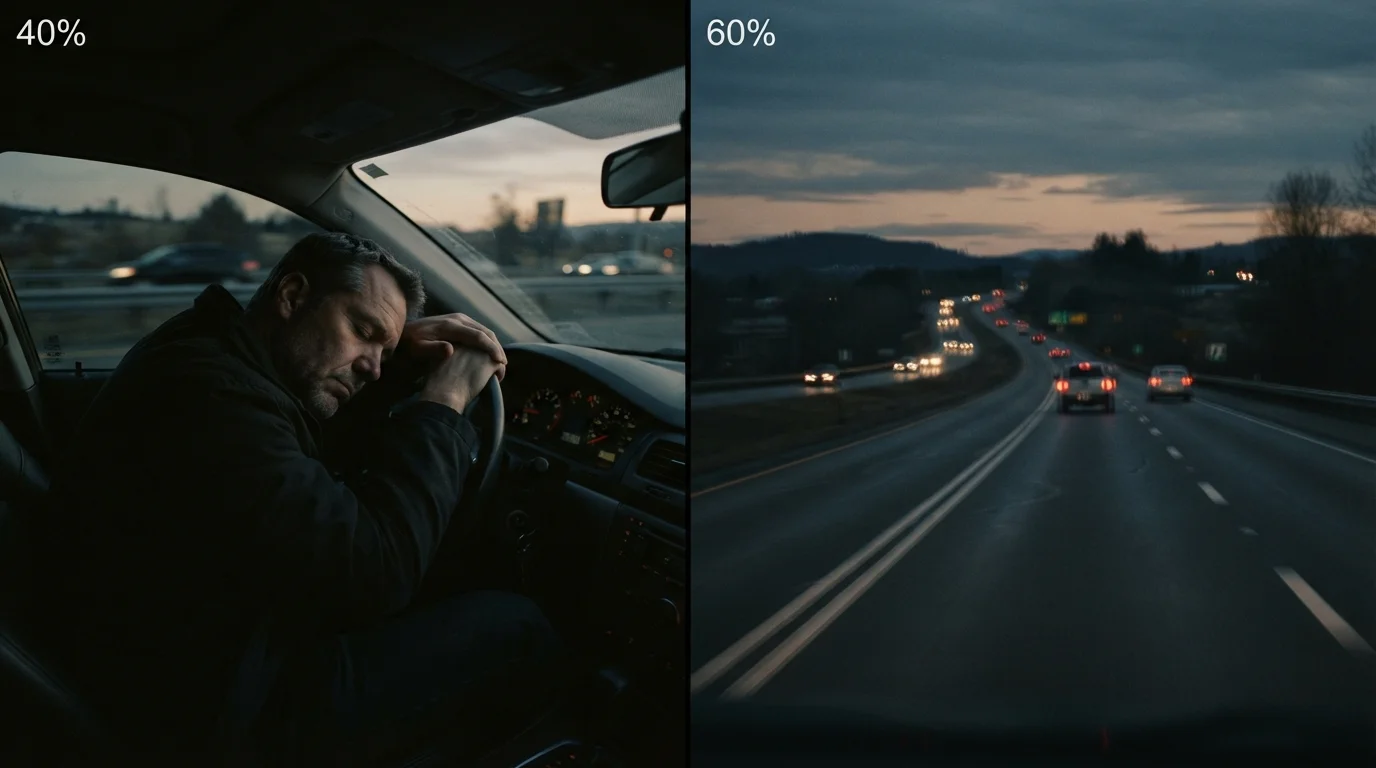
Key Takeaways
Option A
Driver Fatigue
The silent, socially normalized impairment.
Best for: Understanding how chronic sleep deprivation degrades reaction time, judgment, and alertness behind the wheel.
Option B
Drunk Driving
The legally defined and widely recognized impairment.
Best for: Understanding how alcohol measurably disrupts motor control, perception, and decision-making in a legally quantifiable way.
If you've been awake for more than 18 hours and need to drive
Driver Fatigue awareness
You are already operating at a level of impairment that research compares to legal intoxication. Pull over, rest, or arrange an alternative before continuing.
If you want to understand what legal impairment thresholds mean
Drunk Driving
Blood alcohol concentration (BAC) provides a measurable, legally defined standard that makes impairment visible and enforceable - a useful reference point for understanding impairment more broadly.
If you drive frequently at night or after long shifts
Driver Fatigue awareness
Nighttime and post-shift driving dramatically increase fatigue risk; recognizing the signs early is the most effective safety intervention available.
Two Different Causes, Surprisingly Similar Effects
Most US drivers would never get behind the wheel after several drinks. Yet many of those same drivers routinely drive after a night of poor sleep, an overnight shift, or 20-plus hours awake - without a second thought. Research published by sleep scientists and highway safety agencies suggests this disconnect is dangerous.
Both alcohol and sleep deprivation act on the brain in ways that degrade the core skills driving demands: sustained attention, quick reaction, sound judgment, and spatial awareness. The mechanisms differ - alcohol is a depressant acting on the central nervous system, while fatigue results from the brain's built-in drive for recovery sleep - but the downstream effects on driving performance can be strikingly similar.
Studies from institutions including the AAA Foundation for Traffic Safety have indicated that driving after being awake for approximately 18 hours produces impairment comparable to a blood alcohol concentration (BAC) of around 0.05%, and that 24 hours without sleep may correspond to roughly 0.10% BAC - above the legal limit of 0.08% in every US state. These comparisons are research estimates, not legal equivalencies, but they illustrate just how seriously fatigue affects the brain.
| Criterion | Driver Fatigue | Drunk Driving |
|---|---|---|
| Primary cause | Insufficient sleep or prolonged wakefulness | Alcohol consumption affecting CNS |
| Reaction time impact | Significantly slowed after 17-18 hrs awake | Slowed at BAC 0.05% and above |
| Judgment impairment | Reduced; driver often unaware | Reduced; often paired with overconfidence |
| Unique danger | Microsleep - unconscious loss of control | Reduced inhibition; risk-taking behavior |
| Roadside measurability | No reliable objective test exists | Breathalyzer and blood test available |
| Legal threshold | No defined national legal standard | 0.08% BAC in all US states |
| Effective countermeasure | Rest or sleep; no pharmacological fix | Time for body to metabolize alcohol |
How Each Type of Impairment Affects Your Driving
Drunk driving impairs driving through several well-documented pathways. Alcohol slows the transmission of signals between neurons, lengthening reaction time. It reduces peripheral vision, distorts depth perception, and lowers inhibition - meaning drivers often feel more confident precisely as their actual capability declines. Even at BAC levels below 0.08%, coordination and tracking ability are measurably reduced.
Driver fatigue impairs the brain differently but with overlapping results. Sleep-deprived drivers experience slower reaction times, reduced ability to process multiple stimuli at once, and impaired lane-keeping. One uniquely dangerous fatigue effect is microsleep - involuntary sleep episodes lasting two to ten seconds that occur without the driver's awareness. At highway speeds, two seconds of microsleep means traveling nearly 200 feet with no conscious control of the vehicle.
Fatigue also erodes metacognition: tired drivers are often poor judges of how impaired they actually are. This mirrors the overconfidence effect seen with moderate alcohol consumption, making both forms of impairment self-concealing to the person experiencing them.
For a deeper look at how fatigue compounds risk after dark, see our guide to night driving risks.
~20 hrs
Awake time linked to 0.08% BAC-equivalent impairment
AAA Foundation for Traffic Safety research has associated approximately 20 hours of wakefulness with impairment levels comparable to the US legal drunk driving limit.
91,000+
Police-reported drowsy driving crashes annually
The NHTSA has estimated that drowsy driving is involved in over 91,000 police-reported crashes in the US each year, though actual figures may be higher due to underreporting.
2-10 sec
Duration of a microsleep episode
Microsleep episodes - during which the driver is effectively unconscious - can last two to ten seconds, covering hundreds of feet at highway speeds with no driver input.
Detection, Accountability, and What Drivers Can Do
A critical practical difference between the two: drunk driving is objectively measurable. Law enforcement can use breathalyzers and blood tests to assign a BAC reading, creating a legal threshold that is enforceable and well understood. Fatigue has no equivalent roadside test. There is currently no device that reliably tells an officer - or the driver - exactly how sleep-deprived a person is.
This measurement gap means fatigued drivers rarely face the same social or legal accountability as drunk drivers, even when their impairment level may be comparable. It also places more responsibility on individual drivers to self-monitor and make safe decisions.
Practical steps drivers can take:
- Prioritize seven to nine hours of sleep before any long drive.
- Schedule breaks every two hours or 100 miles on extended trips.
- Recognize warning signs: yawning frequently, difficulty keeping eyes open, drifting between lanes, or missing exits.
- If fatigue sets in while driving, pull off safely and rest - even a 20-minute nap can help restore alertness temporarily.
- Do not rely on caffeine or loud music as reliable countermeasures; these strategies mask fatigue rather than resolve it.
Impaired driving in either form - whether from alcohol or exhaustion - puts everyone on the road at risk. Understanding that drowsy driving carries real, measurable danger is a first step toward treating it with the same seriousness we rightly give drunk driving. Also worth reviewing: common distracted driving myths that create a similarly false sense of safety.
This article is for general informational and educational purposes only. It does not constitute legal or medical advice. For guidance specific to your health, sleep conditions, or driving fitness, consult a qualified healthcare or legal professional.