

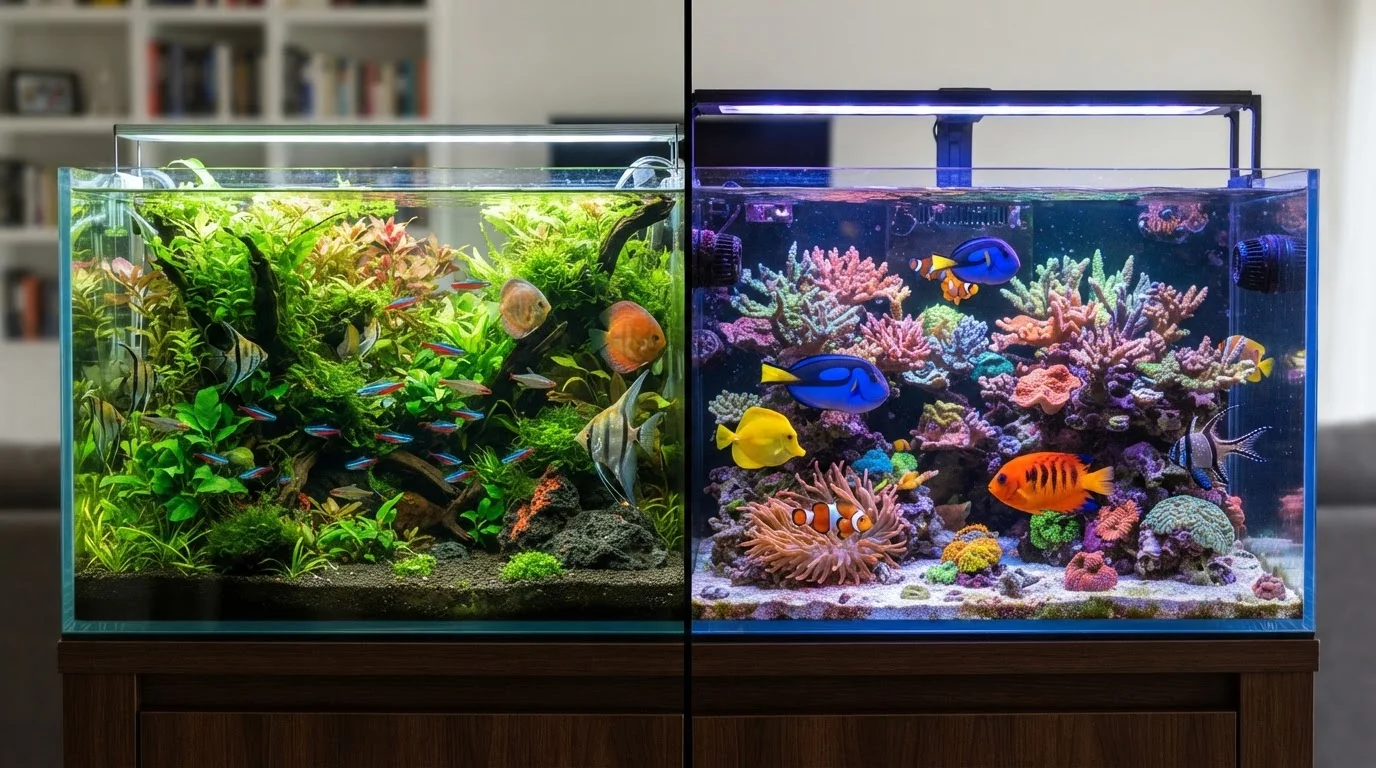
Key Takeaways
Option A
Freshwater Tank
The accessible, forgiving choice for new fishkeepers.
Best for: Beginners, budget-conscious hobbyists, and anyone who wants lower-maintenance aquarium keeping.
Option B
Saltwater Tank
The visually stunning, technically rewarding challenge.
Best for: Experienced aquarists or dedicated beginners prepared for greater complexity and ongoing investment.
If you are new to fishkeeping
Freshwater Tank
Freshwater systems are more forgiving of beginner mistakes, require less equipment, and cost less to start and maintain.
If you want the most visually dramatic aquarium
Saltwater Tank
Marine tanks support vibrant coral reefs and exotic species that simply cannot be replicated in a freshwater setup.
If you are working with a tight budget
Freshwater Tank
Lower startup costs, cheaper livestock, and less specialized equipment make freshwater far more cost-accessible.
If you have prior aquarium experience and time to invest
Saltwater Tank
Experienced hobbyists who can commit to regular monitoring and maintenance will find saltwater deeply rewarding.
If you want a wide variety of species in one tank
Freshwater Tank
Freshwater fishkeeping offers thousands of compatible species across community, planted, and cichlid setups.
Setup Costs and Equipment
The gap between freshwater and saltwater tanks becomes apparent immediately at setup. A basic freshwater aquarium - tank, filter, heater, lighting, substrate, and a few decorations - can be assembled for a few hundred dollars or less. Saltwater tanks, by contrast, require additional specialized equipment: a protein skimmer to remove organic waste, a high-output lighting system to support coral photosynthesis, and often a sump (a secondary filtration chamber beneath the tank). Live rock, used to seed beneficial bacteria and provide structure, also adds meaningful cost.
Saltwater fish and coral are considerably more expensive than freshwater livestock. A single marine fish may cost several times what a popular freshwater species does, and corals can range from affordable frags to very costly specimens depending on type and color morph.
For a realistic picture of all the ongoing costs involved beyond the initial setup, see our article on the hidden costs of owning a small pet.
| Criterion | Freshwater Tank | Saltwater Tank |
|---|---|---|
| Startup cost | Lower - basic setups accessible | Higher - specialized gear required |
| Ongoing maintenance | Weekly water changes, filter upkeep | Daily top-offs, parameter monitoring |
| Water chemistry complexity | Moderate - pH, ammonia, nitrate | High - salinity, calcium, alkalinity |
| Species variety | Thousands of compatible species | Striking marine species and corals |
| Beginner-friendliness | High - forgiving parameters | Low - narrow tolerance ranges |
| Livestock cost | Generally low to moderate | Moderate to very high |
| Visual impact | Strong, especially planted tanks | Exceptional with healthy reef |
Water Chemistry and Maintenance
Freshwater tanks generally tolerate a wider range of water parameters, which is one reason they suit beginners well. While pH, ammonia, nitrite, and nitrate still need monitoring, most common freshwater fish adapt to a broad range of conditions. Weekly partial water changes and regular filter maintenance keep most setups healthy.
Saltwater tanks add another layer: salinity (measured as specific gravity or salinity in parts per thousand) must be maintained precisely, typically between 1.023 and 1.026 specific gravity for a reef tank. Evaporation raises salinity quickly, so top-off systems or daily manual top-offs are often necessary. Reef tanks also require stable levels of calcium, alkalinity, and magnesium to support coral growth - parameters that freshwater keepers never need to track.
Both freshwater and saltwater tanks depend on a functioning nitrogen cycle before fish can be safely introduced. If you are unfamiliar with this process, the fish tank nitrogen cycle explainer is essential reading before you add any livestock.
~700+
Freshwater fish species commonly kept
Estimates from aquarium industry sources suggest hundreds of freshwater species are regularly available to hobbyists in the US market.
1.023-1.026
Target specific gravity for reef tanks
Most marine aquarium references recommend maintaining specific gravity within this narrow range to support fish and coral health.
2-3x
Estimated cost difference at startup
Hobbyist communities and aquarium guides commonly cite saltwater setups costing two to three times more than equivalent freshwater systems.
Species Variety and Compatibility
Freshwater fishkeeping offers extraordinary diversity. Tetras, livebearers, gouramis, cichlids, corydoras catfish, and dozens of other groups give hobbyists nearly endless options for community tanks, species-only setups, or planted aquascapes. Many freshwater species are captive-bred, which generally means hardier fish and less ecological impact from wild collection.
Saltwater tanks open the door to clownfish, tangs, wrasses, angelfish, gobies, and the spectacular world of coral reef invertebrates. A well-established reef tank is genuinely one of the most visually impressive things you can keep at home. However, many marine species are still wild-caught, making responsible sourcing an important consideration. Compatibility research is critical in both tank types - but in marine tanks, aggression and dietary needs tend to be more specialized and less forgiving of mismatches.
For beginners drawn to the idea of a reef tank, a FOWLR (fish-only with live rock) setup is a practical middle ground: it introduces marine fishkeeping without the demanding requirements of coral care.