

Key Takeaways
Fixed vs. Variable Expenses
Fixed expenses are costs that stay the same each month regardless of your behavior - think rent, car payments, or insurance premiums. Variable expenses, by contrast, fluctuate based on your choices and usage - groceries, dining out, and entertainment fall into this category. Understanding which is which helps you quickly identify where you actually have room to maneuver in your budget.
Some expenses are semi-variable (also called mixed costs): they have a fixed floor - like a base utility charge - plus a variable component tied to consumption. Treating these as variable gives you the most accurate picture of your spending flexibility.
Why the Distinction Matters Before You Budget
Most people approach budgeting by asking, "Where can I spend less?" That's the right instinct - but without categorizing your expenses first, you're guessing. The fixed-versus-variable framework gives you a structured answer.
Fixed expenses are non-negotiable in the short term. Your landlord doesn't care if you had a slow month; your mortgage servicer won't skip a due date because you overspent on dining. These costs create the floor of your budget - the minimum you must cover no matter what.
Variable expenses are where your day-to-day decisions live. Every time you choose where to shop, whether to cook at home, or how often to fill the gas tank, you're influencing this category. That agency is your primary savings lever.
For a broader view of how this framework fits into different budgeting systems, the comparison of popular budgeting methods walks through zero-based, 50/30/20, and other approaches in detail.
~33%
Average share of income spent on housing
The U.S. Bureau of Labor Statistics Consumer Expenditure Survey consistently shows housing as the largest single expense category for American households.
$1,200+
Annual savings from one $100 fixed-cost reduction
Eliminating or reducing a single $100 monthly fixed expense generates over $1,200 in automatic annual savings with no ongoing behavioral effort required.
Nearly 40%
Americans unable to cover a $400 emergency
Federal Reserve research has found that a significant share of U.S. adults would struggle to cover a modest unexpected expense, underscoring the importance of building variable-spending flexibility.
How to Categorize Your Own Expenses
Start by pulling three months of bank and credit card statements. For each recurring charge, ask one question: Would this amount change if I made different day-to-day choices this month? If no, it's fixed. If yes, it's variable.
Common Fixed Expenses
- Rent or mortgage payment
- Auto loan or lease payment
- Insurance premiums (health, auto, home/renters)
- Minimum debt payments (student loans, credit cards)
- Subscription services at a flat rate
Common Variable Expenses
- Groceries and household supplies
- Dining out and takeout
- Gas and rideshares
- Clothing and personal care
- Entertainment and hobbies
Don't overlook semi-variable costs. Your electricity bill has a base charge you can't avoid, but your usage - and therefore most of the bill - is within your control. Treat these as variable for budgeting purposes so you're accounting for the full range of your influence.
Use a Simple Two-Column List First
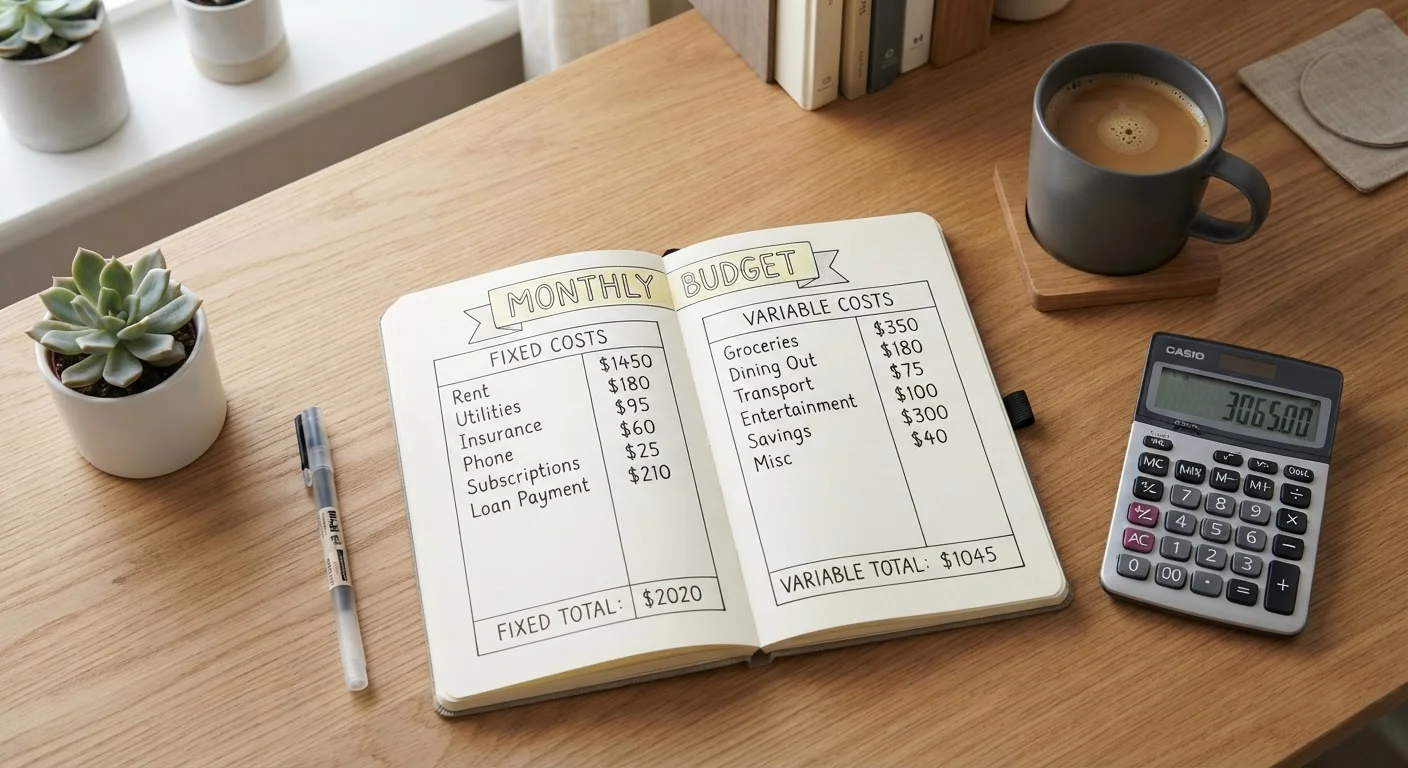
Before opening a budgeting app or spreadsheet, write out your expenses by hand in two columns: Fixed and Variable. The physical act of sorting tends to surface expenses you've forgotten about and reveals patterns more clearly than staring at a transactions list. Keep the list somewhere visible for the first month.
Where to Find Savings in Each Category
The practical payoff of this framework is knowing which kind of effort to apply in each category.
Cutting Variable Expenses: Small Decisions, Compounding Results
Variable expenses respond quickly to behavioral changes. Meal planning, reducing impulse purchases, and auditing streaming subscriptions are low-friction adjustments that show up in the same month's statement. These changes don't require renegotiating contracts or making major life decisions - they require consistent attention. Seasonal spending spikes are a common source of variable-expense blowouts worth planning for separately.
Cutting Fixed Expenses: Higher Effort, Higher Return
Reducing a fixed expense - moving to a lower-cost home, refinancing debt, or dropping a recurring subscription - takes more work upfront. But the savings are automatic going forward; you don't have to re-earn them every month. Even shaving $100 off a fixed monthly cost saves $1,200 a year without any ongoing discipline required.
This is why financial planners often say fixed-cost reductions are structurally more powerful than variable-cost reductions, even when the dollar amounts look similar.
Putting the Framework Into Practice
Once you've labeled your expenses, calculate your total fixed costs as a percentage of your take-home pay. If that number is above 50%, your financial flexibility is significantly constrained - and the path forward involves examining fixed costs, not just trimming discretionary spending.
If your fixed costs are manageable, focus your savings energy on the three or four variable categories where you spend the most. Tracking these weekly - even informally - tends to be more effective than reviewing them once a month after the damage is done.
This framework also supports longer-range planning. Knowing your fixed floor helps you model what a job change, parental leave, or move would actually cost you in practice, not just in theory. For those managing travel spending as part of their budget, the budget trip planning hub applies the same discipline to vacation costs.
This article is for general informational and educational purposes only and does not constitute personalized financial advice. Consult a qualified financial professional for guidance specific to your situation.