

Key Takeaways
Option A
Zero-Based Budgeting
The meticulous, every-dollar-accounted-for system.
Best for: Households that want granular control over their full income and are comfortable revisiting the budget each month.
Option B
The Envelope Method
The tactile, category-capped spending system.
Best for: Households that struggle with overspending in specific categories and benefit from a physical or visual spending limit.
If you want full visibility into every spending category each month
Zero-Based Budgeting
Zero-based budgeting forces you to justify each dollar of spending before the month starts, giving you a complete picture of where your income goes.
If you consistently overspend in categories like dining or entertainment
The Envelope Method
Physical or digital envelopes create a hard stop when the money runs out, making overspending structurally difficult rather than relying on willpower alone.
If you have variable income or irregular monthly expenses
Zero-Based Budgeting
Rebuilding the budget from scratch each month makes it easier to adapt to income swings and shifting expense priorities.
If you prefer a simple, low-tech approach to managing day-to-day spending
The Envelope Method
Once envelopes are funded, there's little ongoing calculation required - you simply spend from the relevant envelope and stop when it's empty.
If you're budgeting jointly with a partner and need shared accountability
Zero-Based Budgeting
A written, category-by-category plan gives both partners a documented reference point for spending decisions and trade-offs.
How Each Method Actually Works
Both approaches share the same core premise - spend intentionally, not reactively - but they achieve that goal through very different mechanics.
Zero-based budgeting (ZBB) starts with your total monthly income and subtracts expenses, savings, and debt payments category by category until you reach zero. That zero doesn't mean you've spent everything; it means every dollar has been assigned a job. If you earn $5,200 a month, your categories - rent, groceries, utilities, savings, and so on - must collectively add up to exactly $5,200. Any unassigned dollar gets redirected into savings or debt repayment before the month begins.
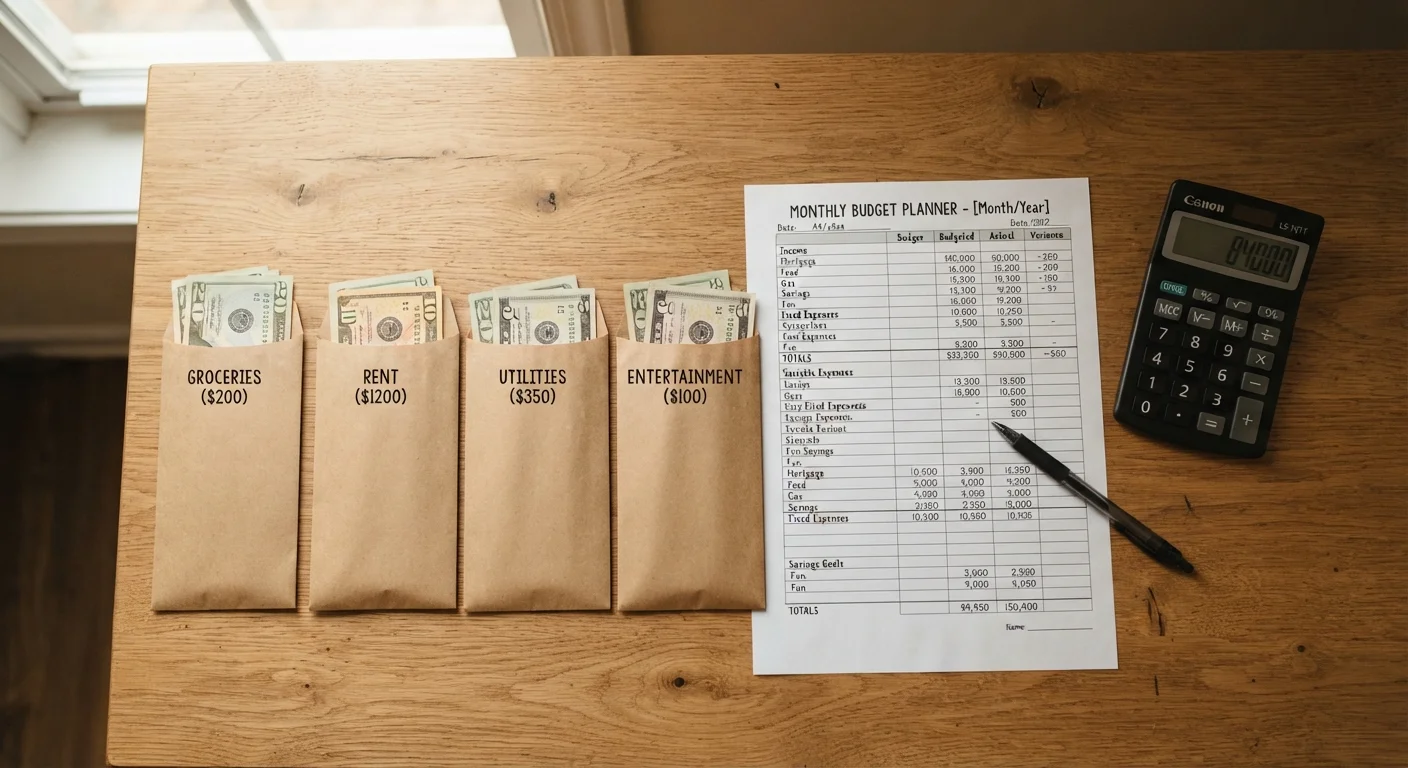
The envelope method divides your spending into discrete categories and physically (or digitally) loads a set amount of cash into each envelope at the start of the pay period. When the grocery envelope hits zero, grocery spending stops for that period - full stop. Historically this meant literal cash envelopes, but many households now use digital envelope apps that replicate the same constraint without requiring physical currency.
If you're newer to budgeting structures, the beginner's guide to building a household budget provides useful groundwork before deciding between these two systems.
Side-by-Side: Where They Differ
The practical differences between the two methods become clearer when you compare them across everyday decision points.
| Criterion | Zero-Based Budgeting | Envelope Method |
|---|---|---|
| Scope | All income, all categories | Variable/discretionary categories |
| Monthly time commitment | 30-60 min to rebuild each month | 5-15 min to fund envelopes |
| Spending enforcement | Plan-based; relies on checking the budget | Hard stop when envelope is empty |
| Flexibility | Easy to reallocate between categories | Requires deliberate envelope transfer |
| Best format | Spreadsheet or budgeting app | Cash or digital envelope app |
| Handles variable income | Well - rebuilt monthly | Moderately - needs refunding adjustment |
| Learning curve | Moderate to high | Low to moderate |
One important nuance: the envelope method typically covers only discretionary or variable spending categories. Fixed expenses like rent, loan payments, and insurance are usually handled separately, outside the envelope system. Zero-based budgeting, by contrast, accounts for every line item - fixed and variable alike - in a single unified plan.
For a broader look at how these methods stack up against other frameworks such as the 50/30/20 rule, see budgeting methods compared across different household situations.
Time Investment and Ongoing Maintenance
Zero-based budgeting is front-loaded with effort. Because the budget is rebuilt from scratch each month, households typically spend 30-60 minutes at the start of each pay period reviewing income, adjusting categories, and allocating every dollar. That monthly reset is also the method's strength - it prevents budget drift and forces regular financial check-ins.
The envelope method has a lower monthly maintenance burden once initial category amounts are set. Funding envelopes takes only a few minutes per pay period. The main discipline required is checking your envelope balance before spending rather than after. The tradeoff is less flexibility: if an unexpected expense arises in one category, shifting funds between envelopes requires a deliberate decision rather than a quick reallocation.
~33%
Americans with a written monthly budget
Gallup polling has consistently found that fewer than one-third of U.S. households maintain a detailed monthly budget, underscoring how much room both methods leave to improve financial awareness.
2-3x
More category awareness with cash-based systems
Behavioral research - including studies cited by the Journal of Consumer Research - suggests people track category spending more accurately when using physical cash compared to card-based payments.
For households managing finances as a couple, the monthly planning session that zero-based budgeting requires can serve double duty as a financial alignment conversation. The guide to budgeting as a couple covers how to structure those conversations productively.
Choosing the Right Fit - and What to Do Next
The most effective budgeting system is the one you'll actually maintain. A few questions can help clarify which structure suits your household:
- Do you have consistent monthly income? Either method works well. If income varies month to month, zero-based budgeting's monthly rebuild is more adaptable.
- Do you overspend in specific categories? The envelope method's hard stop is structurally more effective at containing category-level overspending than a written plan alone.
- How much time can you realistically commit? If a monthly planning session feels sustainable, zero-based budgeting offers more comprehensive oversight. If time is scarce, the envelope method's lower maintenance may fit better.
- Are you comfortable with digital tools? Zero-based budgeting benefits from spreadsheet or app support. The envelope method can be entirely analog, which suits households that prefer physical money management.
Neither approach locks you in permanently. Many households start with the envelope method to develop category discipline, then graduate to zero-based budgeting as their financial picture becomes more complex. Others use a hybrid: zero-based planning for fixed costs and savings, envelope constraints for variable discretionary spending.
If you're weighing even more options, the 50/30/20 rule and its limitations is worth reviewing, as is the pay-yourself-first approach for savings-forward households. The complete household budgeting reference ties all these frameworks together in one place.
This article provides general financial information for educational purposes only and is not personalised financial advice. Consider consulting a qualified financial professional for guidance specific to your situation.