

Key Takeaways
Option A
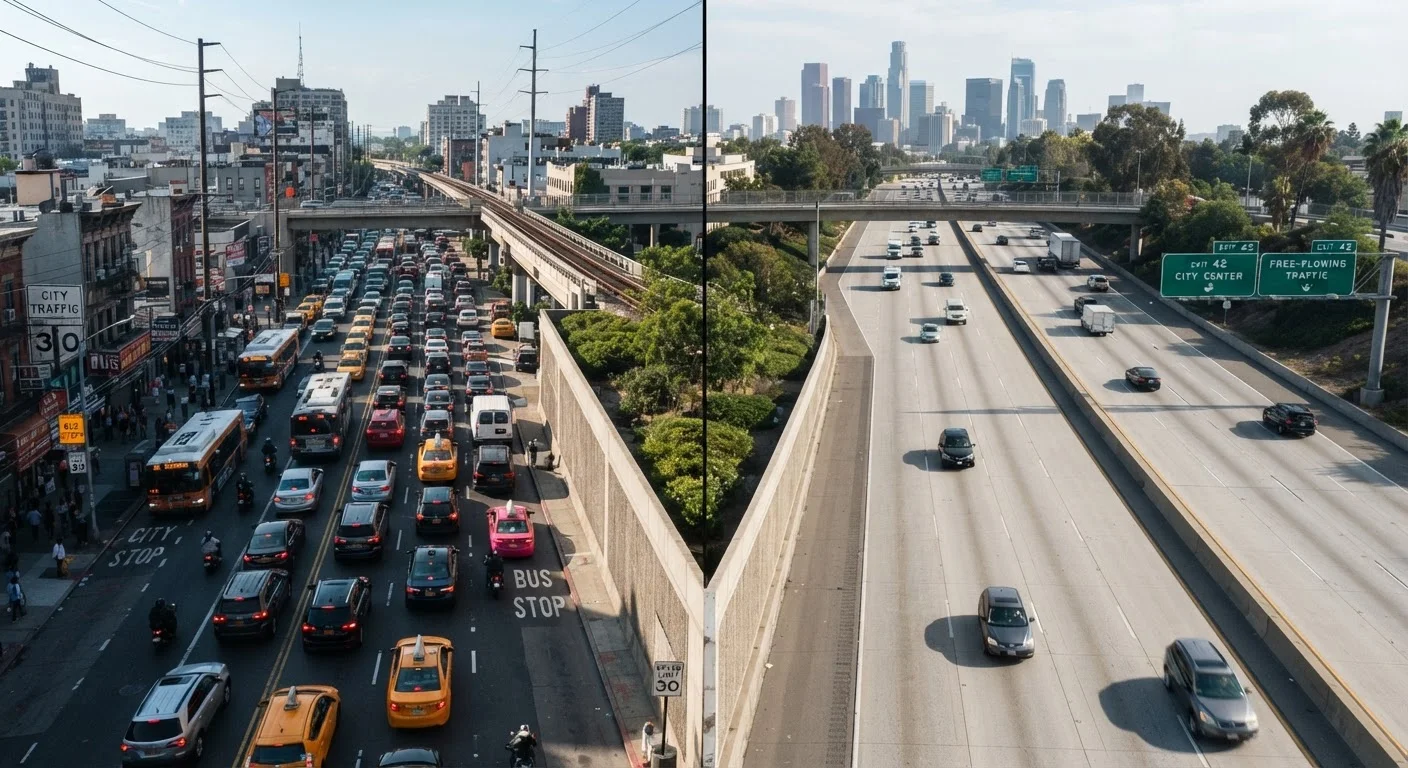
City Driving
The stop-and-go environment that punishes fuel economy.
Best for: Drivers navigating urban errands, short commutes, and dense traffic corridors where frequent stops are unavoidable.
Option B
Highway Driving
The steady-speed environment where most engines find their stride.
Best for: Drivers covering longer distances at consistent speeds where aerodynamic drag becomes the primary efficiency challenge.
If you drive mostly city routes and want to cut fuel costs immediately
City Driving (optimized)
Smooth acceleration, coasting to stops, and minimizing idle time can meaningfully reduce fuel use without changing your route at all.
If you're planning a long highway trip and want to maximize range
Highway Driving (optimized)
Maintaining a steady speed at or below 65 mph and using cruise control are the two highest-impact actions for highway fuel economy.
If you're considering a hybrid or EV for a city-heavy commute
City Driving
Hybrids recover braking energy through regenerative braking, making stop-and-go conditions far less costly than they are in conventional vehicles.
If you drive a mix of city and highway and want one universal habit
City Driving (optimized)
Eliminating aggressive acceleration delivers fuel savings in both environments, but the returns are proportionally larger in city driving.
Why the Same Car Gets Different Mileage in Different Settings
If you've ever noticed that your car's fuel economy shifts depending on where you drive, you're not imagining it. Vehicle stickers and government testing distinguish between city and highway ratings for good reason: the mechanical demands on your engine change dramatically between the two environments.
In city driving, your engine repeatedly accelerates from rest, idles at lights, and brakes - only to start the cycle again. Each acceleration spike demands a significant burst of fuel, and all that kinetic energy is simply lost as heat through the brakes. Idling, meanwhile, burns fuel while producing zero forward movement.
On the highway, your engine reaches a steady cruising state. Fuel consumption becomes more predictable and, for most conventional vehicles, more efficient - but only up to a point. As speed climbs above roughly 50 mph, aerodynamic drag increases exponentially, demanding more engine output and more fuel to maintain pace.
These aren't small differences. The U.S. Department of Energy notes that aggressive city driving - with hard stops and rapid acceleration - can lower fuel economy by 15-30% compared with steady driving. Understanding which forces are at work helps you apply the right strategies in each environment. For a broader look at how all these factors interact, see the definitive fuel efficiency guide for budget-conscious drivers.
Head-to-Head: How Each Environment Drains Your Tank
The table below breaks down the key differences between city and highway driving across the factors that matter most to fuel economy.
| Criterion | City Driving | Highway Driving |
|---|---|---|
| Primary fuel drain | Repeated acceleration from stop | Aerodynamic drag at speed |
| Idle fuel use | High - frequent stops and lights | Minimal - engine stays under load |
| Braking energy | Lost as heat (conventional vehicles) | Rarely needed; less waste |
| Hybrid/EV advantage | Significant - regenerative braking helps | Moderate - less stop-start to recover |
| Speed consistency | Low - constant changes | High - steady cruising |
| Best fuel-saving tactic | Smooth, gradual acceleration | Maintain 55-65 mph with cruise control |
| AC/window impact | AC load notable at low speeds | Open windows add drag above ~50 mph |
One important nuance: the efficiency gap shrinks considerably in hybrid and plug-in hybrid vehicles. Their regenerative braking systems capture energy that would otherwise be lost as heat and return it to the battery - making stop-and-go driving far less wasteful than it is in a conventional internal-combustion car. If your daily commute is city-heavy, this is worth factoring into any vehicle decision.
Engine design also plays a role. Smaller turbocharged engines may be very efficient at steady highway speeds but less so during the constant load fluctuations of city driving. How engine size and type shape fuel economy explains this dynamic in more detail.
15-30%
City MPG loss from aggressive driving
According to the U.S. Department of Energy, rapid acceleration and hard braking can reduce fuel economy by this range compared with steady driving.
~50 mph
Speed where aerodynamic drag starts rising sharply
The EPA and fuel economy researchers note that drag increases exponentially above this threshold, making speed management critical on the highway.
14%
Fuel penalty for every 10 mph above 50 mph
The U.S. Department of Energy estimates roughly a 14% decrease in fuel economy for each 10 mph increment beyond 50 mph on the highway.
Proven Strategies for Each Driving Environment
In the City
The single most effective city driving habit is smoothing out your acceleration. Pressing the gas gradually - rather than flooring it to keep pace with traffic - cuts the fuel spike that follows every green light. Equally valuable is anticipating stops: if you can see a red light ahead, lifting off the accelerator early and coasting means your brakes do less work and your engine burns less fuel. Everyday driving habits that quietly drain your tank covers this and other overlooked behaviors in depth.
Minimizing idle time also adds up. Modern fuel-injected engines use virtually no fuel when you release the accelerator while moving, but they do burn fuel while stationary. If you're waiting more than about 60 seconds - at a drive-through, for instance - turning the engine off is generally more efficient than idling.
On the Highway
Speed is the dominant variable on the highway. Most vehicles achieve their best fuel economy somewhere between 45 and 60 mph; above that, drag rises quickly. Using cruise control on flat stretches removes the subtle speed fluctuations that many drivers don't notice but that cumulatively add fuel use. Maintaining a safe following distance also lets you adjust speed gradually rather than braking and re-accelerating repeatedly. For longer drives, the pre-trip fuel efficiency checklist can help you squeeze more miles from every gallon before you leave the driveway.
Air management matters too. At highway speeds, open windows add aerodynamic drag. Running the air conditioning has a fuel cost, but at speeds above roughly 45-50 mph, it's often comparable to the drag penalty of open windows. The real fuel cost of staying cool walks through the tradeoffs in detail.
Route Planning Can Bridge Both Worlds
Choosing a slightly longer route with fewer traffic signals and smoother traffic flow can sometimes be more fuel-efficient than the shortest path through dense stop-and-go streets. Smarter route planning for daily commutes explores how elevation, signal density, and traffic patterns all factor into real-world efficiency. Also check whether some beliefs about saving fuel are actually myths - fuel efficiency myths that cost drivers money is a useful companion read.